

iGaming Email Support: SLA-Ready Guide for Operators
August 6, 2026
How to Evaluate Outsourcing Partner Quality: 2026 Guide
August 8, 2026A CDP unifies and activates first-party behavioral data across every touchpoint; a CRM manages sales and service workflows for known contacts. According to the CDP Institute, a CDP is packaged software that builds a persistent, unified customer record and handles identity resolution. Salesforce frames the two as force multipliers when integrated, with the CDP serving as the intelligence layer and the CRM as the engagement layer.
Quick decision rules:
- CRM alone is sufficient when your team manages a defined list of known contacts, runs a linear sales pipeline, and has no cross-channel behavioral data to unify.
- Add a CDP when you have data siloed across three or more systems, need anonymous-to-known identity resolution, or are running personalization campaigns that require real-time behavioral signals.
- You need both when your go-to-market motion combines high-volume digital engagement with human-touch sales or service workflows.
Table of Contents
- What is a CDP, and how does it differ from a CRM?
- How CDPs and CRMs differ across every dimension that matters
- Where do DMPs fit, and when should you use one?
- When should you choose a CRM, a CDP, or both?
- How CDPs and CRMs work together in practice
- What does a CDP or CRM implementation actually cost?
- Is your organization ready to add a CDP?
- Key Takeaways
- What Workanova has learned from operators who got this right
- Useful sources and further reading
What is a CDP, and how does it differ from a CRM?
These two platforms solve different problems. Conflating them is one of the most expensive mistakes a marketing or sales team can make.
Defining a CDP
The CDP Institute defines a Customer Data Platform as:
That definition carries three load-bearing words: packaged, persistent, and unified. Packaged means it ships as a product, not a custom build. Persistent means the profile survives across sessions, devices, and channels. Unified means it stitches together anonymous behavioral events, known contact data, transactional records, and zero-party inputs into a single profile. The CDP Institute’s RealCDP certification exists specifically to distinguish genuine CDPs from marketing automation tools that simply added a “CDP” label to their product pages.
Defining a CRM
A Customer Relationship Management system tracks structured interactions between your team and known contacts. Its core objects are contacts, accounts, deals, and cases. Sales reps log calls, update pipeline stages, and forecast revenue inside a CRM. Support agents open and close tickets. The system is built around human-to-human workflows, not high-frequency event ingestion. CDP.com’s glossary puts it plainly: CRMs manage structured interaction data for known individuals, while CDPs handle both anonymous and known behavioral data for activation.
Side-by-side snapshot
| Dimension | CDP | CRM |
|---|---|---|
| Primary purpose | Unify behavioral data; build persistent profiles for activation | Manage sales, service, and relationship workflows |
| Primary users | Marketing, analytics, data engineering | Sales, customer success, support |
| Example data types | Web events, app sessions, purchase history, email clicks, device IDs | Contact records, deal stages, call logs, support tickets |
How CDPs and CRMs differ across every dimension that matters
The definitions above tell you what each system is. This section tells you why those differences affect your buying decision, your integration architecture, and your team’s day-to-day operations.
| Dimension | CDP | CRM |
|---|---|---|
| Identity model | Anonymous-to-known; resolves cross-device and cross-channel identities | Known contacts only; no anonymous profile stitching |
| Data sources | Web, app, offline events, third-party enrichment, zero-party surveys | Manual entry, email sync, call logs, form fills |
| Profile persistence | Profiles survive across sessions and channels indefinitely | Records exist while a contact is active in the pipeline |
| Activation channels | Email, push, paid media, on-site personalization, agent consoles | Email sequences, call queues, deal workflows, support cases |
| Operational features | Segmentation, predictive scoring, audience export | Pipeline management, forecasting, ticketing, SLA tracking |
| Scalability | Architected for high-frequency event streams (millions of events/day) | Degrades under high-volume event ingestion; not designed for it |
| Retention and storage | Long-term behavioral history; often NoSQL-backed for scale | Structured relational records; optimized for workflow queries |
| Integration points | Data warehouse, marketing automation, ad platforms, agent consoles | ERP, billing systems, marketing automation, support platforms |
Privacy and compliance: CDPs and CRMs handle personally identifiable information differently, and that gap matters under CCPA and other US state privacy laws. A CDP ingests behavioral data at scale, which means consent capture, data retention policies, and the right-to-delete workflow must be built into the CDP architecture from day one. CRMs typically manage consent at the contact level, which is simpler but insufficient once you are stitching anonymous web behavior into profiles. TechTarget notes that CDPs are appropriate once data is truly siloed across multiple channels, which is also the point where compliance complexity spikes.
Implications by team:
- Marketing teams — gain the most from a CDP: real-time segmentation, cross-channel personalization, and suppression lists that actually reflect current behavior.
Trying to use a CRM as a CDP at scale causes database bloat and degraded performance. CRMs are not architected to ingest high-frequency event streams or perform cross-device identity resolution, and forcing that workload onto them creates technical debt that compounds quickly.
Where do DMPs fit, and when should you use one?
A Data Management Platform (DMP) predates the CDP and solves a narrower problem: building anonymous audience segments for paid media targeting. HubSpot’s comparison is direct on this point: DMPs rely on anonymous identifiers (cookies, device IDs) for third-party audience segments, while CDPs unify first-party and zero-party data into persistent, named profiles.
| Platform | Primary purpose | Identity model | Primary data sources | Best use case |
|---|---|---|---|---|
| CRM | Relationship and workflow management | Known contacts | Manual entry, email, calls | B2B sales pipeline, support case management |
| CDP | Behavioral unification and activation | Anonymous + known | Web, app, transactional, zero-party | Cross-channel personalization, identity resolution |
| DMP | Anonymous audience segmentation | Fully anonymous | Third-party cookies, device graphs | Programmatic ad targeting (declining relevance) |
When a DMP still matters vs. when a CDP wins:
- A DMP remains relevant if your primary channel is programmatic display and you rely on third-party audience data to reach net-new prospects.
- A CDP wins when you need to activate your own first-party data across owned channels, build persistent profiles, or comply with data minimization requirements.
- The trend is clear: third-party cookie deprecation across major browsers has eroded the DMP’s core data supply. Organizations that built their personalization strategy on DMP-sourced segments are migrating toward CDP-first architectures that rely on first-party behavioral data they actually own.
The practical takeaway: if you are evaluating platforms today, a DMP is rarely the right starting point. For most marketing teams, the choice is between a CRM alone and a CRM plus CDP.
When should you choose a CRM, a CDP, or both?
The right answer depends on your data maturity, your go-to-market motion, and the channels you need to activate. Here are the signals that point each way.
Choose CRM only when:
- Your sales team manages a defined list of accounts and contacts with a clear pipeline.
- You have one or two primary engagement channels (email and phone).
- You do not need to track anonymous web behavior or stitch cross-device sessions.
- Your organization has fewer than three distinct data sources feeding customer records.
Add a CDP when:
- You have data siloed across four or more systems (web analytics, email platform, POS, mobile app, support platform).
- Campaigns are failing because segments are built on stale or incomplete data.
- You need to resolve anonymous visitors to known profiles before they convert.
- You are running real-time personalization across more than two channels simultaneously.
You need both when:
- Your revenue motion combines high-volume digital engagement with human-touch sales or service.
- AI-driven lead scoring or next-best-action recommendations require unified behavioral context that the CRM alone cannot supply.
- You operate in a regulated environment (financial services, iGaming, healthcare) where compliance requires a governed, auditable customer record separate from the operational CRM.
Short vignettes:
Small B2B inside sales team: A 15-person SaaS company with a defined ICP and a two-stage sales cycle gets full value from HubSpot CRM alone. Adding a CDP before they have meaningful behavioral data across multiple channels is premature investment.
Enterprise omnichannel retail: A retailer with a mobile app, e-commerce site, loyalty program, and in-store POS cannot build accurate segments without a CDP. The CRM handles post-purchase service; the CDP unifies the behavioral journey that precedes it.
iGaming operator: A licensed online casino or sportsbook generates thousands of behavioral events per player per session. Deposit patterns, game preferences, session length, and bonus redemption behavior all need to feed real-time retention triggers. A CRM alone cannot ingest that event volume or resolve cross-device sessions. The CDP handles identity and behavioral unification; the CRM (or agent console) handles the human-touch VIP and retention workflows.
Pro Tip: Deploy CRM first, then CDP. Get your pipeline and contact data clean inside the CRM before you attempt identity resolution at scale. A CDP built on dirty CRM data produces dirty profiles.
How CDPs and CRMs work together in practice
Salesforce describes the integrated stack as two force multipliers: the CDP enriches the CRM with behavioral intelligence, and the CRM feeds human-touch context back into the CDP. That bidirectional loop is where the real value lives.
How data flows between the two systems
A typical real-time flow looks like this:
- Event ingestion: — The CDP collects raw behavioral events (page views, clicks, deposits, game launches) from web, app, and offline sources.
Batch flows follow the same sequence but run on a schedule (hourly or nightly) rather than in real time. Most organizations run both: real-time for high-priority triggers (churn risk, cart abandonment, VIP activity) and batch for lower-priority enrichment.
Integration checklist
| Requirement | What to define |
|---|---|
| Identity keys | Agree on the canonical identifier (user ID, email, loyalty number) used across both systems |
| Data mapping | Document which CDP profile attributes map to which CRM fields before any connector is built |
| Latency requirements | Define which use cases need real-time sync vs. batch, and set SLAs for each |
| Error handling | Specify what happens when a sync fails: retry logic, alerting, and fallback behavior |
| Consent propagation | Confirm that opt-out signals in the CRM suppress activation in the CDP and vice versa |
| Data governance | Assign ownership of the unified profile: who can modify it, who can delete it, and under what conditions |
What does a CDP or CRM implementation actually cost?
Neither platform is cheap to run well. The cost drivers are different, and so are the failure modes.
CDP cost drivers:
- Data volume (events per month, profile count) is the primary pricing lever for most SaaS CDPs.
- Connector count: each source and destination integration adds licensing and engineering cost.
- Identity resolution complexity: cross-device and cross-channel matching requires more compute and more data engineering time.
- Professional services for initial data mapping, schema design, and governance setup.
- Ongoing data hygiene, QA, and schema maintenance as upstream sources change.
CRM cost drivers:
- Per-user licensing is the dominant model. Costs scale with seat count, not data volume.
- Add-on modules (forecasting, AI scoring, service cloud) layer on top of base licensing.
- Integration work with billing, ERP, and marketing automation.
- Admin and customization time, which is often underestimated.
TechTarget’s CDP definition confirms that CDP pricing typically scales with data volume while CRM pricing scales per user, which means the two platforms have opposite cost curves as you grow.
Typical implementation timelines
| Phase | CDP | CRM |
|---|---|---|
| Pilot / POC | Typically several weeks to a few months | Typically several weeks to a few months |
| Initial integration (few sources) | Several months is common | Several months is common |
| Full activation (all channels live) | Often takes multiple months | Often takes multiple months |
| Organization-wide rollout | Can take over a year | Can take multiple months to a year |
Hidden costs to plan for:
- Data transformation work: raw event streams rarely arrive in the schema the CDP expects.
- Identity key reconciliation: if your CRM, email platform, and mobile app use different user IDs, you need a resolution layer before the CDP can build accurate profiles.
- Governance debt: skipping data governance in the first three months creates compliance and data-quality problems that block activation later. The CDP Institute identifies identity resolution, governance, and activation as three parallel tracks that must run simultaneously from the start.
- Ongoing maintenance: upstream schema changes break CDP pipelines. Budget for a dedicated data engineer or a managed integration layer.
Short vendor profiles
Salesforce (Sales Cloud / Salesforce CDP): Sales Cloud is the market-defining CRM for enterprise B2B sales teams. Salesforce CDP (now part of Data Cloud) extends that foundation with real-time behavioral unification and AI-driven activation, making it the natural choice for organizations already deep in the Salesforce ecosystem.
Twilio Segment: The most widely referenced CDP for engineering-led organizations. Segment’s strength is its connector library and its event-stream architecture, which makes it a natural fit for product-led SaaS companies that generate high volumes of behavioral data.
Acquia CDP: Built for content-heavy digital experiences, Acquia CDP targets marketing teams running Drupal-based properties or complex content ecosystems where behavioral data from content interactions needs to feed personalization.
HubSpot CRM: The go-to CRM for SMB and mid-market teams that want a fast deployment, a clean UI, and a tight integration with HubSpot’s marketing automation suite. HubSpot does not position itself as a CDP, but its contact timeline and behavioral tracking cover many CDP-adjacent use cases for organizations that are not yet at enterprise data volumes.
Pro Tip: Run your POC on a single high-value use case with a clear KPI (e.g., VIP retention uplift or cart-abandonment recovery rate). Define acceptance criteria before you start, timebox the pilot to 8 weeks, and require the vendor to provide the integration support. A vendor that hesitates on a structured POC is telling you something about their implementation confidence.
Is your organization ready to add a CDP?
TechTarget’s guidance is clear: CDPs make sense once data is truly siloed across multiple channels. Smaller organizations with limited systems often get more value from an optimized CRM first. Use this checklist to assess your readiness.
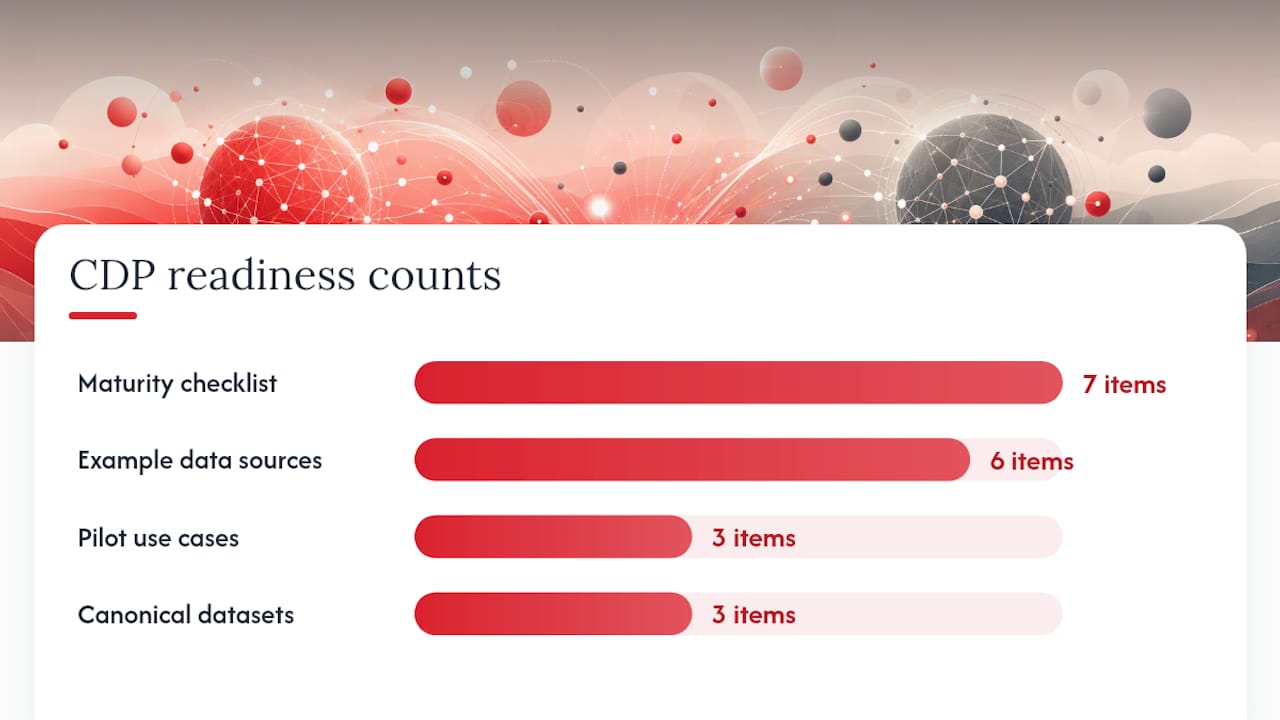
Maturity checklist:
- You have four or more distinct data sources feeding customer records (web, app, email, POS, support, loyalty).
- Your marketing team cannot build accurate segments because data lives in disconnected systems.
- You have experienced campaign failures attributable to stale or incomplete identity data.
- Your analytics team spends more time reconciling data than analyzing it.
- You have a defined personalization use case with a measurable KPI ready to test.
- Legal and data governance stakeholders are aligned on consent management and data retention requirements.
- You have at least one data engineer or a managed integration partner available for the rollout.
If you check four or more of those boxes, a CDP pilot is justified. Fewer than four, and an optimized CRM with better marketing automation integration will likely deliver more value per dollar.
POC sequencing:
- Pick a single high-value use case: VIP retention uplift, cart-abandonment recovery, or cross-sell personalization based on behavioral signals.
- Identify the two or three canonical datasets required (web events, CRM contacts, transaction history).
- Define the KPI and baseline before the pilot starts.
- Run a 6–12 week pilot with a clear timebox and vendor-supported integration.
- Measure lift against the baseline KPI and present findings to legal, analytics, marketing, and operations stakeholders before committing to full deployment.
Pro Tip: The most common CDP pilot failure is starting with too many use cases. Pick one, measure it cleanly, and use that win to build internal alignment for the full rollout. Stakeholder alignment across legal, analytics, marketing, and operations is not optional — it is the prerequisite.
Key Takeaways
A CDP and a CRM solve different problems, and the decision to add a CDP should be driven by data maturity and use-case clarity, not vendor momentum.
| Point | Details |
|---|---|
| Core difference | A CDP unifies behavioral data and resolves identity; a CRM manages sales and service workflows for known contacts. |
| When CRM alone is enough | Fewer than three data sources, a defined contact list, and no cross-channel personalization requirements. |
| When to add a CDP | Four or more siloed data sources, failed campaigns from poor identity data, or real-time personalization needs. |
| Integration value | CDPs enrich CRM records with behavioral signals; CRMs return human-touch context to complete the profile loop. |
| Cost and timeline | CDP pricing scales with data volume; CRM pricing scales per user. A full CDP activation typically takes 6 months. |
What Workanova has learned from operators who got this right
The CDP vs. CRM debate looks different from the support operations side. Most of the operators Workanova works with arrive with a CRM already in place and a growing suspicion that their agents are working with incomplete context. A player contacts support about a withdrawal delay, and the agent sees a contact record with a few ticket notes. What they do not see is that the player deposited three times in the last 48 hours, hit a new lifetime value threshold, and triggered a churn-risk score two days ago. That gap between what the CRM holds and what the CDP knows is where retention opportunities get missed.
The biggest operational gain Workanova sees when operators integrate a CDP into their support stack is not the personalization campaigns. It is the agent console enrichment: pushing next-best-action triggers and behavioral context directly into the interface the agent is already using. When an agent can see that a player’s last five sessions were on mobile, that their preferred game category shifted last week, and that their deposit frequency dropped, the conversation changes. Handle time drops. Resolution quality improves. VIP escalations happen before the player asks.
One lesson worth passing on: before you invest in a CDP, ask your support partner two questions. First, can their agent console accept real-time data pushes from an external platform via API? Second, what SLA governs the latency between a behavioral event and its appearance in the agent view? If the answer to the first is “not yet” and the answer to the second is “we’ll figure it out,” your CDP investment will stop at the marketing layer and never reach the support team that needs it most.
If you are evaluating how outsourced player support integrates with your data stack, Workanova’s teams are built to connect into your tech infrastructure, including CDP-driven agent enrichment, from day one.
Useful sources and further reading
- What is a CDP? | CDP Institute
- CDP vs CRM | CDP.com glossary
- CDP vs CRM | Shopify blog
- CDP vs CRM | Salesforce
- What are the differences between CRM, CDP, and DMP platforms? | TechTarget
- Customer data platform (CDP) definition | TechTarget
- Customer data platform — Wikipedia
Recommended