

Best KYC Providers for US-Licensed Online Casinos
July 27, 2026
Language Quality Assurance for iGaming Operators
July 29, 2026For licensed online casinos and sportsbooks, the Zendesk vs Freshdesk decision comes down to one variable: how much operational infrastructure you already have. If your support team has a dedicated admin, complex integration requirements with payments and KYC providers, and the headcount to configure a powerful platform, Zendesk is the stronger long-term choice. If you’re running lean or need to go live fast, Freshdesk’s lower entry cost and simpler setup give you a faster path to value. And if you want to skip platform administration entirely, a managed provider is the right call.
- Mature ops team with a dedicated administrator and complex integrations: Pilot Zendesk’s enterprise tier. Budget for add-ons and an admin role before signing.
- Lean or mid-market team (under 15 agents, limited IT resources): Start with Freshdesk. Model your AI billing before enabling Freddy AI at scale.
- No platform ops capacity: Contact a managed provider like Workanova. You’ll be live in weeks, not months, with SLAs built for regulated markets.
Table of Contents
- How do Zendesk, Freshdesk, and Workanova compare for iGaming support?
- How should licensed casinos and sportsbooks choose a support platform?
- Why do some operators outsource player support instead of buying a platform?
- Key Takeaways
- The Workanova view on how we recommend the right model
- Workanova’s managed player support for operators ready to move fast
- The part of this comparison most operators miss
How do Zendesk, Freshdesk, and Workanova compare for iGaming support?
The table below maps each option against the dimensions that matter most to licensed operators. Read the notes after for the one operational caveat per option.
| Dimension | Zendesk | Freshdesk | Workanova (Managed) |
|---|---|---|---|
| Best for | Enterprise teams with dedicated admin | SMB to mid-market, lean ops | Operators avoiding platform ops |
| Pricing entry point | $25/agent/month (Support Team) | — | Recurring managed-services contract |
| AI capabilities | Autonomous AI agents, copilot, voice AI, knowledge-base generation | Freddy AI: auto-triage, suggested replies, vertical agents | Trained human agents + QA governance |
| AI billing model | Per verified resolution | Per session | Included in managed fee |
| Reporting & analytics | Deep (Explore); custom dashboards gated to higher tiers | Functional; less customizable at lower tiers | SLA-backed KPI reporting (CSAT, FCR, AHT) |
| Admin overhead | High; typically requires a dedicated Zendesk administrator | Low to moderate; simpler configuration | None; Workanova manages ops |
| iGaming integrations | Larger marketplace, deeper API, custom objects | Modular; add-ons for chat/voice at lower tiers | Native KYC/payments workflows, CRM integration |
| Deployment speed | Weeks to months | Hours to a few weeks | Live in weeks with dedicated team |
| Support & SLAs | Enterprise SLAs on higher tiers | Standard SLAs; enterprise options available | Strict SLAs tailored to regulated markets |
| Security & compliance | SOC 2, ISO 27001, data residency options | SOC 2, ISO 27001 | Compliance-aligned workflows; SOC/ISO vendor stack |
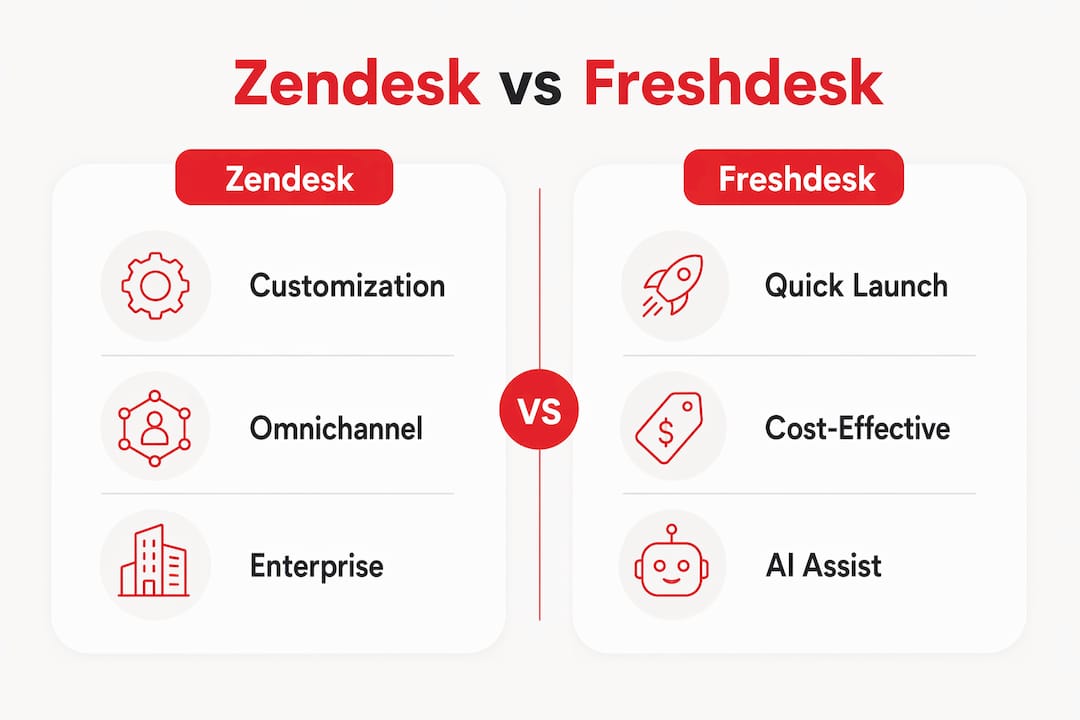
Zendesk: Built for teams that need deep customization and a unified omnichannel workspace. The caveat is real: you’ll likely need a dedicated Zendesk administrator to manage triggers, nested automations, and custom objects. That’s a headcount cost that rarely appears in the initial pricing conversation.
Freshdesk: Faster to launch and cheaper at entry, with Freddy AI easy to pilot on specific tasks like auto-triage and suggested replies. The caveat: omnichannel at lower tiers often requires separate Freshworks modules (Freshchat, Freshcaller), so your “unified” workspace may still feel like separate apps in separate tabs.
Workanova: No platform to configure, no admin to hire. KYC and payments workflows are handled by trained agents under strict SLAs. The caveat: this is a managed service, not a software license. You’re buying operational outcomes, not a configurable tool.
Pro Tip: Before enabling AI at scale on either platform, run a 30-day pilot on a subset of ticket volume. AI billing models shifted materially in 2026 — Freshdesk bills Freddy AI per session while Zendesk bills per verified resolution. The overage behavior is different, and the gap between projected and actual AI spend can be significant at iGaming ticket volumes.
How should licensed casinos and sportsbooks choose a support platform?
Work through this checklist before you sign anything.
- Assess your admin capacity. Do you have someone who can own platform configuration full-time? If not, a highly configurable platform adds hidden cost. Operational overhead from a dedicated admin role is frequently the variable that flips the value equation.
- Map your integrations. List every system that must connect: payments providers, KYC tools, CRM, game platform APIs. Zendesk’s marketplace and API depth handle complex, legacy stacks better. Freshdesk works well for standard connectors but may require custom work for niche iGaming APIs.
- Model AI total cost of ownership. Don’t evaluate AI as a feature. Treat it as a recurring operational cost. Ask vendors: How do you bill AI? Per session, per verified resolution, or per seat? What counts as a verified resolution?
- Verify compliance attestations. For U.S.-licensed operators, require SOC 2 Type II and ISO 27001 documentation. Confirm data residency options for any jurisdiction where KYC and payments data flow through the support tool.
- Check omnichannel and multilingual coverage. iGaming players contact support via live chat, email, and increasingly voice. Confirm whether voice and live chat support are bundled or require add-on modules, and at what cost.
- Define your SLA requirements. Regulated markets expect fast first-response times. Get SLA commitments in writing, including uptime guarantees and escalation paths for VIP and KYC queues.
Red flags to watch for: opaque AI overage metrics with no usage cap; mandatory per-seat AI add-ons that apply to your entire team even when only a subset uses the feature; no SOC/ISO documentation available on request; no data residency option for U.S. operations.
AI billing impact on annual TCO — illustrative model (25 agents, 500 tickets/day):
| Billing model | Assumption | Estimated annual AI cost |
|---|---|---|
| Per session (Freshdesk-style) | AI billing per session | — |
| Per verified resolution (Zendesk-style) | 20% AI resolution rate; $1.50/resolution | — |
| Managed service (flat fee) | Included in contract | Predictable; no overage |
Assumptions are illustrative. Actual rates depend on your negotiated contract and ticket mix. Request vendor-specific billing documentation before modeling.
The two selection paths: Build/configure means choosing a platform and investing in admin, integrations, and AI tuning. Buy managed means contracting a provider who delivers the outcome without the platform overhead.
Why do some operators outsource player support instead of buying a platform?
The honest answer is speed and risk reduction. A self-managed platform rollout, including configuration, integrations, agent training, and QA setup, typically takes two to four months before you’re operating at full capacity. A managed provider can have a dedicated support team live in four weeks.
For licensed operators, the specific motivators are:
- KYC and payments handling: Trained agents who understand document verification workflows and payment escalation paths are harder to build in-house than operators expect.
- 24/7 multilingual coverage: Staffing around the clock in 14+ languages requires significant headcount. Outsourcing converts that fixed cost to a variable one.
- SLAs built for regulated markets: Generic platform SLAs don’t account for the compliance-sensitive nature of iGaming support queues.
- QA governance: Managed providers maintain quality assurance frameworks that satisfy regulatory audit requirements without you building the infrastructure.
Operators that move from self-managed platforms to a managed provider consistently report two gains: faster time-to-live for new markets and a reduction in the internal headcount dedicated to support operations. The platform administration burden, including AI tuning, integration maintenance, and reporting configuration, transfers to the provider, freeing internal teams to focus on product and growth.
Key Takeaways
Operational maturity is the single most important variable when choosing between Zendesk, Freshdesk, or a managed provider for iGaming player support.
| Point | Details |
|---|---|
| Operational maturity decides the platform | Zendesk fits teams with a dedicated admin; Freshdesk fits lean teams that need to go live fast. |
| Model AI TCO before you commit | AI billing method (per session vs per verified resolution) can shift annual spend by tens of thousands of dollars at iGaming volumes. |
| Compliance is non-negotiable | Require SOC 2 Type II, ISO 27001, and data residency documentation for any U.S.-licensed operation. |
| Outsourcing removes platform risk | Managed providers eliminate admin overhead, AI overage risk, and slow deployment timelines. |
| Workanova as managed alternative | Workanova delivers 24/7 multilingual support with KYC/payments handling and strict SLAs, live in weeks. |
The Workanova view on how we recommend the right model
When an operator comes to us evaluating Zendesk versus Freshdesk, the first questions aren’t about features. They’re about team size, ticket complexity, and how many internal resources are available to own platform operations. A sportsbook with 20 agents, a strong IT team, and existing CRM integrations can probably get value from Zendesk with the right admin in place. A casino launching in a new market with a four-person support team and a six-week go-live deadline cannot.

Two patterns come up repeatedly. A mid-market sportsbook with an established ops team chose to keep platform operations in-house, invested in a Zendesk administrator, and built custom integrations with their payments provider over three months. The outcome was solid, but the time-to-live was longer than projected and the admin cost was underestimated at the outset. Contrast that with an online casino operator that outsourced to Workanova to avoid the hiring cycle entirely. They were handling live player queries in under a month, with KYC escalation paths already built into the workflow.
For Workanova-managed stacks, we require that every vendor in the integration layer meets SOC 2 Type II and ISO 27001 standards, and we document data residency for every market the operator is licensed in.
Workanova’s managed player support for operators ready to move fast
If the platform comparison above confirmed that you don’t have the admin capacity or the runway to configure and maintain a help desk, Workanova is the direct alternative. You get 24/7 iGaming player support with trained agents handling live chat, email, VIP queues, KYC verification, and payments escalation, all under strict SLAs, without hiring a single in-house agent or configuring a single automation rule.
The deployment timeline is weeks, not quarters. Workanova has operated in regulated iGaming markets since 2014, covering 14+ languages and the compliance-sensitive workflows that generic BPOs don’t handle well. If you’re evaluating whether outsourcing fits your operation, the fastest next step is a readiness scan: map your current ticket volume, channel mix, and SLA requirements, then contact Workanova to scope a pilot. Security and compliance documentation is available on request.
Useful sources for vendor due diligence
- Freshdesk vs Zendesk 2026: Pricing, AI & Value Compared (Pluno) — best for AI billing models, TCO analysis, and operational maturity framing.
- Zendesk vs Freshdesk in 2026 (Chatsy) — useful for AI capabilities comparison and deployment speed benchmarks.
- Freshdesk vs. Zendesk (Hiver) — covers reporting depth and add-on cost structures; good for procurement conversations.
- Freshdesk vs. Zendesk: A Simple Guide (PCMag) — omnichannel architecture and module dependencies explained clearly.
- Zendesk vs Freshdesk: How to Choose (HelpDesk Picker) — compliance checklist and admin overhead analysis; use for procurement red flags.
- Freshdesk vs. Zendesk: Which should you use? (Zapier) — pricing tier breakdown and feature-by-feature comparison; reliable for list-price benchmarking.
The part of this comparison most operators miss
The Zendesk vs Freshdesk debate gets framed as a features race. It isn’t. The real question is whether your organization has the operational infrastructure to extract value from a configurable platform, and whether the AI billing model you’re signing up for will stay predictable as your ticket volume grows.
Most iGaming operators underestimate both. They buy the platform, understaff the admin function, enable AI without modeling the billing, and end up with a tool that’s technically capable but operationally underperforming. The platform didn’t fail. The deployment did.
The operators who get the most out of Zendesk are the ones who treat it like an enterprise software deployment: dedicated admin, phased integration rollout, AI piloted on a controlled subset before full enablement. The operators who get the most out of Freshdesk are the ones who accept its modular nature and don’t try to force it into an enterprise configuration it wasn’t designed for. And the operators who get the most out of managed services are the ones who recognize that their competitive advantage isn’t in configuring a help desk. It’s in the product, the player experience, and the markets they serve.
Recommended
- Workanova | 24/7 iGaming Player Support Outsourcing
- Workanova | Outsourced Player Support for iGaming Ops
- Workanova | 24/7 Turkish iGaming Support: Now Mandatory
- Workanova | Scale iGaming Support Without 50 New Hires
Write your worst support ticket on our wall — best one wins a free month. Book a meeting