

Best Help Desk Software for iGaming Operators
July 30, 2026
Intercom vs Drift for iGaming Operators: 2026 Guide
August 1, 2026A compliant, scalable KYC verification process for US-licensed online casinos and sportsbooks combines eKYC automation — OCR, biometric face match, and liveness detection — with sanctions, PEP, and AML screening, plus 24/7 human review under defined SLAs. Under the Bank Secrecy Act (BSA) and FinCEN’s Customer Identification Program rules, your operator license depends on getting this right. Outsourcing to a managed player-support partner like Workanova lets you deploy a trained, SLA-backed KYC team in weeks rather than quarters.
Every operator-grade KYC program needs these components from day one:
- ID capture: Document upload or camera capture at account opening
- OCR and data extraction: Automated reading of name, DOB, document number, and expiry
- Document authenticity validation: MRZ, barcode, chip, and security-feature checks
- Biometric face match and liveness: Confirms the applicant holds the document and is physically present
- Sanctions, PEP, and adverse-media screening: Real-time watchlist checks against OFAC, FinCEN, and global databases
- Risk scoring and routing: Auto-approve low-risk profiles; escalate ambiguous or high-risk cases
- Manual review queue: Trained agents resolve flags under SLA, log rationale, and disposition cases
- Record retention and reporting: Encrypted storage, audit logs, and BSA-compliant retention schedules
Table of Contents
- What does the KYC verification process look like step by step?
- Why KYC compliance requirements matter for US casinos and sportsbooks
- Core technologies that make high-volume iGaming KYC work
- How to design a risk-based KYC workflow that routes players correctly
- KPIs and SLAs operators should track to measure KYC performance
- What to require when outsourcing KYC to a managed player-support partner
- Typical implementation phases and cost models for US operators
- How to handle high-risk cases and VIP exceptions without losing revenue
- Key Takeaways
- KYC belongs inside player support, not in a separate silo
- Workanova delivers managed KYC inside your player-support operation
- Useful sources
What does the KYC verification process look like step by step?
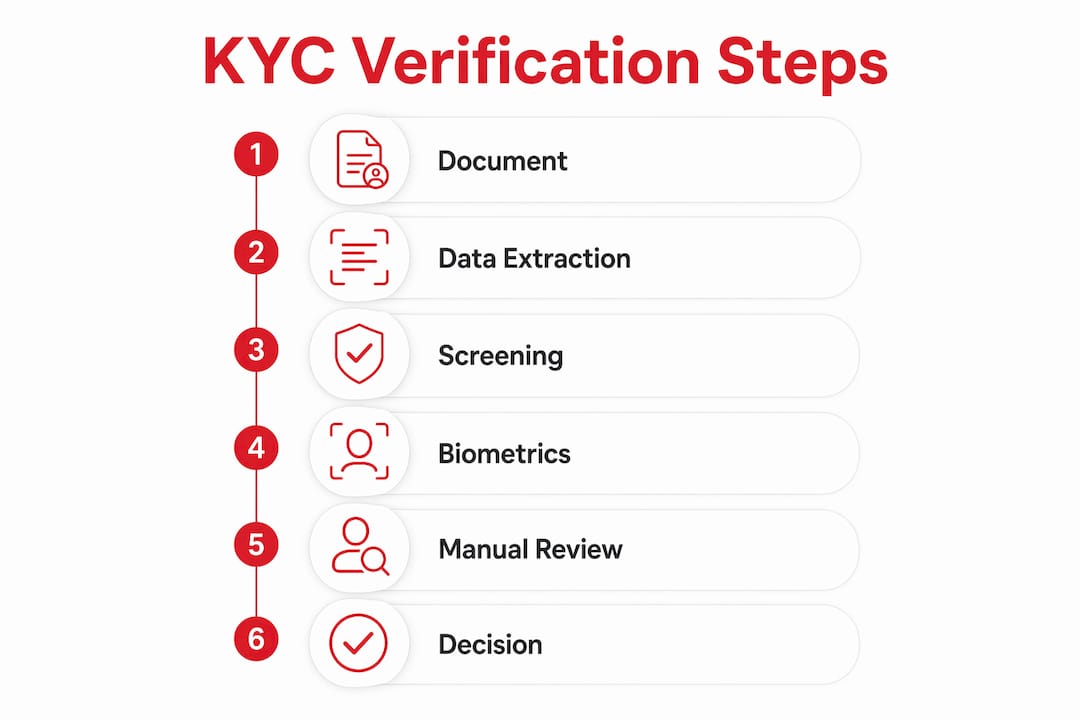
The five-step eKYC flow — capture, recognize, validate, biometrics, decision — maps directly onto iGaming onboarding. Here is how each step runs in practice for a US operator.
- Step 1 — Capture customer data and ID: Collect full legal name, date of birth, address, and a government-issued document. For US players, acceptable documents include a passport, state driver’s license, or state ID card. For cross-border customers, international passports and national identity cards are standard, with document-type coverage varying by jurisdiction.
- Step 2 — OCR and data extraction: Automated OCR reads the document fields and cross-checks them against the self-declared data. Mismatches flag for review rather than auto-reject.
- Step 3 — Document authenticity validation: The system checks MRZ integrity, barcode data, chip data where present, and visible security features. NIST SP 800-63A defines this as confirming the evidence is authentic, accurate, and valid.
- Step 4 — Biometric face match and liveness detection: A selfie or short video is compared to the document photo. Liveness detection blocks photo spoofing and deepfake attacks.
- Step 5 — Sanctions, PEP, and AML watchlist screening: The verified identity is checked against OFAC SDN, FinCEN 314(a), PEP databases, and adverse-media feeds in real time.
- Step 6 — Risk scoring and routing: Low-risk profiles receive instant approval. High-risk or ambiguous profiles enter a manual review queue with a defined escalation SLA.
- Step 7 — Record retention and ongoing monitoring: KYC is not a one-time event; triggers including ID expiry, unusual transactions, and sanctions-list updates require periodic re-verification and continuous monitoring.
Pro Tip: Build a “fast lane” for low-risk players — auto-approve anyone who clears document validation, biometrics, and watchlist screening in the first pass. Reserve manual queues for genuine flags. Excessive friction at step one drives abandonment before a player ever deposits.
Why KYC compliance requirements matter for US casinos and sportsbooks
The BSA requires licensed gaming operators to maintain a written AML program, file Currency Transaction Reports (CTRs) for cash transactions above $10,000, and submit Suspicious Activity Reports (SARs) when warranted. State gaming commissions layer additional identity and record-keeping obligations on top of federal requirements. Non-compliance carries consequences beyond fines: license suspension, reputational damage, and civil liability.
Historic KYC/AML enforcement has produced multi-billion-dollar industry fines, and the trend is toward larger penalties, not smaller ones. Operators who treat KYC as a checkbox rather than a live control environment are the ones who end up in enforcement headlines.
Commercially, slow or overly frictional onboarding costs you players before they convert. Speed and accuracy of first-pass verification are competitive differentiators. The goal is a process that stops bad actors without adding unnecessary steps for legitimate players.
Core technologies that make high-volume iGaming KYC work
| Technology | What it prevents or detects |
|---|---|
| OCR and data extraction | Manual entry errors, mismatched identity fields |
| MRZ/barcode/chip validation | Forged or altered documents |
| Biometric face match | Identity substitution (someone else’s document) |
| Liveness detection | Photo spoofing, deepfakes, replay attacks |
| Sanctions/PEP/adverse-media screening | High-risk individuals, politically exposed persons |
| Device, IP, and geolocation signals | Account farming, VPN abuse, geo-restricted players |
| Transaction-monitoring hooks | Structuring, unusual deposit patterns post-onboarding |
| Real-time rule engine | Rapid threshold updates without code deployments |
| Versioned audit logs | Audit-ready evidence trail for regulators and internal QA |

KYC compliance requirements evolve constantly, which means your vendor’s screening lists must update in real time. A stale sanctions list is a compliance failure, not a technical inconvenience. Require SOC 2 Type II and ISO 27001 certifications from any vendor handling player identity data, and confirm encryption at rest and in transit as baseline expectations.
Pro Tip: Require vendors to demonstrate rapid rules updates — new sanction entries live within hours, not days — and to provide testable audit logs your compliance team can query during regulatory examinations. Treat this as a contract requirement, not a nice-to-have.
How to design a risk-based KYC workflow that routes players correctly
Risk-based KYC means applying basic Customer Due Diligence (CDD) to typical players and Enhanced Due Diligence (EDD) to high-risk ones, with senior review whenever EDD is triggered.
Risk band definitions:
- Low risk: Domestic player, standard document, clean watchlist, no adverse signals. Route: auto-approve after biometric pass.
- Medium risk: Minor document discrepancy, partial name match, or unverified address. Route: secondary automated check, then manual review if unresolved within defined thresholds.
- High risk: PEP match, sanctions hit, adverse media, high-value first deposit, or biometric failure. Route: EDD queue with specialist investigator and senior sign-off.
Escalation SLA commitments to contract for:
- Low-risk auto-approval: under 60 seconds
- Medium-risk manual review: within 2–4 hours
- High-risk EDD review: within 24 hours, with interim account hold and player communication
VIP players need a differentiated flow. A high-value depositor who triggers a minor flag should not sit in the same queue as a suspected fraudster. Dedicated VIP player support handling with expedited SLAs — minutes to hours, not days — protects revenue while keeping compliance intact.
KPIs and SLAs operators should track to measure KYC performance
Manual review queues are a critical bottleneck in iGaming. Tracking the right metrics lets you catch bottlenecks before they affect conversion or compliance.
| KPI | Why it matters | Suggested SLA/target |
|---|---|---|
| Average time to decision (TAT) | Directly affects player abandonment rate | Under 60 seconds for auto-approval |
| Auto-approval rate | Measures automation efficiency | High approval rate for low-risk flows |
| Manual review rate | Flags over-triggering rules | A small fraction of total verifications |
| False-positive rate | Measures rule precision | Track and trend; minimize unnecessary holds |
| Onboarding abandonment rate | Conversion impact of friction | Benchmark and reduce quarter-over-quarter |
| SLA compliance rate | Vendor accountability | Near-perfect adherence to contracted TAT windows |
| Audit-log completeness | Regulatory readiness | Complete record retention with no gaps |
Operators frequently underestimate the total cost of ownership for KYC by ignoring ongoing monitoring overhead, periodic re-verification costs, and the manual effort required to clear false positives. Build these into your vendor contract and internal budget model from the start.
What to require when outsourcing KYC to a managed player-support partner
Common vendor selection mistakes include under-specifying SLAs and skipping audit-access clauses. Use this checklist in your RFP.
Security and compliance:
- SOC 2 Type II and ISO 27001 certifications
- Encryption at rest and in transit
- Data retention policies aligned with BSA five-year minimum
- CCPA and GDPR data-subject request handling procedures
Operational requirements:
- 24/7 multilingual staffing across all player time zones
- Defined TAT SLAs for auto-approval, manual review, and EDD queues
- API and webhook integration support with sandbox testing credentials
- Real-time watchlist update frequency documented in contract
Contractual clauses:
- Audit rights for compliance teams and regulators
- Breach notification timelines (72 hours or less)
- Record-retention responsibilities explicitly assigned to vendor
- Liability caps and indemnification for regulatory failures
Operational proofs to request:
- Sample audit logs with redaction policies
- Staff training records and certification evidence
- Evidence of real-time sanctions-list update processes
Pro Tip: Require a joint runbook for VIP exceptions and dispute handling before go-live. Without it, a high-value player who triggers a false positive during a peak traffic event will wait in a generic queue — and likely churn.
Typical implementation phases and cost models for US operators
Implementation phases:
- Discovery and scope: map current player data flows, document types, and compliance obligations
- API or webhook integration: connect your platform to the KYC vendor’s endpoints
- Configuration and ruleset tuning: set risk thresholds, document-type coverage, and escalation rules
- Parallel testing and QA: run live traffic alongside existing controls to validate accuracy
- Pilot launch: limited player cohort under full SLA monitoring
- Full cutover and ongoing governance: hand over to managed team with regular reporting cadence
Simple API integrations with standard rulesets typically go live in 4–6 weeks. Complex platform integrations with custom EDD rules and enterprise SLA requirements run 8–14 weeks, depending on sandbox availability, legal review timelines, and data-transfer agreement execution.
Cost model comparison:
- Per-check pricing: Predictable per-verification fee. Works well for steady, foreseeable volume. Cost spikes during jackpot drops or promotional traffic surges.
- Subscription or seat model: Fixed monthly fee for defined capacity. Protects against volume spikes but may leave unused capacity during slow periods.
- Blended managed-service retainer: Covers KYC handling, manual review agents, QA, and reporting in one contract. Best fit for operators who want a single accountable partner rather than a patchwork of point solutions.
For high-variance iGaming traffic, a blended managed-service model typically offers better cost predictability than pure per-check pricing. Secure scalable player support without absorbing the staffing risk yourself.
How to handle high-risk cases and VIP exceptions without losing revenue
Escalation steps for high-risk cases:
- Triage: Automated system flags the case and routes to specialist queue with full evidence packet
- Specialist review: Trained investigator reviews document, biometric, and watchlist data; logs rationale
- Temporary account hold: Clear time limit communicated to player; interim access restrictions applied
- Final disposition: Approve, reject, or escalate to senior compliance officer; record decision and evidence
For VIPs, a dedicated reviewer or small specialist team handles escalations with expedited SLAs measured in minutes to hours. Alternative verification options — video call verification or certified document submission — reduce friction for high-value players who cannot complete standard biometric flows.
Dispute handling requires a documented evidence checklist for investigators and a feedback loop that updates automated rules when false positives recur. Secure document handling practices matter here: investigators need access to evidence without creating data-leakage risk.
Pro Tip: Maintain a quarantine-versus-block policy. Quarantine holds an account for further verification while compliance finishes its review. Blocking immediately forfeits the revenue and the player relationship. Reserve outright blocks for confirmed bad actors.
Key Takeaways
A compliant KYC verification process for US-licensed operators combines eKYC automation with 24/7 SLA-backed human review, real-time watchlist screening, and audit-ready record retention under BSA/FinCEN obligations.
| Point | Details |
|---|---|
| Combine automation with human review | Auto-approve low-risk players in under 60 seconds; route flags to trained agents under defined SLAs. |
| Demand real-time watchlist updates | Contract for sanctions-list updates within hours and testable audit logs your compliance team can query. |
| Require SOC 2 and ISO 27001 | Security certifications are baseline requirements, not differentiators, for any vendor handling player identity data. |
| Plan for ongoing monitoring costs | Re-verification, false-positive resolution, and manual queue overhead are recurring costs — build them into TCO from day one. |
| Workanova as managed KYC partner | Workanova delivers embedded KYC handling inside 24/7 iGaming player support, with SLA-backed manual review and multilingual coverage. |
KYC belongs inside player support, not in a separate silo
The conventional framing treats KYC as a compliance function that sits upstream of player support. That separation creates real operational problems. When a player’s verification stalls, they contact support. If the agent handling that contact has no visibility into the KYC queue, no authority to expedite a VIP case, and no documented escalation path, you lose the player and create a compliance gap simultaneously.
Workanova’s position is that KYC handling belongs inside the player-support operation, not adjacent to it. Verification, payments queries, dispute resolution, and VIP retention are all part of the same player journey. Treating them as one workflow — with shared SLAs, shared audit logs, and a single accountable team — produces faster outcomes and fewer handoff failures.
Workanova has delivered outsourced iGaming player support since 2014, covering 24/7 multilingual operations across 14+ languages with SLA-backed KYC and payments handling. Operators get a dedicated, trained team live in weeks.
Workanova delivers managed KYC inside your player-support operation
Operators who outsource KYC as a standalone point solution still carry the manual-review burden, the SLA risk, and the compliance accountability — but with an extra vendor to manage. Workanova’s managed iGaming player support embeds KYC handling directly inside your 24/7 support operation: trained agents handle manual review queues, VIP escalations, and dispute resolution under a single SLA framework, with full audit-log access for your compliance team.
You get multilingual coverage across 14+ languages, SOC 2 and ISO 27001-aligned security practices, and a team that is live in weeks — not quarters. The engagement starts with a technical discovery to map your platform integration, document-type requirements, and SLA targets, followed by sandbox testing, a pilot launch, and a full handover with ongoing governance reporting. Schedule a technical discovery with Workanova to scope your KYC and player support integration today.
Useful sources
These primary sources back the regulatory and technical claims in this guide.
| Source | What it covers |
|---|---|
| NIST SP 800-63A | Identity assurance levels, evidence validation, and biometric verification requirements |
| FinCEN / BSA guidance | KYC documentary evidence standards and qualified intermediary rules |
| Regula Forensics — identity verification | eKYC technology chain: OCR, document validation, biometrics, liveness |
| Persona — KYC compliance | Evolving compliance requirements, real-time watchlist obligations, enforcement risk |
| Persona — KYC verification overview | Ongoing monitoring lifecycle, re-verification triggers, TCO considerations |
| HyperVerge — KYC process guide | Risk-based approach, automation vs. human review, VIP handling |
| Okta — KYC verification process | CDD vs. EDD definitions and risk-band application |
| Data leakage prevention for regulated industries | Operational controls for data handling in compliance-sensitive environments |
This article is general operational and compliance information, not legal advice. Confirm current BSA/FinCEN requirements and state gaming obligations with qualified legal counsel or your compliance officer before implementing any KYC program.
Recommended
- Workanova | 24/7 iGaming Player Support Outsourcing
- Workanova | Outsourced Player Support for iGaming Ops
- Workanova | iGaming World Cup 2026 Traffic Surge Prep
- Workanova | 24/7 Turkish iGaming Support: Now Mandatory
Write your worst support ticket on our wall — best one wins a free month. Book a meeting