

Zendesk vs Freshdesk for iGaming Operators: 2026 Guide
July 28, 2026
Best Help Desk Software for iGaming Operators
July 30, 2026Language quality assurance (LQA) is the system that guarantees a predefined, auditable quality level for each player-facing content type. For licensed U.S. casino and sportsbook operators, the most effective approach combines automated mechanical checks, MQM-compatible LQA scoring, and targeted human review inside a continuous validation pipeline.
- CSAT and FCR improve when players receive accurate, culturally appropriate responses in their language, not just grammatically correct ones.
- Compliance risk drops when KYC instructions, responsible gaming (RG) disclosures, and payment messaging are reviewed at 100% coverage before they reach players.
- Speed to quality is achievable: Workanova delivers SLA-backed, multilingual QA integrated into live player support in weeks, without requiring operators to build an in-house linguistics team.
Pro Tip: Don’t treat LQA as a one-time project. The operators who avoid costly rework govern it as a continuous production metric, not a pre-launch checklist.
Table of Contents
- What language quality assurance covers in iGaming player support
- Core QA principles: MQM scoring, sampling, and governance
- What your tech stack needs to handle automated and human LQA
- Which metrics belong on your LQA dashboard
- How to stand up language QA: timeline and cost drivers
- What to ask vendors and what red flags to watch for
- When to keep QA in-house versus when to outsource
- Key Takeaways
- Why the conventional wisdom on LQA gets it wrong
- Workanova delivers multilingual QA from day one
- Useful sources and further reading
What language quality assurance covers in iGaming player support
Language quality assurance is not a single review step. It is a structured system that defines, measures, and enforces agreed quality thresholds across every player-facing content type. In iGaming, that scope is wider than most operators initially budget for.
Content types that require LQA governance:
- Live chat (synchronous): tone, speed of resolution, and cultural register matter as much as accuracy; errors surface in real time and affect CSAT immediately.
- Email and async support: higher tolerance for turnaround time, but errors compound across ticket threads and damage player trust over time.
- Knowledge base and FAQs: static content reviewed less frequently but read by thousands of players; outdated or mistranslated RG or payment instructions create regulatory exposure.
- Marketing and promotional copy: brand voice and jurisdictional phrasing must align with state-level advertising rules.
- KYC and payment messaging: zero tolerance for ambiguity; a mistranslated field label or instruction can cause failed verifications and chargebacks.
- Responsible gaming disclosures: U.S. licensed operators must meet state-specific RG language requirements; a wrong phrase is a compliance failure, not just a quality issue.
- VIP and retention messaging: personalization and tone carry outsized weight; errors here directly affect lifetime value.
The governing principle is that QA guarantees a predefined quality level per content type, not maximum possible quality everywhere. A live chat response and a legal disclaimer need different review depths, different linguist profiles, and different SLA targets.
Core QA principles: MQM scoring, sampling, and governance
The MQM (Multidimensional Quality Metrics) framework gives you an objective, penalty-weighted LQA score across error categories: accuracy, fluency, terminology, style, and locale convention. Each error is assigned a severity (critical, major, minor), and the weighted total produces a score that is comparable across languages, vendors, and time periods. Smartling’s LQA implementation is one widely used example of MQM-compatible scoring in production.
Sampling by content risk is where most operators get the balance wrong. A practical framework:
- 100% review: KYC instructions, RG disclosures, payment messaging, legal terms.
- Target partial review for VIP and retention emails, promotional copy, and onboarding flows with moderate sampling.
- Apply targeted sampling to a portion of general knowledge base articles and standard live chat templates.
High-volume multilingual support typically targets 10–20% human review of total string volume, with automation handling the rest. That ratio only works if your automated checks are well-calibrated and your human reviewers are focused on high-risk strings.
Governance requirements that must be in place before sampling begins:
- Approved glossaries per language and per product vertical.
- Banned-word lists covering competitor names, prohibited gambling terms, and jurisdiction-specific phrases.
- Style guides per channel (live chat register differs from VIP email register).
- ISO 17100-aligned second-linguist review for high-risk content types.
- Traceability: every reviewed string must be traceable to a reviewer, a date, and an error disposition.
Pro Tip: Build your glossary before you run your first LQA cycle. Centralized translation memory and terminology databases are the single largest lever for quality consistency across 14+ languages.
What your tech stack needs to handle automated and human LQA

Automated checks catch mechanical issues: missing tags, placeholder mismatches, numeric and date format errors, glossary violations, and segment length overflows. Human linguists judge what automation cannot: tone, emotional register, cultural appropriateness, and brand voice alignment. Both layers are mandatory.
Core tooling checklist:
- TMS (Translation Management System): central hub for string management, workflow routing, and reporting.
- CAT tools with QA checkers: tools in the style of Xbench or Verifika surface errors during translation, not after review cycles begin.
- Translation memory ™: reuses approved language, enforces consistency, and reduces per-string cost over time.
- Terminology management: enforces glossary compliance programmatically; flags deviations before human review.
- Automated Quality Estimation (AQE): AI-scored quality signals that help triage which strings need human attention.
- Semantic monitoring: real-time analysis of live production strings to catch brand-safety or compliance drift between scheduled review cycles.
Integration checklist for connecting LQA to your ticketing and live chat stack:
- Webhook-based push of flagged strings from TMS to your CRM or ticketing system (Zendesk, Salesforce Service Cloud, or equivalent).
- String-level traceability so corrections in the TMS propagate back to production strings automatically.
- Feedback loop from LQA scores into translation memory so future translations improve without manual re-entry.
- Audit log export for regulator requests, with timestamps and reviewer IDs attached to each string disposition.
Automate these checks first: placeholder and tag integrity, numeric and date format validation, glossary term enforcement, and segment completeness. These catch the errors that are cheapest to fix and most likely to cause compliance failures if they reach players.
Which metrics belong on your LQA dashboard
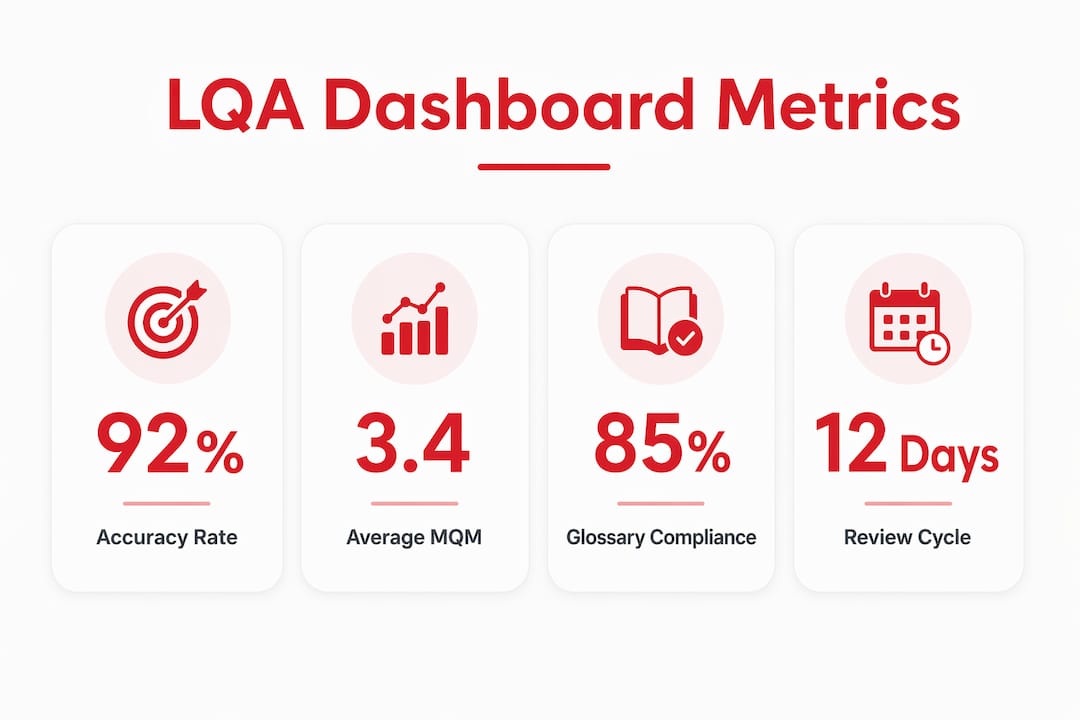
| Metric | Definition | Reporting cadence |
|---|---|---|
| LQA score (MQM) | Penalty-weighted error score per language, normalized to a scale | Weekly per language |
| First-pass yield | % of strings passing review without rework | Weekly |
| Error density | Errors per thousand words, segmented by error category | Weekly |
| CSAT by language | Player satisfaction score filtered by support language | Monthly |
| FCR by language | First-contact resolution rate per language | Monthly |
| AHT impact | Average handle time delta for tickets with localization-related escalations | Monthly |
| SLA compliance | % of QA reviews completed within agreed turnaround | Monthly |
| Vendor scorecard | Aggregated LQA score, error density, and SLA compliance per vendor | Quarterly |
Normalizing scores across languages requires calibrated thresholds, not a single global pass/fail line. A language with a smaller reviewer pool or higher linguistic complexity may need a wider acceptable range, documented and agreed in the SLA. CSAT, FCR, and AHT are the business-level proof that LQA is working. If LQA scores improve but CSAT stays flat, the review criteria are misaligned with what players actually experience.
Every string-level error must carry a reviewer ID, timestamp, and error category for regulator audit requests. Build that traceability into your TMS from day one.
How to stand up language QA: timeline and cost drivers
| Phase | Activity | Typical duration |
|---|---|---|
| Discovery | Glossary build, style guide creation, content audit, tooling selection | 1–2 weeks |
| Pilot and calibration | LQA sampling on a single language pair, threshold-setting, reviewer calibration | 2–4 weeks |
| Go-live with sampling | Full sampling model active, automated checks integrated, reporting live | 4 weeks to 2 months |
| Full rollout | All languages, all content types, continuous validation loop running | 2 to 4 months |
For operators who want to stand up outsourced support quickly, the discovery and pilot phases can run in parallel with agent onboarding.
Primary cost drivers:
- Number of languages covered (each adds reviewer cost and glossary maintenance).
- Review depth: 100% coverage for KYC/RG content costs significantly more than 10% sampling for KB articles.
- SLA targets: tighter turnaround windows require larger reviewer pools or premium rates.
- Tooling fees: TMS licensing, AQE tools, and semantic monitoring platforms.
- Post-editing vs. full human review: machine translation post-editing (MTPE) reduces per-word cost but requires calibrated QA protocols to catch AI-generated errors.
Vendor onboarding checklist:
- Confirm data security posture: SOC 2, PCI DSS scope, and data handling agreements for player PII.
- Background checks for all linguists handling KYC and payment content.
- Training on U.S. state-specific RG phrasing and prohibited gambling advertising terms.
- Sandbox integration test for TMS-to-ticketing webhook before go-live.
- Signed SLA covering QA turnaround, error rate thresholds, and escalation paths.
What to ask vendors and what red flags to watch for
A rigorous vendor RFI covers more than language coverage and price. These are the questions that separate capable partners from those who will create compliance exposure:
- What MQM-compatible LQA schema do you use, and can you share a sample scorecard?
- Do you provide second-linguist review for high-risk content types (KYC, RG, payments)?
- What is your SLA for QA turnaround on critical content, and what are the penalties for breach?
- How do you integrate with our ticketing system? Can you provide string-level traceability for regulator audits?
- What is your data security posture for handling player PII? Are linguists background-checked?
- Can you demonstrate 24/7 coverage across all contracted languages?
- What is your onboarding timeline to go-live with a dedicated team?
Red flags that should end an evaluation:
- No second-linguist review process for any content type.
- No defined LQA schema or MQM-compatible scoring methodology.
- No integration path to your CRM or ticketing system.
- Opaque AI model governance: they use machine translation but cannot explain how errors are caught or how the model is governed.
- Vague data security answers or no documented PCI/SOC 2 posture.
Pro Tip: Ask for a sample LQA scorecard from a live client engagement before signing. A vendor who cannot produce one has not operationalized LQA at scale.
A managed-service partner like Workanova, operating iGaming player support since 2014, can deliver dedicated, trained teams with QA governance integrated into your ticketing stack in weeks, not quarters.
When to keep QA in-house versus when to outsource
| Criteria | In-house favored | Outsourcing favored |
|---|---|---|
| Language breadth | 1–3 languages | 4+ languages |
| Regulatory control | High, single jurisdiction | Multi-state, multi-jurisdiction |
| 24/7 coverage need | Business hours only | Round-the-clock required |
| Speed to scale | Months acceptable | Weeks required |
| Total cost of ownership | Lower at very low volume | Lower at medium-to-high volume |
| QA expertise available | In-house linguists on staff | No dedicated QA team |
In-house QA makes sense when you operate in one or two languages, have a stable ticket volume, and already employ qualified linguists. The moment you add a third language or need 24/7 coverage, the cost and complexity of in-house QA typically exceeds outsourcing.
Hybrid models that work in practice:
- In-house governance, outsourced execution: your team owns the glossaries, style guides, and LQA schema; a managed-service partner runs the review cycles and reports against your thresholds.
- Outsourced baseline, in-house escalation: the outsourced team handles 100% of standard content; your internal team reviews only critical or novel content types (new RG regulations, new payment methods).
Scaling player support without proportionally scaling headcount is the core argument for outsourcing. A hybrid model gives you control where it matters and speed where you need it.
Key Takeaways
Effective language quality assurance for licensed U.S. iGaming operators requires a hybrid pipeline combining automated checks, MQM-compatible LQA scoring, and targeted human review, governed by SLA-backed processes and continuous validation.
| Point | Details |
|---|---|
| QA guarantees agreed thresholds | LQA sets predefined quality levels per content type, not maximum quality everywhere. |
| Risk-based sampling is mandatory | Apply 100% review to KYC, RG, and payment content; 10–20% sampling for general support content. |
| Metrics drive accountability | Track LQA score, CSAT by language, FCR by language, and SLA compliance on a weekly and monthly cadence. |
| Outsourcing wins at scale | Four or more languages, 24/7 coverage, or rapid scaling almost always favors a managed-service model over in-house QA. |
| Workanova as a turnkey option | Workanova delivers SLA-backed multilingual QA integrated with your ticketing stack, live in weeks, covering 14+ languages. |
Why the conventional wisdom on LQA gets it wrong
Most operators approach language QA as a pre-launch gate: translate, review once, ship. That model fails in iGaming because the content never stops changing. New promotions, updated RG regulations, payment method changes, and live chat volume spikes all introduce new strings that bypass the original review cycle.
The operators who get this right treat LQA as a production metric, not a project deliverable. They run continuous validation pipelines that flag semantic drift in live strings, not just errors in new translations. They normalize LQA scores across languages so they can compare a Spanish live chat agent’s output to a German one on the same scale. And they tie those scores directly to CSAT and FCR data so the business can see the revenue impact of a quality failure, not just the linguistic one.
The other underestimated risk is the QA-versus-QC confusion. QA is proactive and process-oriented; it is built before a single string is translated. QC is reactive, catching errors after the fact. Operators who skip QA and rely on QC pay more in rework, face longer correction cycles, and carry higher regulatory exposure. The fix is not more reviewers at the end of the pipeline. It is better governance at the start.
Workanova delivers multilingual QA from day one
Workanova has operated outsourced iGaming player support since 2014, covering 14+ languages across live chat, email, VIP support, KYC/payments handling, and QA. The concrete advantage for operators evaluating outsourcing: you get a dedicated, trained team with LQA governance already integrated into your ticketing stack, live in weeks, without building a linguistics department from scratch.
Every engagement includes SLA-backed QA governance, MQM-compatible scoring, and real-time monitoring tied to your CSAT and FCR targets. If you are evaluating vendors or structuring an RFI, Workanova can run a pilot engagement covering your highest-risk content types first, so you see measurable quality outcomes before committing to a full rollout. Request a pilot at workanova.com/industries/igaming/igaming-player-support and get your team live in weeks.
Useful sources and further reading
- ISO 17100:2015: The primary international standard for translation service providers, covering revision, review, and traceability requirements.
- Smartling LQA Overview: MQM-compatible LQA schema, severity weighting, and LQA Agent for scaled evaluations.
- Seprotec: Translation Quality Assurance: Practical guide to predefined quality levels, translation memory, and terminology governance.
- PoliLingua: QA vs QC in Translation: Clear breakdown of proactive QA versus reactive QC, including MTPE considerations.
- Extanto: Language Validation Revisited: Continuous validation pipelines and semantic monitoring for 24/7 markets.
- TextUnited: What Is LQA?: LQA as a feedback loop into translation memory and terminology systems.
- Lokalise: Translation QA Best Practices: Sampling guidance and efficiency benchmarks for high-volume multilingual support.
Operator artifacts to produce during discovery: language-pair glossaries, channel-specific style guides, an MQM-compatible LQA schema with agreed severity weights, a banned-word list per jurisdiction, and a content-type risk register that maps each content category to its required review depth and SLA.
Recommended
- Workanova | 24/7 iGaming Player Support Outsourcing
- Workanova | Outsourced Player Support for iGaming Ops
- Workanova | 24/7 Turkish iGaming Support: Now Mandatory
- Workanova | iGaming World Cup 2026 Traffic Surge Prep
Write your worst support ticket on our wall — best one wins a free month. Book a meeting