

Dedicated iGaming Support Teams: Scale 24/7 in Weeks
August 10, 2026Every licensed U.S. iGaming operator needs a documented set of player support procedures covering responsible gambling (RG) policy, detection and escalation SOPs, self-exclusion workflows, KYC and payment integrity controls, SLA targets, staff training records, and behavioral monitoring KPIs. That is the minimum. Without all seven components in place and auditable, you are exposed to regulatory action, player harm, and churn you cannot explain on a dashboard. Run your current program against the checklist in the SOP section below before you build anything new.
Your minimum required components at a glance:
- Documented RG policy with version control and sign-off log
- Detection and escalation SOP with trigger definitions and severity tiers
- Self-exclusion and account lock workflow with payout rules
- KYC and payment integrity controls coordinated with AML/compliance
- Published SLAs for first response, resolution, and verification timelines
- Training records covering onboarding and refresher cadence
- Behavioral monitoring dashboard with defined KPIs and reporting schedule
Key Takeaways
Documented, auditable player support procedures are the single most effective risk mitigation tool a U.S. iGaming operator can deploy, covering RG policy, detection SOPs, self-exclusion workflows, KYC controls, SLA targets, training records, and behavioral monitoring KPIs.
| Point | Details |
|---|---|
| Seven minimum components | Every program needs RG policy, detection SOP, self-exclusion workflow, KYC controls, SLAs, training records, and monitoring KPIs. |
| 90-day implementation | A phased rollout across foundation, build, and go-live stages gets a compliant program operational without a multi-year project. |
| Hybrid AI and human routing | Automate detection and routine tasks; reserve human specialists for RG interventions, VIP contacts, and critical escalations. |
| Training refreshers every 6 months | Survey data shows universal RG training but persistent tooling gaps; refresher cadence and integrated detection close the gap. |
| Workanova as outsourced implementation | Workanova’s managed iGaming support delivers RG-trained agents, KYC handling, and QA governance with a dedicated team live in weeks. |
Table of Contents
- What do iGaming player support standards actually require?
- How to build an RG policy that your support team can actually use
- What training does your support team need, and how often?
- How to handle self-exclusion and account controls step by step
- How do you detect and assist players who may be at risk?
- What player-facing tools does every operator need to provide?
- KYC, payment flows, and how they connect to player safety
- Marketing controls and how support handles opt-outs
- Which KPIs should your support team track?
- What SOPs, templates, and documentation does your team need?
- How to implement these procedures in 90 days
- How automation and hybrid workflows help you scale without losing control
- Why outsourced support teams often implement these standards faster
- Workanova delivers SOP-ready iGaming support from day one
- Sources
What do iGaming player support standards actually require?
The phrase “standardne procedure podrške igaming” translates directly to “standard iGaming support procedures” in industry usage. In the U.S. context, those procedures are shaped by three overlapping frameworks: the Standards & Criteria for iGaming Accreditation published by RG Check, the eGAP Requirements (eCOGRA) that seal holders must satisfy, and guidance from the National Council on Problem Gambling (NCPG), which is the primary U.S. reference body for responsible gambling standards.
RG Check organizes its framework around nine standards and 48 criteria covering policy, governance, staff training, product controls, marketing, and monitoring. eGAP Requirements add explicit player-protection controls: a visible RG policy link, deposit limits, self-exclusion mechanics, and documented testing of fairness and payout processes. NCPG guidance, particularly its Responsible Gambling Standards for U.S. operators, maps to the same functional areas but is calibrated to state-by-state licensing environments.
Together, these frameworks define what auditors look for. The table below maps each functional area to the relevant standard.
| Functional Area | RG Check Standard | eGAP Requirement | NCPG Guidance |
|---|---|---|---|
| RG policy and governance | Standard 1: Policy | Section 2: Player Protection | Core Standard 1 |
| Staff training | Standard 3: Training | Section 4: Staff Competence | Core Standard 3 |
| Account controls (limits, self-exclusion) | Standard 4: Player Controls | Section 3: Account Controls | Core Standard 4 |
| Detection and monitoring | Standard 5: Monitoring | Section 5: Behavioral Monitoring | Core Standard 5 |
| Marketing and communications | Standard 6: Marketing | Section 6: Responsible Promotions | Core Standard 6 |
| KYC and payments | Standard 7: Verification | Section 7: Payment Integrity | Core Standard 7 |
| Product testing | Standard 8: Product | Section 8: Fairness Testing | Core Standard 8 |
Audit evidence to retain: policy version history, training completion records with dates and scores, self-exclusion logs with timestamps, limit-change audit trails, and monthly monitoring reports. Auditors expect to see documentation that connects each control to a named owner and a review date.
How to build an RG policy that your support team can actually use
A responsible gambling policy is not a compliance document that lives in a shared drive. It is an operational instruction set that every support agent references when a player contacts them in distress. The minimum sections every RG policy must include:
- Scope and purpose: which products, channels, and player segments the policy covers
- Definitions: problem gambling indicators, at-risk player categories, and escalation terminology
- Player controls: deposit limits, loss limits, session limits, cooling-off periods, and self-exclusion
- Detection obligations: behavioral triggers agents must recognize and act on
- Escalation path: who receives a flagged player, within what timeframe, and what action is required
- Referral resources: NCPG Helpline (1-800-522-4700), state-specific programs, and self-assessment tools
- Marketing restrictions: what promotional communications are prohibited for flagged or self-excluded players
- Review schedule: who signs off, how often the policy is reviewed, and how changes are versioned
| Policy element | Owner | Review frequency | Evidence retained |
|---|---|---|---|
| Policy document | Head of Compliance | Annual minimum | Version log, sign-off record |
| Training alignment | Head of Support | After each policy update | Training completion records |
| Escalation matrix | Support Operations Manager | Quarterly | Matrix version, incident log |
| Referral resource list | Compliance / Support | Semi-annual | Updated resource list with dates |
Pro Tip: Pin the current policy version number and effective date to your support team’s internal knowledge base homepage. When an auditor asks whether agents are working from the current version, you need that answer in under 30 seconds, not 30 minutes.
Cultural adoption is the harder problem. Policy sign-off is a formality; agents acting on it under pressure is the real test. Build a brief scenario library (five to ten realistic player contact examples) into your onboarding and refresher training so agents practice applying the policy before they face a live situation.
What training does your support team need, and how often?
Every frontline agent needs training across six core modules before they handle a live player contact. The modules are not optional and not interchangeable.
- RG fundamentals: what problem gambling is, how it presents, and why early intervention matters
- Detection signals: behavioral, transactional, and conversational indicators of at-risk play
- Escalation procedures: how to flag a player, who receives the flag, and what happens next
- KYC handling: document types, verification steps, and how to communicate delays without causing abandonment
- Payment and cashier support: withdrawal timelines, dispute handling, and when to escalate to payments specialists
- Empathy and de-escalation: how to manage distressed players, set boundaries, and close contacts professionally
According to a survey of iGaming support operations, support teams universally receive RG training, yet 51.8% of operators still rely on manual review processes and 75% depend on supervisor review as a primary detection mechanism. That gap between training and tooling is where players fall through. Six-month refresher cycles close part of it; integrating detection tooling closes the rest.
Keep all records in your LMS or HR system with the agent’s name, module, date, and score. Auditors pull these records during accreditation reviews.
How to handle self-exclusion and account controls step by step
Self-exclusion is the highest-stakes workflow in your support operation. A missed step or a delayed account lock is a regulatory breach and a direct harm event. The process must be documented, tested, and auditable.
Self-exclusion workflow:
- Player contacts support via any channel requesting self-exclusion.
- Agent confirms player identity using standard verification (name, date of birth, last four digits of payment method or equivalent).
- Agent informs the player of the exclusion terms: duration options, effect on active bonuses, and withdrawal process.
- Agent initiates account lock in the CRM/back-office system, selecting the appropriate exclusion type (temporary cooling-off, operator self-exclusion, or third-party program enrollment such as a state gaming commission exclusion list).
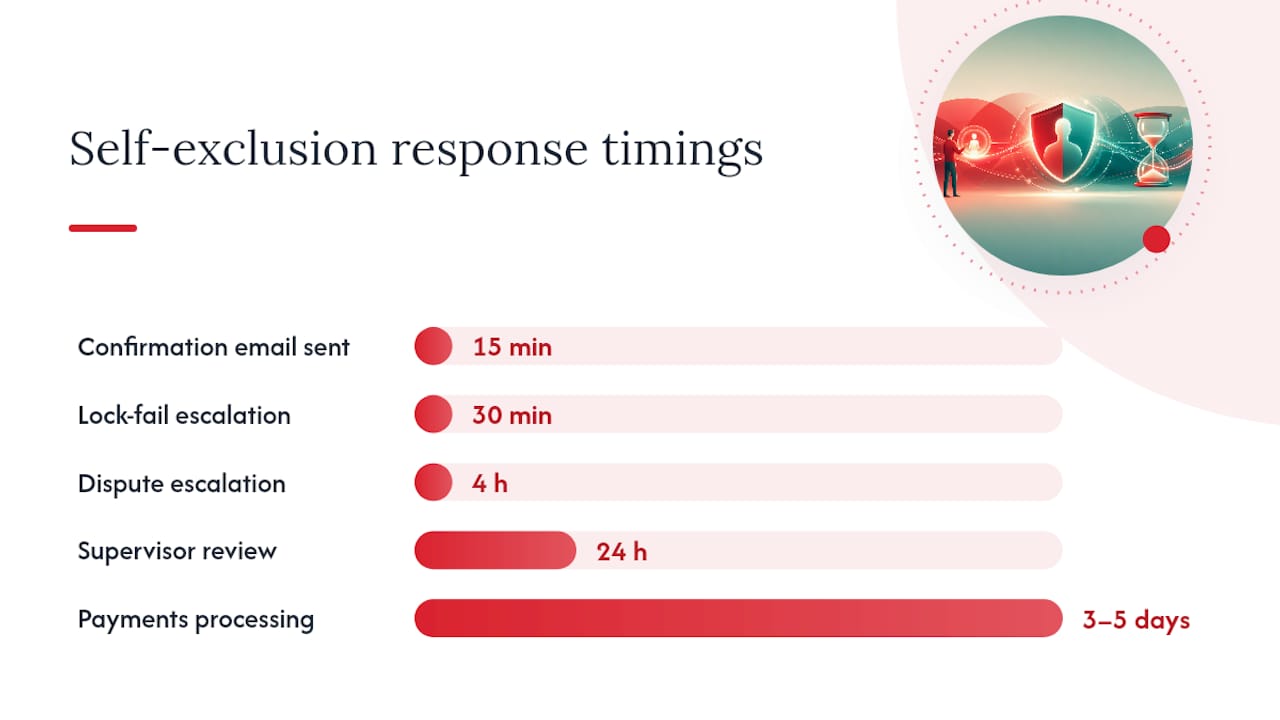
- System sends automated confirmation email to the player within 15 minutes of lock.
- Agent logs the contact in the support system with timestamp, exclusion type, and duration.
- Payments team is notified to process any pending withdrawal balance within the operator’s published timeline (typically 3–5 business days).
- Marketing system is updated to suppress all promotional communications immediately.
- Supervisor reviews the log within 24 hours to confirm all steps completed.
Confirmation email template fields:
- Player’s first name
- Exclusion type and duration
- Effective date and time
- Withdrawal balance status and expected processing timeline
- NCPG Helpline number and link to state resources
- Instructions for re-entry requests (if applicable) and the mandatory cooling-off period before any re-entry is considered
Escalation rules for edge cases:
| Scenario | Required action | Timeframe | Owner |
|---|---|---|---|
| Player disputes withdrawal during exclusion | Escalate to payments specialist; do not reverse exclusion | Within 4 hours | Payments + Compliance |
| Player requests re-entry before exclusion period ends | Decline and document; provide NCPG referral | Immediate | Agent + Supervisor |
| Third-party exclusion list enrollment requested | Provide state program link; document referral | Within 1 business day | Agent |
| Account lock fails technically | Escalate to tech team; manually flag account; notify supervisor | Within 30 minutes | Tech + Support Ops |
Cooling-off periods (24 hours to 6 weeks) follow the same account lock process but with a shorter duration and a re-activation step at expiry. Deposit limit changes that reduce a limit take effect immediately; increases must have a mandatory 24-hour delay before activation.
How do you detect and assist players who may be at risk?
Detection is not a single trigger. It is a layered system of behavioral, transactional, and conversational signals which, in combination, indicate a player may need intervention. Agents need a clear list of what to look for and an equally clear escalation matrix that tells them what to do next.
Behavioral and transactional triggers:
- Deposit frequency increasing significantly over a short period (multiple deposits within a single session)
- Deposits immediately following a withdrawal request or cancellation
- Session length exceeding operator-defined thresholds (e.g., 3+ hours without a break prompt response)
- Chasing losses: rapid re-deposit after a significant loss event
- Repeated limit increases within a short window
- Contact center contacts expressing frustration, distress, or references to financial pressure
- Requests to remove self-imposed limits ahead of schedule
- Multiple failed payment attempts followed by immediate successful deposit via a different method
- Bonus abuse patterns that suggest compulsive play rather than recreational engagement
Escalation matrix:
| Trigger severity | Example trigger | Required action | Timeframe | Owner |
|---|---|---|---|---|
| Low | Single extended session | In-session reality check prompt | Automated, immediate | System |
| Medium | Two or more triggers in 7 days | Agent outreach contact; offer limit review | Within 24 hours | Agent |
| High | Chasing losses + distress language in contact | Specialist handoff; mandatory self-exclusion offer | Within 2 hours | RG Specialist |
| Critical | Player states financial harm or self-harm | Immediate escalation; NCPG referral; supervisor notification | Immediate | Supervisor + Compliance |
Agent script for medium-severity outreach:
“Hi [Player Name], I’m reaching out because we noticed some changes in your recent activity and wanted to check in. We have tools available, including deposit limits and cooling-off options, that some players find helpful. Would you like me to walk you through those? There’s no obligation, and your account stays open either way.”
Pro Tip: Route medium and high-severity flags to a dedicated RG specialist queue, not the general support pool. Agents handling billing disputes are not in the right headspace to conduct an RG intervention. Separate routing takes under an hour to configure in most help desk platforms and materially improves intervention quality.
What player-facing tools does every operator need to provide?
Player tools are not a feature list. They are a regulatory expectation and, when surfaced correctly, a retention mechanism. Players who can control their own experience are less likely to self-exclude abruptly and more likely to return after a cooling-off period.
Required tools checklist:
- Deposit limits (daily, weekly, monthly) with immediate reduction and 24-hour increase delay
- Loss limits with the same delay structure
- Session time limits with in-session alerts
- Reality check prompts at configurable intervals (e.g., every 30 or 60 minutes)
- Self-assessment questionnaire (PGSI or equivalent) accessible from the account dashboard
- Cooling-off periods (24 hours to 6 weeks)
- Self-exclusion (operator-level and state program enrollment)
- Account history and spend summary accessible without contacting support
UX placement best practices:
- Surface deposit and loss limits during the first deposit flow, not buried in account settings.
- Place a “Responsible Gambling” link in the cashier footer and the main navigation, not only in the site footer.
- Trigger a reality check prompt after every session that exceeds the player’s configured threshold, not just at login.
- Show a plain-language spend summary on the account dashboard homepage, updated in real time.
- Make the self-assessment questionnaire completable in under three minutes and link it from the RG page and the cashier.
Metrics to track tool usage:
- Percentage of active players with at least one limit set
- Monthly self-assessment completion rate
- Reality check dismissal rate versus pause rate (a high dismissal rate signals the prompt needs redesign)
- Cooling-off uptake as a percentage of flagged players offered the option
- Self-exclusion conversion rate from RG outreach contacts
KYC, payment flows, and how they connect to player safety
KYC is not just an AML obligation. Efficient, clearly communicated verification directly protects player lifetime value by reducing abandonment at deposit and withdrawal touchpoints. Practitioners confirm that poor KYC execution, whether through delays, unclear instructions, or inconsistent document requests, leads to failed deposits, chargebacks, and players who simply leave.
Standard vs. enhanced KYC decision tree:
- Player registers and makes first deposit: standard KYC triggered (government ID + proof of address).
- Player reaches withdrawal threshold defined by state license (varies by jurisdiction): enhanced KYC triggered (source of funds documentation).
- Player triggers AML flag (deposit pattern, high-value transaction): enhanced KYC + AML team notification.
- Player fails standard KYC within 72 hours: account restricted; support contacts player with specific document requirements.
- Player fails enhanced KYC: account suspended; compliance team reviews; support communicates outcome within 5 business days.
For payment fraud prevention controls that complement your KYC SOP, the guidance at Vopify’s payment fraud prevention resource covers the finance-side controls that your payments team should coordinate with.
What auditors expect to see:
- KYC decision log with timestamps and document types received
- Communication records showing what was requested, when, and the player’s response
- Escalation records for AML referrals
- Withdrawal processing timelines against published SLAs
| KYC stage | Expected completion | Player communication | Escalation trigger |
|---|---|---|---|
| Standard KYC | 24–48 hours | Automated request + agent follow-up at 24 hours | No response at 48 hours |
| Enhanced KYC | 3–5 business days | Agent-led communication with named contact | No response at 72 hours |
| AML review | 3–5 business days | Compliance-drafted communication | Compliance team owns |
| Withdrawal processing | 1–3 business days post-KYC | Automated status update | Delay beyond SLA |
For operators evaluating KYC verification processes specific to U.S. online casinos, the documentation requirements vary by state license, so always confirm against your specific regulatory conditions.
Marketing controls and how support handles opt-outs
Promotional messaging is a regulatory exposure point. Sending a bonus offer to a self-excluded player or a player with active RG flags is not just a compliance failure; it is a harm event that regulators treat seriously.
Do/don’t checklist for safer promotional copy:
- Do include a responsible gambling message and NCPG helpline number in every promotional email
- Do set minimum deposit and wagering requirements that are clearly stated in plain language
- Don’t send promotional offers to players on the self-exclusion list or with active RG flags
- Don’t use urgency language (“Last chance,” “Expires tonight”) in communications to players with recent RG contacts
- Don’t target players whose deposit frequency has dropped significantly with re-engagement bonuses without an RG review first
- Do include a one-click unsubscribe in every promotional communication
- Do honor unsubscribe requests within 24 hours across all channels
Opt-out and promotional block process:
- Player contacts support or clicks unsubscribe link requesting marketing opt-out.
- Agent confirms the request and the scope (email only, SMS only, or all channels).
- CRM is updated within 2 hours of the request.
- Campaign tool suppression list is updated before the next send cycle.
- Agent sends confirmation to the player: channel, scope, and effective date.
- If the opt-out is linked to an RG flag, the RG specialist queue is notified.
Sample opt-out confirmation:
“Your request to opt out of [channel] marketing has been processed. You will no longer receive promotional messages via [channel] from [Operator Name]. If you also want to set deposit limits or take a break from play, reply to this message or visit your account settings.”
Which KPIs should your support team track?
A monitoring program without defined KPIs is a reporting exercise with no operational value. The KPIs below cover both support performance and RG program effectiveness.
Core KPI set:
- First response time (live chat): target under 60 seconds per industry benchmarks
- First contact resolution (FCR): percentage of contacts resolved without escalation or follow-up
- RG flag rate: percentage of active players flagged for review in a given period
- Time to intervention: average time from flag creation to first agent or specialist contact
- Self-exclusion uptake: percentage of flagged players who accept a self-exclusion or cooling-off offer
- Tool adoption rate: percentage of active players with at least one limit set
- KYC completion rate: percentage of players completing standard KYC within 48 hours
- Withdrawal SLA adherence: percentage of withdrawals processed within published timeline
- CSAT / player satisfaction score: post-contact survey score
Reporting schedule: weekly operational reports go to the Support Ops Manager; monthly RG and compliance reports go to the Head of Compliance and, where required, the state regulator. Quarterly trend analysis covers flag rates, intervention outcomes, and tool adoption changes. All reports are retained for a minimum of two years for audit purposes.
What SOPs, templates, and documentation does your team need?
A support operation without documented SOPs is an audit liability and a training gap waiting to become a player harm incident. The master checklist below covers every document your team needs to create, maintain, and version.
Master SOP checklist:
- RG policy (current version, sign-off log, version history)
- Detection rules document (trigger definitions, severity tiers, review criteria)
- Escalation matrix (trigger-to-action mapping, owner names, timeframes)
- Agent scripts library (RG outreach, self-exclusion, KYC requests, payment delays, opt-out confirmations)
- Self-exclusion SOP (step-by-step workflow, confirmation templates, payout rules)
- KYC and verification SOP (standard and enhanced flows, document requirements, communication templates)
- Marketing opt-out SOP (process, timelines, CRM update requirements)
- Monitoring and reporting SOP (KPI definitions, dashboard fields, reporting schedule)
- Training plan (module list, schedule, assessment criteria, record-keeping)
- Incident response SOP (critical escalation, regulatory notification, post-incident review)
QA scoring rubric:
For language quality assurance across multilingual support teams, the same rubric applies with an additional language accuracy dimension.
How to implement these procedures in 90 days
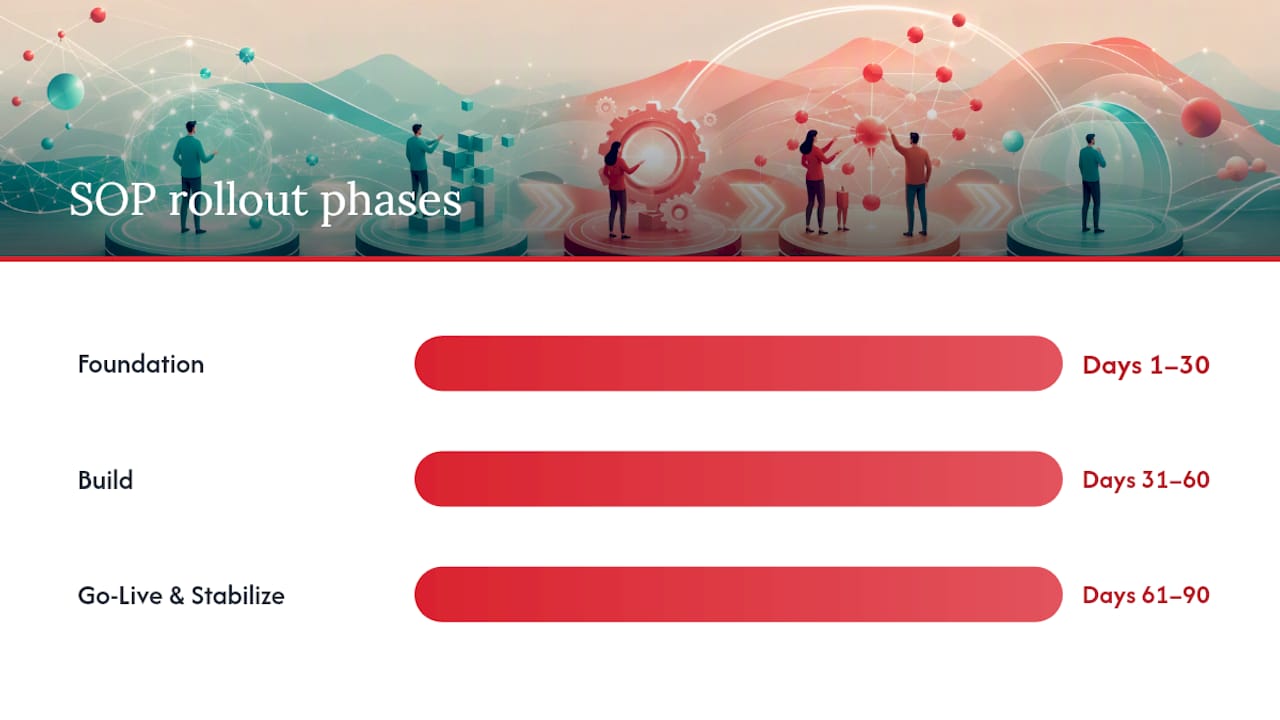
A 90-day rollout is achievable for most operators. The phased plan below assumes you have a licensed platform, a support team (in-house or outsourced), and access to your CRM and back-office systems.
Phase 1: Foundation (Days 1–30)
- Audit current documentation against the master SOP checklist; identify gaps.
- Draft or update the RG policy; route for compliance and legal sign-off.
- Define detection triggers and build the escalation matrix.
- Select or confirm your help desk platform. For platform selection guidance, the best help desk software for iGaming operators comparison covers the key criteria.
- Assign role owners for each SOP area (see role matrix below).
Phase 2: Build (Days 31–60)
- Write all SOPs, scripts, and templates using the master checklist as your guide.
- Configure CRM fields for RG flags, exclusion status, and KYC stage.
- Build the monitoring dashboard with the KPI set defined above.
- Deliver full onboarding training to all agents; record completion.
- Test the self-exclusion workflow end to end; document the test results.
Phase 3: Go-Live and Stabilize (Days 61–90)
- Launch live monitoring; assign weekly reporting owners.
- Conduct first QA review of live contacts against the scoring rubric.
- Run the first escalation drill; log results.
- Deliver first monthly RG report to compliance.
- Schedule 6-month refresher training and policy review dates.
Role matrix:
| Role | Primary responsibilities | SOP ownership |
|---|---|---|
| Head of Compliance | Policy sign-off, regulatory reporting, audit liaison | RG policy, incident response |
| Support Ops Manager | Day-to-day SOP execution, QA, SLA monitoring | Escalation matrix, monitoring SOP |
| RG Specialist | Flag review, intervention contacts, specialist escalations | Detection rules, outreach scripts |
| Payments / KYC Team | Verification, withdrawal processing, AML coordination | KYC SOP, payment SOP |
| Product / Tech | Tool configuration, CRM fields, system integrations | Player tools, system SOPs |
| External BPO | Agent execution, multilingual coverage, 24/7 availability | Agent scripts, training records |
Minimum tech stack:
- Help desk platform with tagging, routing, and SLA tracking (Zendesk, Freshdesk, or equivalent)
- CRM with RG flag fields, exclusion status, and KYC stage tracking
- Behavioral monitoring tool or BI layer connected to player activity data
- Marketing suppression integration between CRM and campaign platform
- LMS for training delivery and record-keeping
For operators evaluating whether to scale support without large hiring programs, the outsourced model cuts the Phase 1 and Phase 2 timeline significantly because the SOP library, training infrastructure, and QA framework already exist.
How automation and hybrid workflows help you scale without losing control
The case for hybrid AI and human workflows in iGaming support is not theoretical. According to the Comm100 iGaming support survey, 51.8% of operators still use manual review as their primary detection mechanism, and 75% rely on supervisor review as a key escalation step. Those are scaling bottlenecks, not safety features.
Automation handles volume. Human specialists handle judgment. The split is not arbitrary; it follows the risk level of the task.
Where automation adds value:
- Balance and transaction inquiries
- Password resets and account access issues
- Basic KYC document guidance and status updates
- Bonus eligibility checks
- Reality check prompt delivery
- Initial behavioral flag generation from player activity data
Where human judgment is non-negotiable:
- RG intervention contacts
- Self-exclusion processing
- Enhanced KYC and AML reviews
- VIP player contacts (the top players by lifetime value need a named host with a 360-degree account view before the conversation starts, not a queue)
- Disputed withdrawal resolution
- Critical escalations involving player-stated financial or personal harm
Recommended hybrid routing logic:
- AI layer monitors player activity in real time and generates behavioral flags.
- Low-severity flags trigger automated in-session prompts (reality checks, limit reminders).
- Medium and high-severity flags auto-route to the RG specialist queue with the player’s flag history attached.
- Critical flags (distress language detected in live chat) trigger immediate supervisor notification alongside the specialist routing.
- All AI-generated flags are reviewed by a human specialist within the timeframes defined in the escalation matrix.
For a detailed breakdown of AI integration in iGaming customer support, the implementation considerations around data residency are particularly relevant: many U.S. states require that player data be processed and stored within specific geographic boundaries, so verify that any AI or SaaS tool in your stack meets your state license’s data residency requirements before deployment.
Pro Tip: Do not use AI sentiment detection as a standalone trigger for self-exclusion offers. Use it as a routing signal that gets a human specialist in front of the player within minutes. The intervention itself must be human-led to be effective and defensible.
Why outsourced support teams often implement these standards faster
The operators who get their SOP programs live fastest are usually not the ones building from scratch in-house. They are the ones who plug into a team that already has the policy templates, training infrastructure, QA rubrics, and escalation workflows built and tested.
Building an in-house RG-compliant support operation from zero typically takes four to six months: policy drafting, compliance sign-off, platform configuration, agent hiring, training delivery, and QA calibration all run sequentially. An outsourced team with an existing iGaming SOP library can compress that to four to six weeks because the foundational work is already done. The operator’s role shifts from building to configuring and approving.
The outcomes that improve fastest with a well-implemented SOP program are first response time, KYC completion rates, and self-exclusion processing speed. Those three metrics have a direct line to player trust and regulatory standing. Monitoring cadence and tool adoption rates take longer to move because they depend on player behavior change, not just operational execution.
The link between SOP quality and player lifetime value is direct. Operators with documented, auditable procedures have fewer regulatory interventions, lower churn at verification touchpoints, and higher player satisfaction scores. The SOP is not overhead; it is a revenue protection mechanism.
Workanova delivers SOP-ready iGaming support from day one
Operators who need their player support program live and compliant without building an internal department from scratch get a concrete advantage with Workanova. Since 2014, Workanova has delivered 24/7 multilingual iGaming player support in 14+ languages, with RG-trained agents, KYC and payments handling, VIP named-host coverage, and QA governance built into every engagement.
The SOP library, escalation matrix, training program, and QA rubric described in this playbook are already operational in Workanova’s delivery model. Operators get a dedicated team live in weeks, not months, with SLA-backed performance from the first contact. For teams evaluating how to scale player support without a large hiring program, Workanova’s managed service model means you add capacity through jackpot drops and traffic peaks without the fixed overhead of a full in-house department. Contact Workanova to discuss your support requirements and get a dedicated team scoped for your operation.
Sources
The following references underpin the standards and benchmarks in this playbook. Each is worth consulting directly when building or auditing your program.
- eGAP Requirements (eCOGRA)
- Standards & Criteria for iGaming Accreditation
- The State of Customer Support in iGaming – A Survey Report
- Skylanc

