

iGaming Customer Support Outsourcing: The Operator’s Guide
August 14, 2026The right answer to covering a jackpot-drop traffic spike is a dedicated, surge-ready outsourced player-support team with pre-agreed activation protocols, event-specific bot scripts, and documented responsible-gambling escalation paths already in place before the event goes live. Poor support during peak events drives measurable churn and lost revenue, while operators with best-in-class coverage see direct gains in player lifetime value and retention.
Your three immediate steps:
- Activate your surge roster at least 48 hours before the jackpot drop, confirming agent headcount, shift overlaps, and VIP routing rules with your outsourced partner.
- Pre-load event-specific bot scripts to handle balance checks, withdrawal status, and bonus queries automatically, freeing trained agents for payments, KYC, and responsible-gambling interventions.
- Confirm RG escalation paths in writing, including documentation standards and the named incident commander who owns live-event triage.
If you need a team live in weeks rather than months, Workanova’s iGaming player-support service is built for exactly this scenario.
Key Takeaways
Outsourced, surge-ready player support with pre-agreed activation protocols, documented RG workflows, and strict SLAs is the only reliable way to protect SLA performance and player retention during jackpot-drop events.
| Point | Details |
|---|---|
| Surge volume is severe | Jackpot drops can multiply support contact volume by 5–10x within minutes of going live. |
| Automation reduces pressure | Configure bots as elastic capacity for transactional queries; route RG, payments, and VIP contacts to trained humans. |
| Pre-event planning is mandatory | Lock surge rosters, bot scripts, and escalation trees at least 48 hours before the event, not on the day. |
| Compliance is non-negotiable | Require SOC 2, PCI DSS signals, and documented RG intervention workflows in every vendor RFP. |
| Workanova delivers fast | Workanova stands up dedicated, RG-trained, multilingual iGaming support teams in weeks, with strict SLAs and post-event RCA included. |
Table of Contents
- Why in-house support fails during a jackpot drop
- What a qualified outsourced partner must deliver for jackpot-drop coverage
- Which operational models actually absorb spike volume?
- How to evaluate a player-support partner for jackpot events
- Your 7–30 day pre-event playbook
- Why Workanova is a practical option for jackpot-drop coverage
- What operators consistently get wrong about event-day support
- Workanova gets your team live before the next jackpot drop
- Sources
Why in-house support fails during a jackpot drop
Event-driven volume during major promotions can multiply support requests by roughly 5–10x, and that spike can arrive within minutes of a jackpot drop going live. In-house teams and generic contact centers are not built for that curve.
The failure modes are predictable:
- Scale mismatch. A team sized for baseline volume hits queue saturation almost immediately. Chat response times blow past SLA thresholds within the first hour.
- Slow activation. Hiring and onboarding even five additional agents takes weeks. By the time they’re trained, the event is over.
- Limited RG expertise. Jackpot events attract high-frequency play. Agents without documented responsible-gambling training cannot identify at-risk behavior or apply operator RG policies to licensing standards.
- Fractured tech stacks. When agents work across multiple consoles without a unified routing layer, VIP contacts get misrouted and payment disputes stall.
The ticket types that flood in during a jackpot drop are specific and often time-critical:
- Payment disputes and withdrawal delays
- KYC friction and identity verification holds
- Bonus and promotion eligibility queries
- Responsible-gambling intervention requests
- Technical troubleshooting (login failures, session drops)
Each of those categories requires a different skill set and a different escalation path. A generic contact center handles none of them well under surge conditions.
What a qualified outsourced partner must deliver for jackpot-drop coverage
Procurement conversations for jackpot support services need to go beyond headcount. These are the capabilities that separate a compliant, surge-ready partner from a vendor who will cost you VIPs and regulatory exposure.
24/7 multilingual live coverage. Players expect round-the-clock availability and fast, personalized responses. For US-regulated operators, that means native-level English across all shifts, with VIP contacts routed to senior agents, not the general queue. Multilingual coverage becomes a compliance requirement in markets with specific language mandates.
Documented RG intervention workflows. Responsible-gambling protocols must be embedded in agent workflows, not treated as an afterthought. Agents need to identify at-risk behavior, apply your RG policies, and document every interaction to the standard your license requires.
Payments and KYC handling. Secure escalation paths for payment disputes and identity verification holds, operated within PCI DSS-aware and SOC 2-aligned processes, are non-negotiable. A partner without documented KYC escalation is a compliance liability.
Workforce management and surge activation SLAs. Pre-planned surge staffing, predictive scheduling, and activation timelines measured in hours, not weeks, are the technical backbone of event coverage.
Tech integration. A single agent console with CRM and OMS access, proper routing logic, and clear bot-to-human escalation rules keeps agents efficient and prevents contact duplication.
QA governance. Scorecards, QA sampling, and post-event root-cause analysis (RCA) give you the data to improve after every drop.
Which operational models actually absorb spike volume?
Three models are in common use for jackpot support services, and each carries real trade-offs for US-regulated operators.
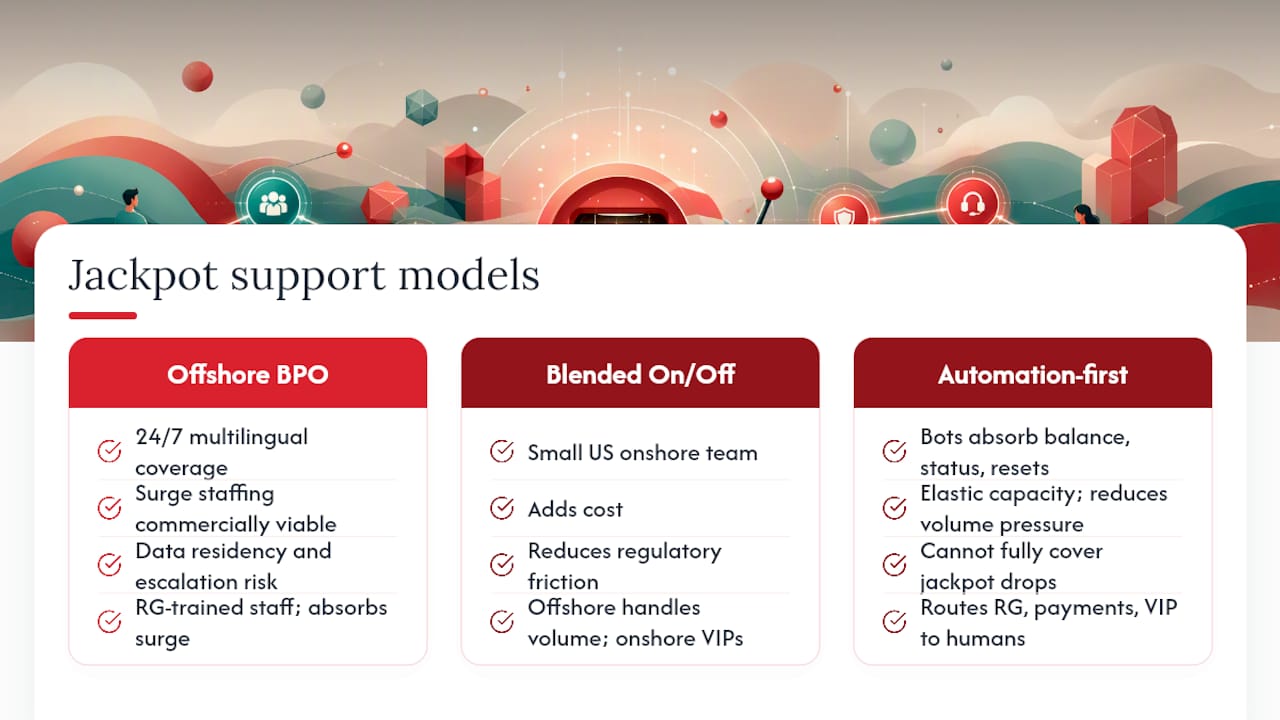
Dedicated offshore BPO teams are the most common choice for operators running frequent jackpot drops. Offshore BPOs with pre-agreed surge protocols provide 24/7 multilingual coverage and RG-trained staff at a cost structure that makes surge staffing commercially viable. The watch-points: data residency requirements under state-level US gaming regulations, escalation latency if the offshore team lacks a direct line to your compliance officer, and accent or quality variance if the partner hasn’t invested in English-language QA.

Blended onshore-offshore models place a small onshore team in the US time zone for VIP and compliance-sensitive contacts, with offshore agents handling volume. This adds cost but reduces regulatory friction for operators in states with strict data-handling requirements.
Automation-first models use AI chatbots and routing as the first layer. Automation works best as elastic capacity during surges: bots absorb balance checks, withdrawal status queries, and password resets, then route RG, payments, and VIP issues to trained humans. Automation alone cannot cover a jackpot drop. It reduces volume pressure, but every complex or sensitive contact still needs a person.
Pro Tip: Map your jackpot-drop calendar to your partner’s shift schedule at least 30 days out. A 2:00 AM EST drop that lands in a shift changeover window is where SLA breaches happen. Lock the shift overlap in writing.
Pro Tip: Configure your bot scripts with event-specific intents before each drop. A generic “withdrawal status” script that doesn’t reference the jackpot promotion will frustrate players and generate unnecessary escalations.
How to evaluate a player-support partner for jackpot events
Use this checklist in your RFP and vendor conversations.
Questions to ask:
- How many agents can you activate within 4 hours of a surge trigger, and what is the contractual activation SLA?
- What is your surge pricing model, and are surge fees capped or variable?
- Can you demonstrate documented RG training and intervention workflows aligned to US state licensing requirements?
- What security certifications does your operation hold (SOC 2 Type II, PCI DSS, ISO 27001)?
- How do you integrate with our CRM and payment provider, and what is the typical integration timeline?
- What QA governance do you apply during live events, and how quickly can you produce a post-event RCA?
Red flags to walk away from:
- No documented RG training or intervention workflows
- No SOC 2, PCI DSS, or ISO 27001 signals in their security posture
- Surge activation measured in days, not hours
- No dedicated escalation path for payments and KYC disputes
- QA described as “periodic” rather than continuous with scorecards
Scoring weights for your evaluation:
- Compliance and RG readiness: 30%
- Speed-to-scale and surge activation SLA: 25%
- Technical integration fit: 20%
- QA governance and post-event RCA: 15%
- Commercial model and cost predictability: 10%
Your 7–30 day pre-event playbook
30 days out: Confirm your jackpot-drop date with your outsourced partner and lock the surge staffing plan. Validate that bot scripts are current and that your CRM routing rules reflect the event’s promotion structure.
14 days out: Run a full agent briefing covering the promotion mechanics, expected ticket types, RG triggers specific to jackpot events, and VIP contact protocols. Live chat staffing should be confirmed as the primary channel for time-sensitive contacts.
7 days out: Upload event-specific bot scripts. Test bot-to-human escalation end-to-end. Confirm the incident commander and the escalation tree for payments, KYC holds, and RG interventions.
48 hours out: Activate the surge roster. Verify shift overlaps cover the full event window plus a 4-hour buffer on each side. Confirm VIP contact mapping is current.
Event day (0 hour): Assign a single incident commander with authority to trigger additional capacity. Stand up the war room with live monitoring of queue depth, AHT, and FCR. Keep the RG escalation path open and staffed.
Post-event: Capture all QA samples within 24 hours. Run the RCA within 72 hours. Deliver a written post-event report to your compliance and operations leads covering SLA performance, RG interventions, and any payment disputes that required escalation.
Why Workanova is a practical option for jackpot-drop coverage
Workanova has delivered outsourced player support for licensed iGaming operators since 2014, covering 24/7 multilingual live chat, email, VIP and retention support, KYC and payments handling, and QA across 14+ languages.
For jackpot-drop coverage specifically:
- Surge-ready dedicated teams with pre-agreed activation protocols, not shared pools that deprioritize your traffic when another client spikes.
- RG-trained agents with documented intervention workflows aligned to operator policies and US licensing expectations.
- KYC and payments handling within SOC 2-aware and PCI DSS-aligned processes, with secure escalation paths for disputes and fraud flags.
- Tech integration into your existing CRM, OMS, and routing layer, reducing go-live friction.
- Strict SLAs covering response times, FCR targets, and escalation timelines, with QA scorecards and post-event RCA as standard.
Experienced partners compress onboarding to a 2–3 week window when they already integrate with common gaming platforms. Workanova’s setup timeline reflects that standard. You can scale player support without a large in-house hiring cycle and have a compliant, trained team live before your next jackpot drop.
What operators consistently get wrong about event-day support
The most common mistake is treating surge staffing as a headcount problem when it’s actually a coordination problem. Operators who pre-brief agents, lock escalation trees, and test bot scripts before the event runs smoother than those who simply add bodies to the queue. Volume is manageable. Confusion about who owns a payment dispute at 3:00 AM is not.
The second mistake is underestimating how much RG exposure concentrates during jackpot events. High-frequency play, large wins, and emotional player states create a cluster of at-risk interactions in a short window. Agents who aren’t specifically briefed on jackpot-event RG triggers will miss them.
Pro Tip: Assign one agent per shift as a dedicated RG monitor during jackpot drops. Their only job is to flag and document at-risk interactions in real time. It costs you one agent’s capacity and protects your license.
Workanova gets your team live before the next jackpot drop
Operators who wait until a jackpot drop is announced to think about support coverage are already behind. Workanova delivers dedicated, surge-ready iGaming player-support teams with 24/7 multilingual coverage, RG-trained agents, and KYC and payments handling, all under strict SLAs. Setup takes weeks, not months.
If your next jackpot event is within 30 days, the time to act is now. Contact Workanova to request a rapid stand-up assessment and get a compliant, trained team in place before your next drop. Get your team live in weeks and stop leaving player retention to chance.
Sources
- 10 iGaming Customer Support Challenges (And How to Solve Them) | Comm100
- iGaming Customer Support in 2026: Why It’s Your Most Underrated Growth Lever | MarketMyTarget
- How online casinos can optimize customer support to increase player value and loyalty | TechTrendery

