

Scaling iGaming Player Support Without Adding Risk
August 27, 2026An SLA penalty is almost never a cash payment. It is a service credit, usually 5–25% of the affected monthly fee, applied to a future invoice when a vendor misses a defined performance target. Loan “penalties” work differently: they are prepayment or late-payment fees written into a credit agreement. Before signing either document, check three things first: how the metric is measured, how the credit or fee is calculated, and whether a liability cap or an earn-back clause limits what you can actually recover.
TL;DR:
- Service credits are usually limited to 5-25% of the affected module’s fee, often undercompensating for actual business losses during outages.
- Many contracts cap the total credit liability at one year’s fees, requiring careful negotiation of caps tied to the affected service line and clear audit rights.
- Earn-back clauses can recover or claw back credit value over multiple months, reducing the net benefit of SLA breaches.
- When disputing breaches or claiming credits, evidence collection, precise calculations, and access to raw data are essential for success.
- Loan penalties for early repayments or missed payments are governed by jurisdiction-specific statutory caps, and proactive communication can prevent defaults.
Table of Contents
- What SLA credits and penalties actually mean in practice
- How SLA credits are calculated and where the math breaks down
- Contract language that controls what you can actually recover
- Loan penalties: prepayment fees, late charges, and legal limits
- A practical checklist for claiming, disputing, and negotiating
- Applying SLA discipline to iGaming player support contracts
- Negotiate for enforceability, not just favorable numbers
- Get SLA-ready player support without building the team yourself
- Sources
What SLA credits and penalties actually mean in practice
Every service level agreement rests on three building blocks: the service level indicator (SLI), the target (SLO), and the contract clause that ties a breach to a remedy (the SLA itself). An SLI might be “chat response time under 60 seconds.” The SLO sets the target, say 98% of chats meeting that mark in a month. The SLA is the document that says what happens when the provider falls short.
What happens is almost always a service credit, not a refund check. A service level agreement applies a percentage of the affected service’s fee back to the customer’s account, and that distinction matters more than most buyers realize. A refund returns money already paid; a credit only reduces what you owe next month, which is worthless if you are about to terminate the contract anyway.
Picture a support platform that guarantees 99.5% uptime on its ticketing module and delivers 98.9% instead. The SLA might specify a 10% credit on that module’s fee for the month, not on the entire contract value. That module could represent a fraction of total spend, so the credit lands far smaller than the outage felt.
Two things determine whether that credit is even collectible:
- The measurement window the SLA defines (monthly, quarterly, or rolling)
- Whether the customer has access to the raw performance data behind the vendor’s own reports
Reported industry range: Service credits typically run between 5% and 25% of the monthly fee for the affected service, scaled to the severity of the breach.
How SLA credits are calculated and where the math breaks down
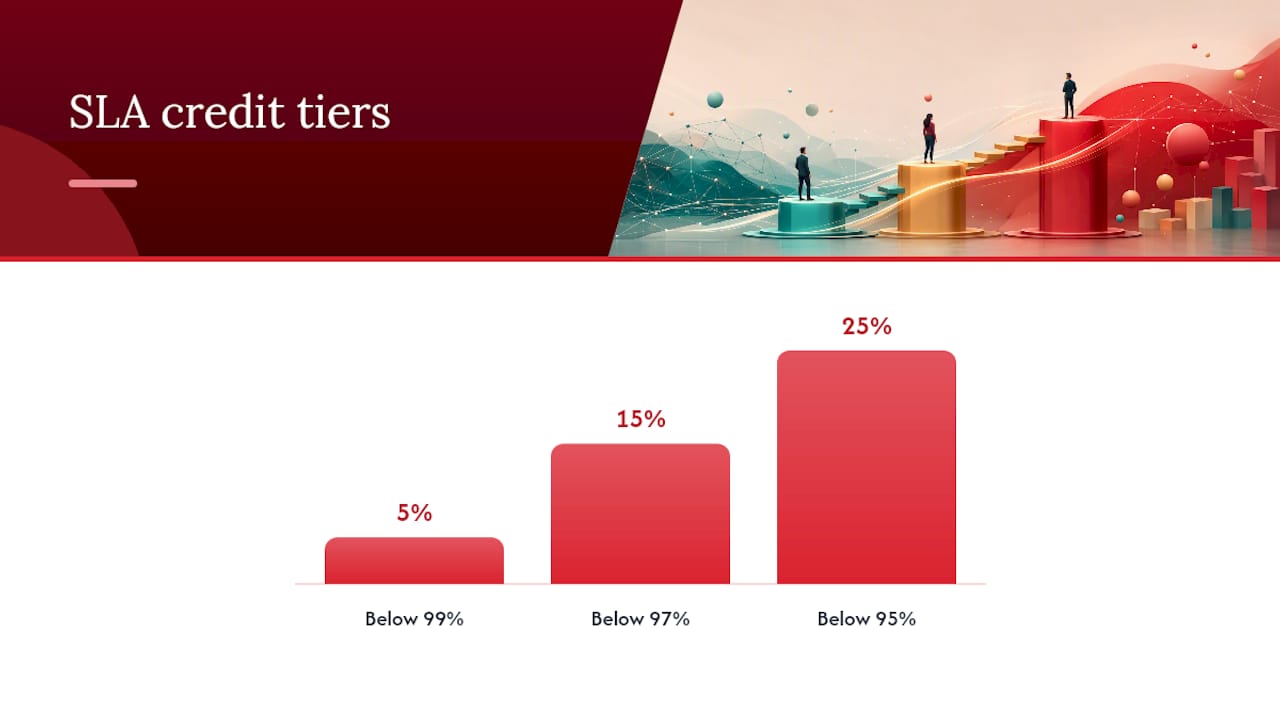
Most SLA credit schedules are tiered. A missed target below 99% might trigger a 5% credit; drop below 97% and it climbs to 15%; below 95%, some contracts cap it at 25%. The schedule looks fair on paper, but three mechanics change what a customer actually recovers.
First, credits are almost always prorated to the failing module’s fee, not total contract value. The credit applies to that line’s slice of the invoice, which explains why so many customers feel shortchanged even after “winning” a claim.
Second, service credits often undercompensate real business loss because they are capped by design. A four-hour outage during a jackpot promotion can cost far more in lost transactions and reputational damage than any contractually available credit will ever cover.
Third, earn-back clauses quietly claw back value. A vendor that performs well for three consecutive months after a breach may be entitled to reverse or forfeit a portion of the credit it owes, under some contract structures.
- Tiered schedules typically scale credit percentage to breach severity
- Credits apply to the affected module’s fee, not the full invoice
- Earn-back clauses can reduce or eliminate the credit’s real value over time
Pro Tip: Ask the vendor for a worked example using your actual invoice numbers before signing. If they can’t produce one in five minutes, the schedule is probably vaguer than it looks on the page.
Contract language that controls what you can actually recover
Reading the credit percentages tells you half the story. The other half lives in the clauses that cap, delay, or reverse what those percentages are worth.
Liability caps are the most consequential. Many vendor contracts limit total exposure to one times annual fees, meaning no matter how many breaches occur in a year, the vendor’s total credit liability cannot exceed what you paid them over twelve months. That sounds generous until you calculate how many separate breaches it would take to hit that ceiling.
Four provisions deserve close attention during negotiation:
- Liability caps. Push for a cap tied to the affected service line rather than a blanket annual limit, or negotiate a higher multiple for mission-critical services.
- Earn-back windows. Insist on a floor, meaning a minimum credit that survives regardless of subsequent performance, and a maximum lookback period the vendor can claw against.
- Chronic-failure triggers. Define a threshold, such as three consecutive months below SLO or a cumulative breach count within a quarter, that unlocks termination rights rather than just another credit.
- Audit and data access. Require the right to pull raw logs and monitoring data, not just the vendor’s summarized monthly report.
That last point is where most disputes actually get won or lost. Buyers who rely solely on vendor-curated reports frequently find they have no independent way to verify a breach occurred, let alone its severity.
Pro Tip: Negotiate audit rights into the contract before you need them. Once a dispute is underway, a vendor has little incentive to hand over anything beyond what the SLA explicitly requires.
Loan penalties: prepayment fees, late charges, and legal limits
The word “penali” shifts meaning entirely once you move from vendor contracts to lending. Here it refers to fees a bank charges when a borrower pays off a loan early or misses a scheduled payment, and those terms live inside the credit agreement itself, the legally binding document that records interest rates, repayment schedules, and every fee clause tied to the loan.
Prepayment penalties and late-payment penalties are distinct charges that borrowers routinely confuse:
- Prepayment penalties apply when a borrower repays part or all of a loan ahead of schedule, calculated as a percentage of the remaining principal or a fixed number of monthly payments.
- Late-payment penalties apply when a scheduled payment is missed, usually a flat fee or a percentage of the overdue amount plus accrued interest.
- Statutory caps in some jurisdictions limit how much a lender can charge for either type of fee, though the limits and windows vary considerably by country and by loan type.
A real-world tariff illustrates the range: one bank’s published fee schedule sets prepayment charges at 0.5% or 1.0% of the remaining principal, depending on the repayment window. Rules like these are jurisdiction-specific, so borrowers outside that market should check their own bank’s tariff sheet and local consumer-protection rules rather than assume the same percentages apply.
If repayment is becoming difficult, contact the lender before missing a payment. Many lenders will renegotiate payment dates or terms rather than let an account default, which almost always costs the borrower more than a renegotiated schedule would.

A practical checklist for claiming, disputing, and negotiating
Whether you are chasing an SLA credit or trying to avoid a prepayment penalty, the process runs on documentation. Vague complaints get vague responses; timestamped logs get results.
- Collect the evidence. Pull raw logs, timestamps, and monitoring data that map directly to the SLI defined in the contract.
- Calculate the credit using the contract’s own formula, not a rough estimate, and show your math when you submit the claim.
- Request the vendor’s internal reports and compare them against your own data before accepting their number.
- Escalate formally with a written claim citing the specific clause, breach period, and calculated amount owed.
- For loans, request a payoff statement and a full fee breakdown in writing before making any prepayment.
Pro Tip: Loop in procurement or legal before you accept the first credit figure a vendor offers. The initial number is rarely the ceiling of what the contract actually allows.
Negotiation leverage often comes from what you are willing to trade. Offering a longer contract term in exchange for a better credit schedule, or agreeing to a narrower earn-back window, tends to move vendors further than a hard-line demand for a bigger cap.
Applying SLA discipline to iGaming player support contracts
Workanova has run SLA-backed, 24/7 multilingual player support for licensed operators since 2014, and the checklist items above translate directly into player-support contract language. Response-time SLIs, resolution-rate targets, KYC-accuracy thresholds, and payout-handling turnaround all need the same rigor as any enterprise SLA.

Operators drafting these clauses should define “affected service” precisely: a KYC delay and a live-chat response miss are different failure modes and should carry separate measurement windows and credit calculations. Contract language should specify who owns the raw ticketing and chat-transcript data, since that data becomes the evidence base for any dispute.
Workanova’s operator SLA checklist walks through exactly these measurement and reporting items, built from years of operating inside licensed operators’ own SLA frameworks.
Negotiate for enforceability, not just favorable numbers
The mistake I see most often is treating SLA negotiation as a numbers exercise: chase the highest credit percentage, the biggest cap, the longest earn-back protection. None of that matters if the metric underneath is poorly defined or unmeasurable in practice.
Prioritize a clean SLI over an impressive credit percentage every time. Reserve termination rights for chronic failure rather than accepting credits indefinitely. Some vendor relationships are worth preserving through a rough quarter; others are not, and the contract should make that distinction possible without a legal fight.
SLA remedies were never designed to make you whole after a serious outage. Build business continuity planning and, where the stakes justify it, insurance around the gaps the contract leaves open.
— Miroslav
Get SLA-ready player support without building the team yourself
Workanova gives operators SLA-backed player support already structured around the exact checklist items covered here: defined SLIs for response time and resolution, KYC and payments handling with accuracy targets, and language QA that feeds directly into your reporting obligations.
That structure matters most when a breach dispute happens, because the evidence trail (timestamped logs, monthly reporting, resolution data) already exists rather than getting reconstructed after the fact. Workanova gets a dedicated, trained team live in weeks, so operators scale through traffic spikes and jackpot drops without hiring ten times the agents just to hit SLA targets during peak load. If your current support setup can’t produce the data an SLA dispute requires, see how Workanova’s player support model for game studios handles the measurement and reporting side from day one, and request a walkthrough of how a dedicated team could be live for your operation within weeks.
Sources
- What is a service level agreement (SLA)? — Flexential
- What is a credit agreement? — Experian
- Vendor service-level agreement metrics, credits, penalties — Legal Clarity
- Obavijest o promjenama Odluke o tarifi naknada — Slatinska banka (tariff example)

