

Medallia vs Qualtrics for iGaming Multilingual Support
July 24, 2026
WhatsApp Customer Support Policy for US iGaming Operators
July 27, 2026What is a knowledge transfer plan and why does it matter in outsourced player support?
A knowledge transfer plan is a structured document that captures and hands over critical role-specific knowledge before a personnel transition, so operations continue without disruption. In outsourced player support for licensed online casinos and sportsbooks, that definition carries real weight.
When an agent, team lead, or compliance specialist exits, they take with them more than a job description. They carry escalation judgment, VIP player context, payment dispute history, and the unwritten rules of your specific regulatory setup. Without a formal plan to transfer that knowledge, your outsourced team is left guessing, your SLAs slip, and players notice.
Four knowledge types matter most in player support operations:
- Explicit knowledge: Documented SOPs, compliance checklists, KYC procedures, and escalation scripts
- Tacit knowledge: Experiential judgment, tone calibration for high-value players, and dispute resolution instincts
- Relational knowledge: VIP relationships, payment processor contacts, and affiliate partner context
- Process knowledge: Workflow sequences, system access logic, and ticket routing rules
The stakes in iGaming are higher than in most verticals. Regulatory requirements in licensed US markets demand consistent, documented processes. A gap in knowledge continuity is not just an operational inconvenience; it can trigger compliance failures, player churn, and SLA breaches that cost real money.
Table of Contents
- Core components every knowledge transfer plan needs for iGaming support
- When to start and how to measure whether your knowledge transfer actually worked
- Leadership and culture determine whether your KT plan succeeds or stalls
- How Workanova handles knowledge transfer in outsourced iGaming player support
- Your knowledge transfer checklist: steps to build and sustain the plan
- Key Takeaways
Core components every knowledge transfer plan needs for iGaming support
A well-structured KT plan includes six components that work together. Miss one and the transfer is incomplete.
- Knowledge inventory: Categorize all knowledge by type (explicit, tacit, relational, procedural) and by risk level. In player support, compliance-related tasks, access credentials, and unresolved escalations sit at the top of the risk register.
- Transfer schedule: Map each knowledge item to a specific date and method. A typical transition allocates initial time to documentation, followed by walkthroughs, shadowing, and live practice.
- Knowledge owners and recipients: Assign a named owner for every knowledge item and a named recipient who will validate comprehension. Ambiguity here is where most transfers fail.
- Transfer methods matched to knowledge type: Explicit knowledge transfers well through written SOPs and recorded walkthroughs. Tacit knowledge requires shadowing, mentoring, and live case observation. Relational knowledge needs warm introductions, not just a contact list.
- Validation criteria: Define what “complete” looks like before the transfer starts. Can the recipient handle a live escalation independently? Can they navigate the payment dispute workflow without prompting?
- Contingency planning: Build a fallback for urgent or incomplete transfers. Identify interim owners, document known gaps, and schedule a 30-day follow-up review.
For outsourced player support specifically, the plan must also integrate with your Learning Management System or internal knowledge base. Workanova embeds this step into every client onboarding, so transferred knowledge is searchable and accessible to the full support team, not just the named recipient.
When to start and how to measure whether your knowledge transfer actually worked

Start as early as possible within the notice period, ideally within the first one to two days of a transition decision. For planned departures or role rotations, starting early provides sufficient time. Senior roles with complex stakeholder relationships benefit from a longer transition period.
Prioritize using an impact matrix. Rank each knowledge area by two factors: how frequently it is used and how difficult it would be to reconstruct if lost. In player support, critical knowledge areas include customer-impacting tasks, compliance procedures, vendor and partner relationships, access credentials, and unresolved issues requiring specific expertise. Transfer those first.
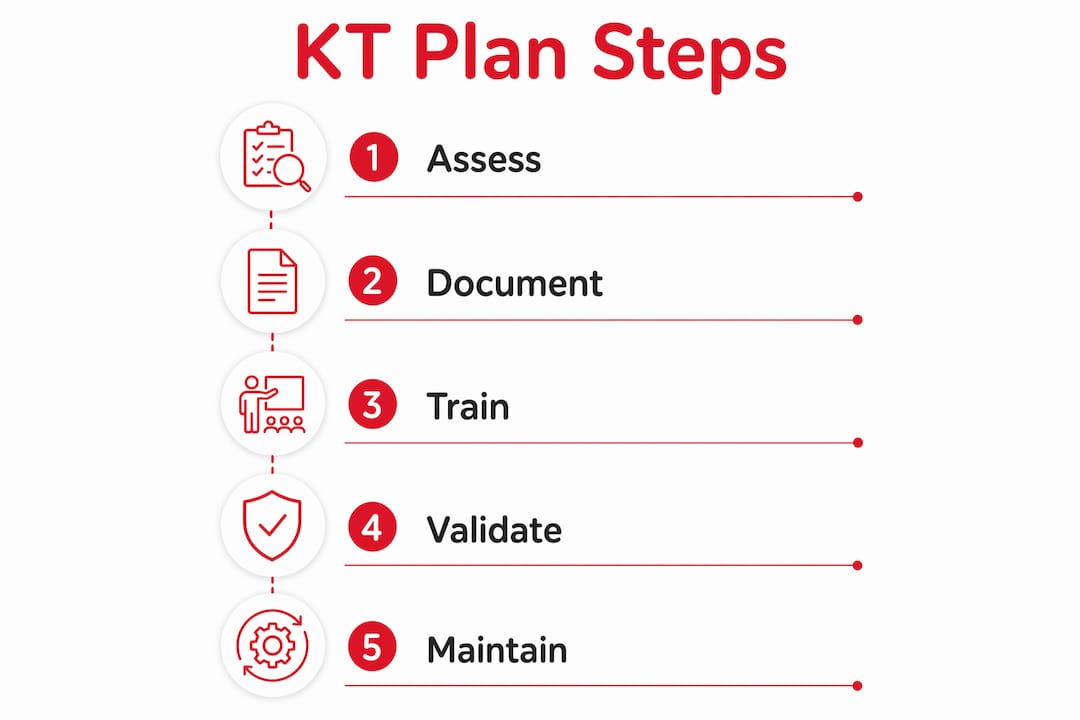
Measurable targets outperform vague intentions. Rather than “improve knowledge sharing,” set a concrete goal: reduce repeated manager queries on a specific workflow within a defined timeframe, or confirm the recipient can handle a live payment dispute without escalation by day ten. Measurable goals tied to business outcomes are what separate effective KT programs from checkbox exercises.
Validation must confirm independent performance, not just document receipt. Effective validation techniques include practical demonstrations, independent task execution under observation, and manager sign-off. Schedule a structured check-in shortly after transfer to surface gaps before they become operational problems. A folder full of files does not prove continuity.
Pro Tip: Have the incoming agent or team lead execute high-risk tasks independently while the outgoing person is still available. The gaps that surface during those tests are the real knowledge transfer.
Leadership and culture determine whether your KT plan succeeds or stalls
Documentation is the easy part. The harder challenge is organizational. Deloitte’s research identifies leadership commitment, including active C-suite sponsorship, as the critical factor in overcoming cultural barriers to knowledge sharing.
Knowledge hoarding is a rational behavior in many support organizations. Agents and team leads who believe their job security depends on being the only person who knows something will resist transferring that knowledge, even when asked directly. Deloitte’s analysis links this behavior to job insecurity and recommends addressing it through aligned incentives: tie knowledge sharing behaviors to performance reviews, recognition programs, and team-level KPIs.
There is also a structural distinction worth making. Tactical knowledge sharing focuses on access: making information available. Strategic knowledge management focuses on accountability: ensuring knowledge is accurate, current, and owned. Assigning a named owner to each knowledge asset, with responsibility for its lifecycle and accuracy, is what turns a one-time transfer into a sustainable program.
For iGaming operators managing outsourced teams, this means building KT expectations into your vendor SLA and your internal performance framework simultaneously. Your outsourced partner should be accountable for knowledge capture and validation on their side; your internal team should be accountable for providing access, context, and sign-off.
How Workanova handles knowledge transfer in outsourced iGaming player support
Workanova has delivered outsourced player support for licensed online casinos and sportsbooks since 2014, operating 24/7 across 14+ languages with strict SLA governance. Knowledge transfer is not a post-onboarding afterthought in that model. It is built into the deployment process from day one.
When a licensed operator brings Workanova in to replace or augment an in-house support team, the transition follows a structured KT methodology:
- Knowledge capture: Workanova works with the operator’s internal team to document explicit processes, map tacit knowledge through recorded walkthroughs, and identify relational context for VIP and high-value player segments.
- Validation checkpoints: Before the dedicated team goes live, agents demonstrate independent competence on the operator’s highest-risk workflows, including KYC handling, payment dispute escalation, and compliance-sensitive interactions.
- Compliance integration: For licensed US operators, KT documentation is aligned with regulatory requirements from the outset. SOPs are written to meet the operator’s specific licensing conditions, not generic templates.
- Tech stack integration: Workanova embeds transferred knowledge directly into the operator’s existing CRM, ticketing system, or knowledge base, so the support team can access it in real time during live interactions.
Operators can scale player support through jackpot drops and traffic peaks without rebuilding institutional knowledge from scratch each time. That is the operational value of treating knowledge transfer as a managed process rather than an offboarding task.
If your current outsourced support setup lacks a formal knowledge transfer framework, Workanova can build one with you. The goal is a dedicated, trained team that operates with the same institutional knowledge your best internal agents carry, available 24/7 from week one.
Your knowledge transfer checklist: steps to build and sustain the plan
A knowledge transfer plan only delivers value if it is executed, not just written. Here is the sequence that works for outsourced player support operations:
- Initiate early. Start within the first two days of any transition decision. For planned departures, target a minimum of two to four weeks.
- Build the knowledge inventory. Identify all critical knowledge by type and risk. Compliance tasks, access credentials, and VIP player context go to the top.
- Assign owners and recipients. Every knowledge item needs a named owner and a named recipient. No ambiguity.
- Match transfer methods to knowledge types. Use SOPs for explicit processes, shadowing for tacit judgment, and warm introductions for relational knowledge.
- Set measurable validation criteria. Define independent performance benchmarks before the transfer starts, not after.
- Validate within 7–14 days post-transfer. Confirm the recipient can execute high-risk tasks without prompting. Document gaps and assign follow-up owners.
- Integrate into your LMS or knowledge base. Transferred knowledge must be searchable and accessible to the full team, not siloed with one person.
- Review and update on a defined cycle. Compliance requirements, product changes, and regulatory updates in licensed US markets mean your knowledge base needs a review cadence, not a one-time build.
Avoid the most common pitfall: treating KT as offboarding paperwork. By the time a departing agent has mentally moved on, the window for capturing tacit knowledge has closed. Build the transfer into daily workflows from the start of the engagement, and your outsourced team will carry institutional knowledge that actually holds up under pressure.
Key Takeaways
A knowledge transfer plan protects operational continuity in outsourced iGaming player support by capturing explicit, tacit, relational, and process knowledge before personnel transitions create gaps.
| Point | Details |
|---|---|
| Start immediately | Begin within the first two days of any transition decision; planned departures benefit from two to four weeks minimum. |
| Prioritize by risk | Compliance tasks, access credentials, and VIP player context carry the highest operational risk and transfer first. |
| Match method to knowledge type | Tacit knowledge requires shadowing and mentoring; explicit knowledge transfers through SOPs and recorded walkthroughs. |
| Validate independently | Confirm recipients can execute high-risk tasks without prompting, with manager sign-off within 7–14 days post-transfer. |
| Embed leadership accountability | Link knowledge sharing to performance objectives and assign named owners to every knowledge asset for sustained accuracy. |
Recommended
- Workanova | 24/7 iGaming Player Support Outsourcing
- Workanova | Scale iGaming Support Without 50 New Hires
- Workanova | Outsourced Player Support for iGaming Ops
- Workanova | 24/7 Turkish iGaming Support: Now Mandatory
Write your worst support ticket on our wall — best one wins a free month. Book a meeting

