

KYC Verification Process for US Online Casinos: What Operators Must Know
July 31, 2026For licensed online casino and sportsbook operators, neither Intercom nor Drift is a complete player-support solution out of the box. Intercom is the stronger platform choice if you want in-house control over AI-driven support and can manage per-resolution billing. Drift carries real vendor-stability risk in 2026 and should not be the basis of a new support contract. For operators that need guaranteed 24/7 multilingual human coverage, KYC and payments handling, and SLA-backed QA without building an internal team, a managed outsourcing partner is the lower-risk path.
The three-way decision breaks down like this:
- Choose Intercom if you have in-house technical staff to manage AI QA, prompt engineering, and consumption-based billing, and your primary need is lifecycle messaging plus support deflection.
- Avoid new Drift contracts unless you already have a migration plan. Drift is being wound down post-acquisition, with roadmap freezes and reported renewal price pressure for non-enterprise features.
- Choose Workanova when you need full 24/7 multilingual human-in-the-loop support, strict SLAs, KYC/payments handling, and rapid scale for traffic surges without the overhead of running a chat platform yourself.
Table of Contents
- How Do Intercom and Drift Compare for iGaming Player Support?
- Workanova Gives You a Managed Player-Support Team, Not a Platform to Run
- Key Takeaways
How Do Intercom and Drift Compare for iGaming Player Support?
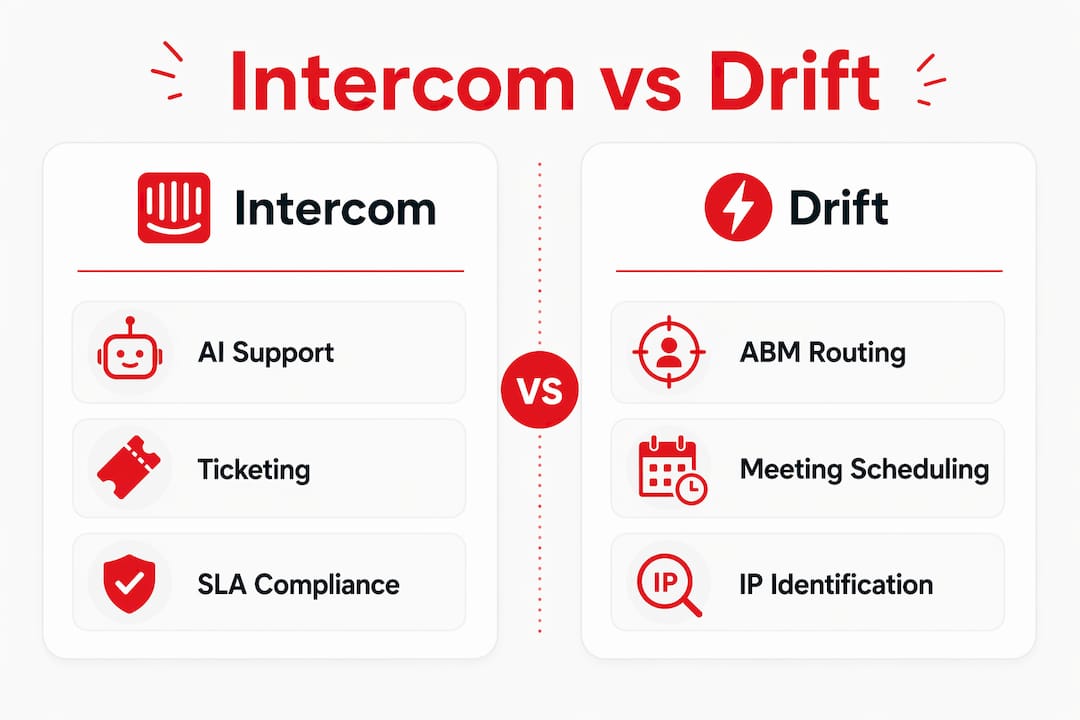
The Intercom vs Drift decision looks different when your job-to-be-done is player support rather than B2B pipeline generation. Here is how the two platforms stack up across the dimensions that matter most to regulated operators.

| Dimension | Workanova | Intercom | Drift |
|---|---|---|---|
| Best for | Operators needing SLA-backed, compliant, human-in-the-loop support | In-house teams wanting platform control and AI deflection | B2B pipeline generation and meeting qualification |
| Support features | Full ticketing, KB, routing, escalation, 2nd-line handoff | Ticketing (added later), KB, inbox, SLA reporting | Chat-to-meeting flows; limited ticketing for complex support |
| AI/chatbot capability | Human-led with AI augmentation and QA governance | Fin AI Agent; multi-turn resolution, KB citation | Bionic Chatbots; AI lead qualification; sales-first design |
| 24/7 human support | Yes, dedicated managed teams | Platform only; you staff it | No managed human layer |
| Multilingual support | 14+ languages, dedicated native agents | Platform supports multiple languages; staffing is your responsibility | Limited; no managed multilingual layer |
| KYC/payments readiness | Integrated into workflows; trained agents | Integration possible; no native KYC workflows | Not designed for KYC or payment disputes |
| Pricing model | Managed-service contract; predictable recurring fee | Seat-based, plus Fin at $0.99 per resolution and Copilot offers 10 conversations free per seat per month, with unlimited usage available at an extra $35 per seat per month | Not publicly listed; custom quote required |
| Deployment timeline | Dedicated team live in weeks | Basic chat live in days; enterprise routing takes longer | Existing customers face playbook migration overhead |
| Vendor stability | Established since 2014 | Actively developed; AI-first roadmap | Sunset risk reported in 2026; migration planning advised |
Intercom’s AI billing deserves a hard look
Intercom’s Fin AI Agent is purpose-built for support resolution, with knowledge-base citation and multi-turn conversation handling. That is genuinely useful for deflecting routine player queries. The cost model, though, requires careful modeling. Fin AI Agent is priced at $0.99 per resolution, with Copilot providing 10 free conversations per seat per month and unlimited usage as a $35 per seat per month add-on. A high-volume operator running thousands of daily chats can see invoices exceed headline seat pricing by a significant margin once AI resolution volume scales. One conversation that triggers multiple procedure steps can still count as a single resolution, so you need to instrument conversation analytics and monitor procedure-trigger events to forecast true monthly spend accurately.
Pro Tip: Before signing an Intercom contract, model three scenarios: current monthly chat volume at 30% AI resolution, 60%, and 90%. Multiply each by $0.99 for Fin usage and add Copilot seat costs according to usage needs. That range is your real budget exposure, not just the seat price on the pricing page.
Intercom also added ticketing capabilities later in its product lifecycle, so SLA reporting and incident workflow depth are worth stress-testing in a demo. Ask specifically for skills-based routing samples and SLA breach escalation logs.
Why Drift does not fit player-support operations
Drift was purpose-built for ABM routing, IP/company identification, and chat-to-meeting flows. Those features serve B2B sales teams well. They do not map to KYC document reviews, payment dispute handling, or bonus investigation workflows. Beyond the feature mismatch, the strategic risk is real: analyst write-ups in 2026 report Drift being steered toward a successor product, with non-enterprise roadmap features frozen. Signing a multi-year Drift contract now means absorbing both a feature gap and a migration event.
Risks every operator must mitigate
Running any AI chat layer without human oversight creates compliance exposure. AI responses can diverge from brand or regulatory expectations, a failure mode sometimes called “support drift.” For KYC verification, payment disputes, and VIP interactions, AI should augment human agents, not replace them. Any vendor contract or managed-service SOW should include QA SLAs, sample audits, and rollback controls. When scaling for concurrent peaks like a World Cup surge, test platform concurrency, message latency, and AI tokenization limits under simulated load before go-live. For broader AI governance best practices, the principles around prompt engineering and output monitoring apply directly to regulated player-support contexts.
Vendor questions to ask in every demo
- What are your SLA metrics for first-response and resolution time, and how are breaches reported?
- Can you show a live KYC or payment-dispute escalation flow?
- What QA controls govern AI outputs, and how quickly can a response be rolled back?
- What are your data residency options, and do you hold SOC 2 or GDPR compliance certifications?
- What does migration support look like if we need to move platforms within 12 months?
- What are the trial or pilot terms before a full contract commitment?
Workanova Gives You a Managed Player-Support Team, Not a Platform to Run
If the comparison above surfaced more operational questions than answers, that is the real signal. Buying Intercom means your team owns AI QA, prompt engineering, staffing, and billing forecasting. Buying Drift in 2026 means inheriting a migration risk. Workanova is a different route entirely: a fully managed, SLA-backed outsourced player-support operation built specifically for licensed casinos and sportsbooks.
Since 2014, Workanova has delivered 24/7 live chat support in 14+ languages, with KYC and payments handling integrated directly into agent workflows, VIP and retention support, and strict QA governance. Operators get a dedicated trained team live in weeks, not months, without hiring or managing agents internally. When traffic surges during a jackpot drop or a major sports event, Workanova scales with you. See how operators scale player support without 50 new hires and request a discovery call to model your languages, peak concurrency, KYC flow, and SLA requirements.
Key Takeaways
For iGaming operators, the Intercom vs Drift decision is secondary to the bigger question: platform self-management versus a fully managed, SLA-backed outsourced player-support operation.
| Point | Details |
|---|---|
| Drift carries vendor risk | Drift is being wound down post-acquisition in 2026; avoid new contracts without a migration plan. |
| Intercom billing scales unpredictably | Fin AI Agent is $0.99 per resolution, with Copilot offering 10 free conversations per seat per month and unlimited usage as a $35 per seat per month add-on; model costs at 30%, 60%, and 90% AI resolution rates plus seat and add-on expenses before signing. |
| AI must not own KYC or disputes | Human-in-the-loop oversight is required for KYC, payment disputes, and VIP interactions in regulated markets. |
| Platform setup adds operational overhead | Intercom requires in-house AI QA, prompt engineering, and staffing; a managed service removes that burden. |
| Workanova for managed iGaming support | Workanova delivers 24/7 multilingual player support with KYC/payments handling and SLA-backed QA, live in weeks. |

