

iGaming Player Support SLA: Operator’s Checklist
August 4, 2026
iGaming Email Support: SLA-Ready Guide for Operators
August 6, 2026For most U.S.-licensed online casinos and sportsbooks, a service-desk model delivered by a managed outsourced partner is the right operational choice. Multi-state licensing, KYC and payments workflows, VIP retention programs, and 24/7 multilingual obligations all demand more than a transactional contact-handling queue. A lightweight help-desk approach leaves too many gaps at exactly the points where player lifetime value is won or lost. If you’re evaluating models right now, here are three steps to take in the next 48–72 hours:
- Ask any vendor shortlist for a sample SLA document with CSAT, first-contact resolution (FCR), and average handle time (AHT) targets specific to iGaming.
- Request a CRM/CDP integration diagram showing how retention triggers surface inside the agent interface.
- Schedule a two-week stress test covering peak withdrawal volume and KYC review queues before committing to a contract.
Evaluate managed service-desk partners with documented iGaming experience. Workanova is one available option, operating in this space since 2014.
Table of Contents
- What’s the difference between a help desk and a service desk in player support?
- When is a help-desk approach acceptable for player support?
- When does a U.S.-licensed operator need a service-desk model?
- How do the two models compare across the dimensions that matter?
- How do you choose the right player support partner?
- What does onboarding a managed service-desk partner actually look like?
- What does rapid scaling look like in practice?
- Key Takeaways
- Why operators keep moving toward managed service desks
- Workanova’s managed service-desk offering for U.S. iGaming operators
- Useful resources for your next steps
What’s the difference between a help desk and a service desk in player support?
These terms get used interchangeably, but they describe fundamentally different operational models. In the context of player support for online casinos and sportsbooks, the distinction carries real commercial weight.
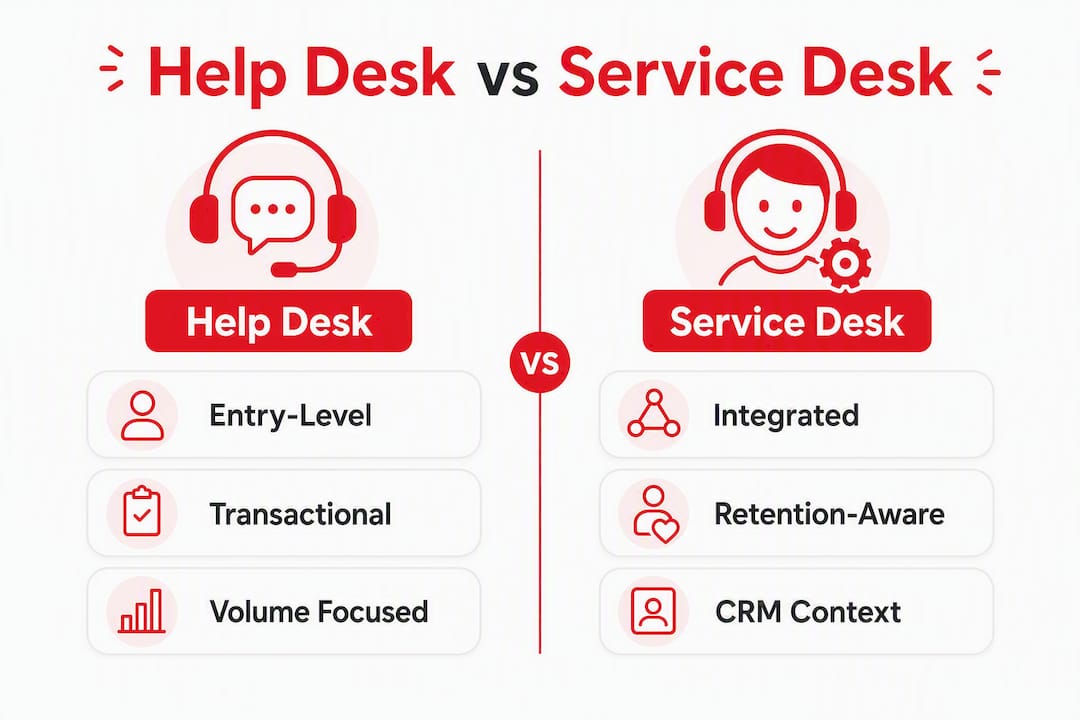
A help desk is an entry-level, transactional contact-handling model. Agents respond to inbound queries, resolve straightforward issues, and close tickets. The scope is reactive. A live-chat agent handling a password reset or a bonus code question is operating in help-desk mode.
A service desk is an integrated, retention-aware support function. Agents work with CRM and CDP context visible in their interface, follow escalation pathways for VIPs and compliance-sensitive cases, and actively contribute to retention outcomes. A named host resolving a VIP withdrawal dispute, surfacing a pre-approved retention offer from the CRM, and negotiating a tailored incentive in real time is operating in service-desk mode.

This article covers player-facing support models only. IT help desks and ITSM incident management are a different subject entirely and are not addressed here.
When is a help-desk approach acceptable for player support?
A help-desk model can be operationally sufficient in a narrow set of scenarios. If your operation fits the profile below, it may serve as a workable interim solution.
Conditions where a help-desk approach is acceptable:
- Your operator is pre-launch or in a single-state pilot with low ticket volume.
- Your product scope is limited (no VIP program, no complex payment methods).
- KYC complexity is low and handled by a separate back-office team.
- You have no 24/7 obligation and no multilingual requirement.
- You need short-term chat or email overflow coverage during a transition period.
Operational trade-offs to accept: VIP players queue alongside general players, CRM context is absent from the agent interface, escalation paths are informal, and QA governance is typically lighter. For a regulated U.S. operator with active licensing, these trade-offs accumulate into measurable retention risk quickly.
When does a U.S.-licensed operator need a service-desk model?
The short answer: as soon as you hold a U.S. gaming license, operate across more than one state, or run any form of VIP or retention program. iGaming customer experience has become a board-level strategic priority because CX interactions are where long-term trust is built or permanently damaged.
Scenarios that require a service-desk model:
- Multi-state licensing with state-specific compliance and responsible gaming (RG) touchpoints.
- KYC and payment workflows requiring documented review, audit trails, and escalation to compliance teams.
- A VIP segment where routing to a generic queue is a measurable LTV mistake.
- Retention programs where CRM-triggered offers must surface inside the support interface or they fail.
- 24/7 multilingual obligations across 14+ languages.
The CRM-to-support handoff is where most retention programs break down. If a retention trigger lands in a generic queue without CRM visibility, the offer fails — the agent has no context, no authority, and no prompt to act. A service desk with CRM integration prevents that failure at the structural level.
Pro Tip: U.S. licensing and KYC/payment handling requirements push operators toward a service-desk model by default. If your compliance team is involved in support escalations, you already need service-desk governance.
How do the two models compare across the dimensions that matter?
| Dimension | Help-desk model | Service-desk model |
|---|---|---|
| Best-fit scenario | Small operators, single-state pilots, overflow coverage | Multi-state licensed operators, VIP programs, retention-integrated operations |
| Channels | Live chat, email | Live chat, email, phone, VIP named-host lanes |
| KYC & payments handling | Minimal; separate back-office | Integrated; documented review with audit trail |
| CRM/CDP integration | None or basic | Full; retention triggers visible in agent UI |
| SLA & QA governance | Informal; light QA sampling | Formal SLAs; QA sampling, coaching, audits |
| Sample KPI targets | Response time only | CSAT, FCR, chat response, withdrawal review SLA targets |
| Multilingual & 24/7 | Limited | 14+ languages, 24/7 coverage |
| Scalability / ramp speed | Slow; ad hoc | Rapid; scaling to more than 650 full-time associates within 45 days has been documented using a specialist outsourced partner |
| Escalation & 2nd-line | Informal | Structured 2nd-line with compliance handoff |
| Pricing model | Per-ticket variable | Dedicated team (headcount-based) or modular |
A per-ticket model aligns vendor incentives with volume, not resolution quality. A dedicated-team model aligns them with your SLA outcomes. For regulated operators, that distinction matters operationally.
How do you choose the right player support partner?
Selection checklist
Must have:
- Documented SLAs with iGaming-specific KPI targets (CSAT, FCR, AHT, response times).
- CRM/CDP integration capability with named references.
- Structured VIP routing to named hosts.
- 24/7 multilingual coverage in your required languages.
- Compliance-aware escalation paths and audit-ready records.
Should have:
- Ramp capability demonstrated by prior iGaming launches.
- Platform experience with Zendesk or Freshdesk.
- QA governance including sampling rates, coaching cadence, and audit schedules.
Nice to have:
- Modular pricing options (dedicated team plus specific service modules).
- Pre-built KYC reviewer workflows.
Vendor interview questions
- Can you share a sample SLA document with iGaming-specific KPI targets?
- How does CRM context surface in your agent interface during a live chat?
- Walk me through your VIP routing logic from first contact to named host.
- What is your documented ramp timeline for a 50-agent team? A 200-agent team?
- Which Zendesk and Freshdesk integrations have you deployed for iGaming clients?
- How do your agents handle KYC escalations and what is your audit trail process?
- What data protection controls apply to player PII under U.S. state gaming regulations?
- How do you structure QA sampling and what is your coaching cadence?
- What is your escalation path when a compliance issue surfaces in a support ticket?
- Can you provide two iGaming operator references with contact details?
- What does your pricing look like for a dedicated team versus a per-ticket model?
- What is your standard onboarding timeline to full live operation?
Red flags: No SLA examples on request, no CRM integration references, no compliance escalation process, QA described as “periodic reviews,” and reluctance to provide operator references.
Pro Tip: Ask vendors to show you a live demo of CRM context surfacing in the agent UI. A vendor who cannot demo this in 15 minutes does not have it built.
Reviewing common mistakes in BPO partner selection before your first vendor call will sharpen your questions considerably.
What does onboarding a managed service-desk partner actually look like?
| Week | Milestone | Owner |
|---|---|---|
| — | Contract, compliance setup, data processing agreements | Operator legal + vendor |
| 1–2 | Knowledge base build, product and compliance training | Vendor + operator SMEs |
| 2–3 | Platform configuration (Zendesk / Freshdesk), CRM/CDP integration | Vendor IT + operator IT |
| 3–4 | KYC and payments provider connection, QA framework setup | Vendor ops + operator compliance |
| 4–5 | Shadow shifts, QA calibration, VIP routing testing | Vendor QA + operator team leads |
| 5–6 | Partial live operation with daily reporting | Vendor ops |
| 6+ | Full live ramp, SLA reporting, coaching cadence active | Vendor ops + operator |
A step-by-step outsourced support setup can reach partial live operation in four weeks when the operator provides SME access and IT resources promptly. The primary delay in most onboardings is CRM integration sign-off on the operator side, not vendor readiness.
Integration touchpoints to plan for: Zendesk or Freshdesk (ticketing), CRM/CDP (retention context), KYC provider (identity review queue), and payments ledger (withdrawal status and dispute data). Operator IT owns the API credentials and data access approvals; the vendor owns the connector configuration.
What does rapid scaling look like in practice?
A sports-betting operator executing a multi-state U.S. launch scaled to more than 650 full-time associates within 45 days using a specialist outsourced partner. The operation covered multiple licensed states simultaneously and maintained SLA adherence throughout the ramp.
Three lessons from that ramp:
- Pre-built KYC reviewer workflows cut onboarding time for compliance-sensitive roles significantly.
- Named-host VIP lanes were configured before go-live, not retrofitted after complaints surfaced.
- CRM connectors were pre-integrated with the ticketing platform, so agents had retention context from day one.
The takeaway for your planning: ramp speed is a function of pre-built infrastructure, not headcount availability. A vendor with pre-configured iGaming workflows will outperform a generalist BPO at any scale.
Key Takeaways
For U.S.-licensed iGaming operators, a managed service-desk model with CRM integration, VIP routing, and documented SLA governance is the only operationally sound choice for regulated, multi-state operations.
| Point | Details |
|---|---|
| Service desk is the default for licensed operators | KYC, VIP programs, and multi-state compliance make a help-desk model operationally insufficient. |
| CRM integration is non-optional | Retention triggers that don’t surface in the agent UI fail; this is a structural risk, not a configuration preference. |
| Ramp speed is achievable | Scaling to more than 650 full-time associates within 45 days has been documented in a multi-state sports-betting launch when pre-built workflows and CRM connectors are in place. |
| Vendor selection requires SLA proof | Ask for sample SLA documents and a live CRM integration demo before shortlisting any partner. |
| Workanova as a managed option | Workanova has delivered 24/7 multilingual iGaming support since 2014 across 14+ languages with documented SLAs and QA governance. |
Why operators keep moving toward managed service desks
The operators I see making the clearest commercial decisions are the ones who stop treating player support as a cost center and start treating it as a retention instrument. The trade-off is real: a per-ticket help-desk model costs less per interaction, but it has no mechanism to protect LTV when a VIP hits a withdrawal delay or a CRM offer goes undelivered. A managed service desk costs more per month and returns more per player. The math favors the service desk at any meaningful VIP concentration. What surprises most directors is how fast a well-structured managed partner can go live. The 45-day ramp case above is not an outlier; it is what pre-built infrastructure makes possible. If you’re weighing the build-vs-buy decision, the question isn’t whether you can afford a managed partner. It’s whether you can afford the retention losses while you build.
Workanova’s managed service-desk offering for U.S. iGaming operators
Workanova’s outsourced player support is built specifically for licensed online casinos and sportsbooks. Since 2014, the team has delivered 24/7 coverage in 14+ languages with documented SLAs, QA governance, and integrations with Zendesk and Freshdesk.
Capabilities include 24/7 multilingual live chat and email, VIP named-host lanes, KYC and payments handling with audit-ready records, 2nd-line escalation, and CRM/CDP integration. Operators get a dedicated, trained team live in weeks, without building an in-house department.
The recommended next step: request a sample SLA, integration diagram, and a four-week onboarding plan directly from the Workanova team. That package gives you everything you need to run a structured vendor comparison and make a decision within days.
Useful resources for your next steps
- Workanova iGaming player support overview — 24/7 multilingual capabilities, compliance experience, and service model options.
- Best help desk software for iGaming operators — platform comparison and integration notes for Zendesk and Freshdesk.
- Outsourced support live in 4 weeks — onboarding checklist and sample timeline.
- Backoffice and compliance support outsourcing — KYC and payments review workflows for licensed operators.
- iGaming customer service trends (Zendesk) — industry context on CX as a commercial lever.
- How player support impacts LTV (Comm100) — CRM handoff analysis and VIP routing best practices.
From any vendor you evaluate, request three documents before signing: a sample SLA with iGaming KPI targets, a CRM integration diagram, and at least two operator references with contact details. Those three items separate vendors who have built this from vendors who are selling it.

