

Salesforce Service Cloud vs Zendesk for iGaming Ops
August 3, 2026A player-support SLA for iGaming must guarantee measurable initial response times (IRT), total resolution targets, 24/7 channel availability, tiered priority handling for payments and game-session incidents, audit-ready security controls (including PCI DSS compliance), and a defined reporting cadence. Without all six, you have a vendor agreement, not a service guarantee.
Non-negotiable SLA elements for any iGaming support contract:
- Defined scope: channels covered (live chat, email, back office, VIP), player vs. platform support boundaries
- Measurable SLIs with numeric targets: IRT, resolution time, availability/uptime, FCR, CSAT
- Priority tiers (P0–P3) with separate response and resolution targets per incident type
- Escalation matrix: acknowledgment, triage, specialist routing, and operator status-update cadence
- Remedies and service credits: formula, cap, cure period, and termination triggers
- Security and compliance obligations: PCI DSS scope, KYC handling, logging, audit rights
- Reporting cadence: daily health checks, weekly ops reports, monthly SLA compliance, quarterly reviews
- Onboarding and exit clauses: ramp timeline, validation tests, data export, and transition obligations
RFP TL;DR: “Vendor must provide 24/7 multilingual player support across live chat and email, meet defined IRT and resolution targets by priority tier, deliver weekly SLA compliance reports, maintain PCI DSS-scoped payment handling, and accept service-credit liability for missed targets.”
Table of Contents
- What is an SLA for iGaming support, and why does it matter commercially?
- Which SLIs and KPIs belong in your iGaming support contract?
- How should you structure priority tiers and incident escalation?
- How do you structure service credits and penalties that actually work?
- What security and compliance controls must your SLA require?
- How should SLA governance, dashboards, and reporting work?
- What does a realistic onboarding timeline look like, and how do you protect continuity on exit?
- What should you ask vendors, and what are the red flags?
- How Workanova operationalizes SLA-backed player support
- Key Takeaways
- Why SLAs work better as partnership roadmaps than penalty documents
- Workanova delivers SLA-backed iGaming support, live in weeks
- Primary references for drafting and negotiating iGaming support SLAs
What is an SLA for iGaming support, and why does it matter commercially?
A Service Level Agreement for iGaming player support is a formal contract between a licensed operator and its support partner that defines measurable service metrics, the remedies for missing them, and the governance model for ongoing oversight. It covers scope (which players, which channels, which incident types), the parties’ obligations, and the SLIs that determine whether the vendor is performing.

The commercial stakes are direct. A payment failure left unresolved for 40 minutes during a live betting window costs real revenue and can trigger a player churn event. A VIP complaint misrouted through a standard queue damages retention. For U.S.-licensed operators, poor support documentation also creates regulatory exposure: state gaming regulators increasingly require operators to demonstrate player-protection processes, and an SLA with audit trails is your first line of evidence.
Core contract sections every iGaming support SLA must include:
- Scope of services: channels (live chat, email, phone, back office, VIP), languages, player-facing vs. B2B support boundaries
- SLIs and KPIs: numeric targets, measurement windows, and exclusions
- Reporting and governance: cadence, dashboard access, QA methodology
- Remedies and credits: formula, cap, cure period
- Escalation procedures: tier definitions, routing, and operator notification
- Security and compliance: PCI DSS, data privacy, KYC handling, audit rights
- Onboarding and exit: ramp timeline, validation tests, data transfer, transition support
Workanova, which has delivered SLA-backed iGaming player support since 2014, structures its managed-service contracts around exactly these sections, covering 24/7 multilingual live chat, email, VIP support, KYC/payments handling, and QA governance.
Which SLIs and KPIs belong in your iGaming support contract?
Help-desk SLAs commonly track a core set of KPIs including IRT, FCR, CSAT, resolution time, and backlog. For iGaming, you need a tighter, channel-specific version of that list, with measurement windows calibrated to 24/7 global traffic.
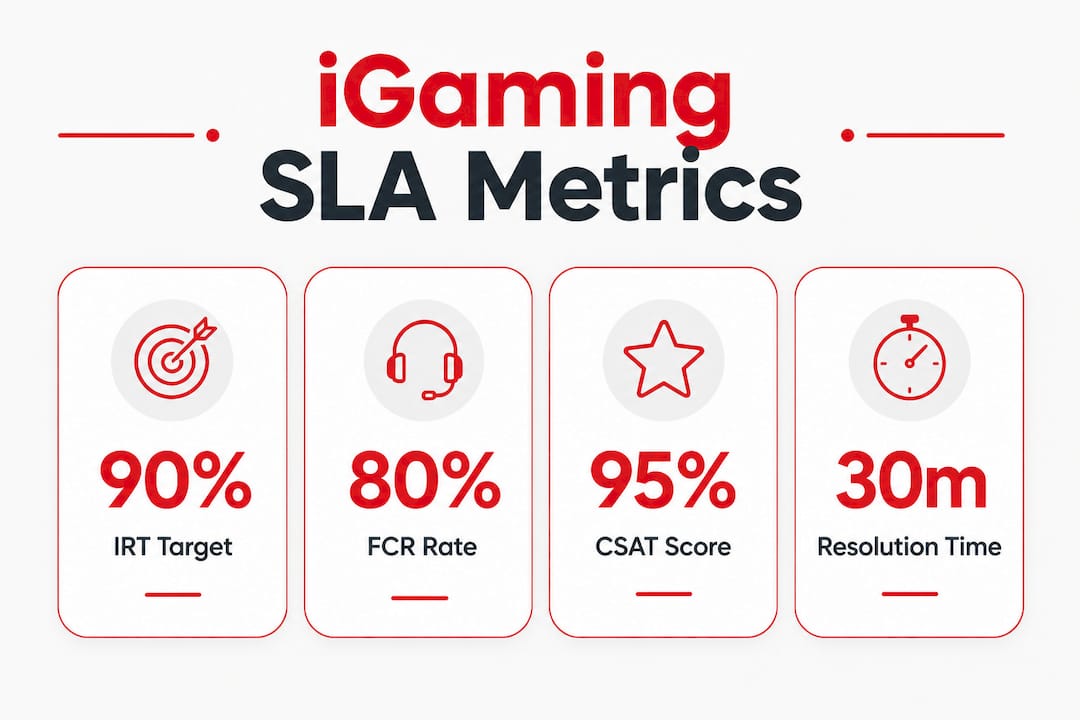
| Metric | Definition | Measurement method | Example target (24/7 iGaming) |
|---|---|---|---|
| Initial Response Time (IRT) | Time from ticket creation to first agent response | Median across all tickets in the period; exclude scheduled maintenance windows | For live chat, IRT targets should align with best-in-class benchmarks; many outsourced vendors advertise a 200-second average for iGaming, and email targets should reflect reasonable 24/7 response expectations. |
| Total Resolution Time | Time from ticket creation to verified close | Mean and 90th percentile; exclude tickets awaiting player response | Resolution targets should be set by priority tiers, with faster closure required for P0/P1 incidents. |
| Channel Availability / Uptime | % of contracted hours live chat/email is staffed and accessible | Calculated from monitoring logs; exclude operator-caused outages | Channel availability should be maintained at 24/7 coverage for core support channels to ensure reliable access. |
| First-Contact Resolution (FCR) | % of tickets resolved without reopening or escalation | Sampled from closed tickets; exclude escalations by design | A significant portion of tickets should be resolved on first contact; precise targets can be benchmarked in later contracts. |
| CSAT / NPS | Player satisfaction score post-interaction | Post-chat/email survey; minimum sample threshold per language | Track CSAT by language, not just in aggregate, to catch market-specific issues; 90% is a strong overall benchmark, but ensure segment reporting. |
| SLA Compliance Rate | % of tickets meeting their tier’s IRT and resolution targets | Automated from ticketing system; reported weekly | SLA compliance rates should meet a defined minimum, e.g., 95% in steady-state, with slightly lower thresholds allowed during a 30-day ramp. |
| Escalations-to-Tech Ratio | % of player tickets requiring technical escalation | Tracked by ticket tag; used to monitor product stability | Technical escalation rates should be monitored over time to identify product issues. |
Measurement windows matter as much as the targets themselves. Require timezone normalization across your player base, and specify that scheduled maintenance windows and third-party provider outages are explicitly excluded from uptime calculations. A vendor who refuses to define exclusions in writing is leaving room to dispute every breach.
Pro Tip: For multilingual operations, require CSAT to be reported by language pool, not just in aggregate. Workanova’s multilingual support model tracks CSAT per language to catch exactly this.
For high-season events — jackpot drops, NFL playoffs, March Madness — require a force-multiplier clause: the vendor must provide a pre-agreed surge staffing plan or temporary headcount model to maintain SLA targets during traffic spikes. Without it, your SLA targets become aspirational during the moments that matter most.
How should you structure priority tiers and incident escalation?
Technical SLAs in iGaming must separate reactive ticket handling from full maintenance SLAs that include proactive 24/7 monitoring of API connections, payment gateways, and game-provider integrations. Treating a payment gateway outage as a standard ticket underestimates severity and delays resolution.
Define four priority tiers with explicit impact descriptors:
| Tier | Incident type | IRT target | Update cadence | Resolution target |
|---|---|---|---|---|
| P0 | Platform-wide outage, all payments down, fraud event in progress | Response targets for the highest priority incidents require immediate acknowledgment and resolution within a short timeframe | ||
| P1 | Payment failure for multiple players, game-session disruption, VIP complaint | Mid-priority incidents have defined response and resolution expectations to mitigate impact | ||
| P2 | Single-player payment hold, KYC document delay, account access issue | Lower priority incidents have longer response and resolution windows appropriate to severity | ||
| P3 | General inquiry, bonus question, non-urgent complaint | The lowest priority incidents allow for the longest response and resolution times consistent with service commitments |
The escalation flow for P0/P1 incidents should follow a fixed sequence: acknowledgment to the operator within the IRT window, triage by a senior agent, specialist escalation (payments team, fraud team, or platform engineer), incident response team activation if unresolved past 30 minutes, and status updates to the operator at the defined cadence until closure.
The practical difference matters. A payment failure affecting 50 players during a live sportsbook event is a P0: it requires immediate escalation, operator notification, and a dedicated incident bridge. A single player asking why a bonus hasn’t credited is a P2. Mixing those in the same queue is how operators lose players and regulatory goodwill simultaneously.
Incidents affecting payments, live game sessions, or platform availability need separate escalation triggers and shorter SLIs than standard consumer inquiries. Build that separation into the contract explicitly, not as a verbal understanding.
How do you structure service credits and penalties that actually work?
Service credits are the most commonly negotiated and most commonly neutered part of an iGaming support SLA. The goal is a remedy structure that creates real cost for the vendor when performance slips, without triggering termination for a single operational variance.
Common remediation models:
- Service credits as a percentage of monthly fees: The most practical model. Define a credit percentage tied to the severity and duration of the breach (e.g., 5% of monthly fees for each week IRT compliance falls below 90%, up to a 20% monthly cap).
- Graduated penalties: Credits escalate with breach frequency. A first breach in a quarter triggers a remediation plan; a second triggers a 10% credit; a third triggers a 20% credit plus a right to terminate.
- Remediation plans in lieu of immediate termination: For a first breach, require a written root-cause analysis and a 30-day remediation plan with measurable milestones. Termination rights activate only if the remediation plan fails.
Sample credit calculation: If your monthly fee is $50,000 and the SLA compliance rate falls to 88% against a 95% target for two consecutive weeks, a 5%-per-week credit formula yields a $5,000 credit against the next invoice. Cap the total monthly credit at 20% ($10,000) to keep the model commercially viable for both parties.
Sample contract language for cure periods:
“If Vendor’s SLA Compliance Rate falls below the agreed threshold in any calendar month, Vendor shall deliver a written remediation plan within five (5) business days. Operator’s right to terminate for cause activates if the Compliance Rate remains below threshold for two (2) consecutive months following delivery of the remediation plan.”
Red flags to reject in penalty clauses:
- Vendor unilateral right to offset credits against disputed invoices
- Credit caps below 10% of monthly fees (effectively no cost to the vendor)
- Broad force majeure clauses with no remediation obligation
- “Best efforts” language replacing numeric SLI targets
What security and compliance controls must your SLA require?
For U.S.-licensed iGaming operators, security obligations in a support SLA are not optional extras. Payment card data handled by support agents falls within PCI DSS scope, and state-level data privacy laws (including California’s CCPA and similar frameworks in other regulated states) impose specific obligations on vendors who process player personal data.
Security items to contract explicitly:
- PCI DSS scope definition: which support workflows touch cardholder data, and the vendor’s current compliance level (SAQ or full QSA assessment)
- Encryption in transit and at rest for all player data, including KYC documents
- Role-based access controls: agents access only the player records relevant to their assigned tickets
- Logging and audit retention: all agent actions on player accounts logged, retained for a minimum period (typically 12 months for gaming regulators)
- Secure KYC document handling: document upload, storage, and deletion procedures with defined retention windows
- Secure deletion procedures: data destruction protocols upon contract termination
Operator audit rights to include:
- Right to request vendor SOC 2 Type II or ISO 27001 attestation annually
- Right to conduct a security questionnaire review semi-annually
- Right to audit agent access logs upon reasonable notice
- Right to require remediation within 30 days of any identified control gap
Operators should also require vendors to specify their data handling and compliance procedures for KYC and payment documents in writing, including who can access documents, how long they are retained, and how they are destroyed.
Pro Tip: Make SOC 2 Type II attestation a contractual milestone, not just a procurement checkbox. Require the vendor to deliver an updated report within 90 days of the contract anniversary. A vendor who cannot produce one within that window has a control gap worth investigating before you renew.
How should SLA governance, dashboards, and reporting work?
Governance is where most SLAs fail in practice. The targets are agreed, the contract is signed, and then reporting becomes a monthly PDF nobody reads until something breaks. Build the governance model into the SLA itself.
Required dashboard panels (specify these in the contract):
- IRT trend by channel and priority tier (daily view, 30-day rolling)
- SLA compliance rate by metric (weekly)
- Top breach reasons and frequency
- Open P0/P1 incidents and time-in-status
- CSAT and FCR by language pool
- Ticket volume vs. staffed headcount (surge visibility)
Reporting cadence:
| Report | Frequency | Contents |
|---|---|---|
| Health check | Daily | Open P0/P1 incidents, IRT compliance flag |
| Operational report | Weekly | SLA compliance by metric, volume, FCR, CSAT |
| SLA compliance report | Monthly | Full KPI scorecard, breach log, credit calculation |
| Business review | Quarterly | Root-cause analysis, trend analysis, improvement targets |
QA sampling should be defined in the SLA: minimum sample size per week (e.g., 5% of closed tickets or 50 tickets, whichever is greater), a scoring rubric covering accuracy, tone, compliance language, and escalation handling, and a dispute resolution process for retroactive breach claims. Language quality assurance across multilingual pools requires separate sampling per language, not a single aggregate score.
Continuous improvement lives in the contract through runbooks (updated quarterly), KPI improvement targets tied to the business review, and a change-management clause requiring 14 days’ notice for any process change that could affect SLA performance.
What does a realistic onboarding timeline look like, and how do you protect continuity on exit?
Vendor onboarding for outsourced iGaming support typically runs four to six weeks from contract signature to full go-live, covering discovery, integrations, training, shadowing, and validation.
Typical onboarding phases:
- Week 1: Discovery. Operator provides playbooks, escalation contacts, platform access credentials, and historical ticket data. Vendor maps workflows and identifies integration requirements.
- Week 2: Integration and training. CRM/ticketing system access configured, payment and KYC workflows documented, agent training on product, tone, and compliance language.
- Week 3: Shadowing. Vendor agents observe live interactions; operator QA team scores outputs against rubric.
- Week 4: Soft go-live. Vendor handles a defined percentage of live volume (typically 30–50%) with operator oversight. Simulated P0/P1 incidents tested.
- Weeks 5–6: Full handover. Vendor takes full volume. SLA compliance tracked from day one of full go-live; ramp-period targets may be slightly relaxed (e.g., 90% compliance vs. steady-state 95%) for the first 30 days.
Validation tests to require during ramp:
- Test ticket batch: 50 scripted tickets covering all priority tiers; measure IRT and resolution accuracy
- Simulated payment failure incident: verify P0 escalation flow and operator notification within target window
- KYC document handling test: verify secure upload, access controls, and deletion confirmation
Exit and transition checklist:
- Data export in agreed format (CSV, JSON, or platform-native) within 10 business days of termination notice
- Knowledge-transfer sessions: minimum two handover calls with incoming vendor or in-house team
- Source-of-truth documentation: runbooks, escalation contacts, and integration credentials transferred
- Transitional support obligation: vendor continues at contracted service levels for 30 days post-notice
- Confirmation of secure data deletion within 30 days of full transition
What should you ask vendors, and what are the red flags?
Negotiation checklist — ask for these before signing:
- Read-only access to the vendor’s live SLA dashboard during the procurement process
- Sample monthly SLA compliance report from an existing client (anonymized)
- Last three months of SLA compliance data by metric
- Resourcing plan for peak events (how many additional agents, what lead time)
- Performance bond or credit model with a worked calculation example
- Security attestation (SOC 2 Type II or ISO 27001) dated within the last 12 months
Red flags that should pause any negotiation:
- KPIs defined as “best efforts” or “target” without numeric thresholds
- Force majeure clauses that cover third-party platform outages without a remediation obligation
- No audit rights or audit rights requiring 30+ days’ notice
- Exclusions so broad they cover most of your actual ticket volume
- Credit caps below 10% of monthly fees
Sample vendor questions and what good answers look like:
- “Show us your last three months of SLA compliance by metric.” A credible vendor produces this within 24 hours. Hesitation or a request to “prepare a summary” is a signal.
- “What is your surge staffing model for a major sporting event?” The answer should name a specific headcount model, a lead time, and a cost structure. “We have a flexible team” is not an answer.
- “How do you handle a P0 payment outage at 2 AM on a Sunday?” Expect a named escalation path, a specific on-call contact, and a maximum response time. Vague answers about “dedicated teams” without specifics indicate the process does not exist in writing.
Tie commercial incentives to KPI improvement, not only to penalties. A vendor who earns a 5% fee uplift for sustaining 98% SLA compliance for two consecutive quarters has a financial reason to improve, not just to avoid credits.
How Workanova operationalizes SLA-backed player support
Understanding what a well-run SLA looks like in practice helps you write better requirements. Workanova has delivered 24/7 outsourced iGaming player support since 2014, covering live chat, email, VIP and retention support, KYC/payments handling, and QA across 14+ languages for licensed online casinos and sportsbooks.
Operational proof points operators should request from any vendor:
- Team structure: dedicated agents per operator (not shared pools), with named escalation contacts for P0/P1 incidents
- Escalation paths: documented runbooks for payment failures, fraud events, and platform outages, tested quarterly
- Integrated tech stack: native integration with the operator’s CRM and ticketing platform, not a parallel system
- QA cadence: weekly sampling with scored rubrics, monthly calibration sessions, and dispute resolution process
- SLA validation during ramp: test ticket batches, simulated incidents, and compliance reporting from day one of full go-live
What to verify in the first 30/60/90 days:
- Day 30: IRT and resolution targets met at ramp-period thresholds; first weekly ops report delivered; QA sampling underway
- Day 60: Full SLA compliance rate at or above steady-state target; first monthly compliance report delivered; escalation paths tested in live environment
- Day 90: First quarterly business review scheduled; remediation plan process tested (even if no breach occurred); security attestation confirmed
Key Takeaways
A player-support SLA for U.S.-licensed iGaming operators must define measurable SLIs, tiered escalation, security controls, and a governance cadence before the contract is signed, not after the first breach.
| Point | Details |
|---|---|
| SLIs need numeric targets | Define IRT, resolution time, availability, FCR, and CSAT with specific thresholds per priority tier. |
| Priority tiers protect revenue | Separate P0–P3 tiers with distinct response targets prevent payment and session incidents from sitting in a standard queue. |
| Credits must have real cost | Cap credits at no less than 20% of monthly fees and tie escalating penalties to repeat breaches, not just single events. |
| Security is contractual, not verbal | Require PCI DSS scope definition, KYC handling procedures, audit rights, and SOC 2 Type II attestation in writing. |
| Workanova as SLA-backed partner | Workanova delivers 24/7 multilingual iGaming support with strict SLAs, QA governance, and teams live in weeks. |
Why SLAs work better as partnership roadmaps than penalty documents
The operators who get the most from their support SLAs are not the ones with the most aggressive penalty clauses. They are the ones who built joint improvement targets into the contract from the start.
A purely punitive SLA creates a vendor who manages to the floor: they hit the minimum thresholds to avoid credits and nothing more. The incentive structure points toward compliance, not improvement. When you add a quarterly business review with shared KPI improvement targets, a remediation plan requirement that precedes any credit trigger, and a commercial upside for sustained outperformance, the vendor’s incentive shifts. They are now managing toward a goal, not away from a penalty.
SLAs function best as a partnership roadmap that aligns the support provider to the operator’s business outcomes, protecting player retention and brand reputation rather than only defining what happens when things go wrong. That framing also produces better contract language: instead of writing clauses that assume bad faith, you write clauses that define shared success and build in the governance to measure it.
One practical consequence: avoid “gotcha” language that penalizes honest operational variance. A vendor who proactively flags a staffing gap before a major event and proposes a mitigation plan is behaving exactly as you want. A contract that penalizes them for the disclosure discourages transparency. Write cure periods and remediation plans that reward early disclosure, and reserve termination rights for sustained, unaddressed failure.
Workanova delivers SLA-backed iGaming support, live in weeks
If you are reviewing an existing support contract or drafting an RFP, Workanova gives you a faster path to SLA-backed coverage than building an in-house team. Since 2014, Workanova has operated as a managed support partner for licensed online casinos and sportsbooks, delivering 24/7 multilingual live chat, email, VIP support, KYC/payments handling, and QA in 14+ languages, all under strict SLAs with defined IRT and resolution targets, weekly compliance reporting, and QA governance built in from day one.
At procurement stage, request Workanova’s onboarding timeline, a sample SLA compliance report, and confirmation of security attestations. Operators get a dedicated, trained team live in as few as four weeks, with no need to hire, train, or manage an internal department. For operators who need to scale player support without a large headcount increase, Workanova’s managed model covers surge events, multilingual coverage, and compliance-sensitive workflows under a single contract.
Get SLA-backed iGaming support from Workanova and request a scoped proposal for your operator.
Primary references for drafting and negotiating iGaming support SLAs
- PCI DSS standards — PCI Security Standards Council: Use for PCI DSS scope definitions and compliance requirements for payment-handling workflows.
- 24/7 iGaming player support outsourcing — Workanova: Use for vendor proof points, SLA-backed service modules, and onboarding timeline benchmarks.
- Outsourced back-office and compliance support — Workanova: Use for KYC and payment document handling procedures and vendor security obligations.
Reminder: Always request vendor-provided SOC 2 Type II or ISO 27001 reports and at least three months of historical SLA compliance data before signing any managed support contract. Published documentation is a starting point; verified attestations and live performance data are the standard.

