

Compliance-Focused Player Support: The US iGaming Buyer’s Guide
August 9, 2026
iGaming Player Support Standards: The Operator’s SOP Playbook
August 11, 2026For most licensed iGaming operators, the right move is to contract a dedicated, outsourced player support team — one that covers 24/7 multilingual live chat, KYC/payments handling, and compliance-ready escalation, and goes live in weeks rather than quarters. Before you open any vendor conversation, send an NDA and request a written scope of coverage. That single step filters out vendors who cannot operate within your regulatory framework.
Start your due diligence with these four questions:
- Which languages do you support natively, and can you prove fluency with a live skills test?
- Do you offer true 24/7 coverage, including weekends and peak events like jackpot drops?
- Can your agents handle KYC verification steps and payment escalations within our compliance rules?
- What is your realistic time-to-live, and what does the onboarding process look like week by week?
Key Takeaways
A dedicated outsourced iGaming support team is the fastest path to 24/7, multilingual, compliance-ready player coverage — without building an in-house department from scratch.
| Point | Details |
|---|---|
| Go live in weeks | A properly scoped dedicated team can be operational in six to eight weeks with a structured onboarding sequence. |
| SLAs from day one | Require measurable KPIs, including CSAT, live chat first response time, and FCR targets in the contract before signing. |
| Compliance is your responsibility | US-licensed operators must contractually assign KYC, AML, and data-handling obligations — the vendor cannot be a regulatory gap. |
| Integration must be confirmed pre-contract | Verify helpdesk, CRM, and payment gateway compatibility in a sandbox before go-live, not after. |
| Workanova | Managed iGaming support since 2014, 14+ languages, KYC/payments handling, and SLA-backed QA — dedicated teams live in weeks. |
Table of Contents
- What does a dedicated iGaming player support team actually do?
- Non-negotiable features to require in your RFP
- What compliance and KYC handling must you require from a US-licensed operator’s vendor?
- How should your vendor integrate with your existing tech stack?
- What SLAs, KPIs, and QA processes should you set from day one?
- What pricing models and onboarding timelines should you expect?
- Why Workanova is a recommended choice for licensed iGaming operators
- How do you evaluate and select the right vendor?
- The operational reality most operators underestimate
- Workanova gives you a dedicated team live in weeks
- Sources
What does a dedicated iGaming player support team actually do?
“Dedicated” means a single-tenant team, trained exclusively on your brand, your rules, and your platform — not a shared pool of agents rotating between clients. That distinction matters operationally: your players reach agents who know your bonus structures, your wallet logic, and your escalation thresholds.
The functional scope of an iGaming customer support representative covers far more than answering chat messages. A properly scoped team handles:
- Core channels: live chat, email, phone, and increasingly social/WhatsApp and in-game chat
- VIP and retention: proactive outreach, loyalty handling, and escalation for high-value players
- Payments and KYC: deposit/withdrawal queries, document verification steps, and fraud/chargeback triage
- 2nd-line escalation: routing complex cases to compliance, AML, or technical teams with full context
- Account maintenance: bonus adjustments, account status changes, and complaint handling within permitted actions
When you write your Statement of Work, specify languages, coverage hours, escalation tiers, which account actions agents may take, data access limits, and reporting cadence. Vague SOWs produce vague service.
Non-negotiable features to require in your RFP
Your RFP needs to be specific enough that every vendor response is directly comparable. Generic requirements produce generic answers. Build your feature checklist around these items:
- 24/7 live chat support with documented response-time SLAs
- Native-speaker fluency in every language you require, verified by a live skills test during evaluation
- A dedicated VIP desk with named escalation contacts and defined response windows
- Demonstrated KYC and payment-handling competence, including AML awareness and fraud triage
- Platform-specific training on your wallet, sportsbook, or casino engine before go-live
- CRM and game-platform API access with scoped, auditable permissions
- Full ticketing and audit logs exportable to your own systems
- Named recovery-time objectives for escalations, plus a documented business continuity plan
- Coverage guarantees for peak events — jackpots, World Cup, major tournaments — with staffing plans in writing
On the technology side, require support for your existing helpdesk (Zendesk, Freshdesk, or equivalent), single-sign-on or scoped admin access, full conversation transcripts, and a clear data retention policy. Operators who skip the technology requirements discover integration gaps after contract signature, which delays go-live by weeks.
Pro Tip: Require a short skills assessment or a live shadowing session during vendor evaluation. Ask agents to handle a sample KYC query and a payment dispute in each required language. Fluency on a CV and fluency under pressure are different things.
Regulatory and localization requirements can shift vendor selection entirely. Mandatory 24/7 Turkish-language support, for example, is now a licensing condition in certain markets — and not every vendor can staff it. Language-specific requirements like Turkish 24/7 coverage should be treated as hard pass/fail criteria in your RFP scoring, not nice-to-haves.
What compliance and KYC handling must you require from a US-licensed operator’s vendor?
US-licensed operators carry the regulatory obligation. Your vendor cannot be the point where compliance breaks down. That means written contractual responsibilities, not verbal assurances.
Your contract must include:
- PCI scope restrictions: define exactly which payment data agents may view, and prohibit storage of card data outside approved systems
- KYC/AML handling rules: specify which verification steps agents may perform, when they must escalate to your compliance team, and what evidence thresholds trigger a freeze or referral
- Geolocation constraints: agents must understand and enforce state-level access restrictions — a player in a non-licensed state cannot be served the same way as one in New Jersey or Pennsylvania
- Record retention: define minimum retention periods for chat transcripts, verification records, and escalation logs, aligned with your license conditions
- Audit access: both you and your regulator must be able to access records on demand; confirm this in writing before signing
- Incident reporting timelines: require the vendor to notify you within a defined window (typically 24 hours) of any data incident or compliance breach
For agent-level rules, specify which account actions are permitted (e.g., initiating a payout review) versus prohibited (e.g., approving a withdrawal unilaterally). Agents handling KYC verification for US online casinos need to know the difference between a document check they can complete and a case that requires your compliance officer.
Pro Tip: Run a KYC playbook exercise during onboarding. Give agents three or four real-pattern case types — an expired ID, a mismatched address, a politically exposed person flag — and walk through expected responses before they touch live accounts.
How should your vendor integrate with your existing tech stack?
Verify integration capability before contract signature. A vendor who cannot connect to your primary systems adds manual handoffs, which create errors and slow resolution times.
Common integrations to confirm:
- Helpdesk routing: Zendesk or Freshdesk ticket assignment, queue management, and SLA tracking. Zendesk’s iGaming-specific features include automation and personalized support workflows worth reviewing as a baseline for what to expect.
- CRM and player database: read access to player profiles, transaction history, and bonus status — scoped to what agents need, nothing more
- Game provider APIs: session state, bet history, and player status lookups for dispute resolution
- Payment gateway consoles: deposit/withdrawal status, reconciliation views, and chargeback queues
- Fraud and AML tool feeds: read access to risk scores and flagged accounts, with escalation hooks to your compliance team
Require the vendor to produce a handoff diagram before go-live: how does a live chat conversation become a ticket, how does a ticket escalate to your ops team, and how does resolution get logged? Also require a sandbox testing window — at least two weeks — where agents work in a test environment before touching live player accounts. For operators evaluating helpdesk software options, confirming vendor compatibility with your chosen platform during the RFP phase saves significant rework later.
What SLAs, KPIs, and QA processes should you set from day one?
Require measurable SLAs and a joint QA program in the contract, not as a post-launch addition. Operators who defer QA governance to “once we’re settled” typically spend months correcting tone, accuracy, and policy adherence issues that a structured program would have caught in week two.
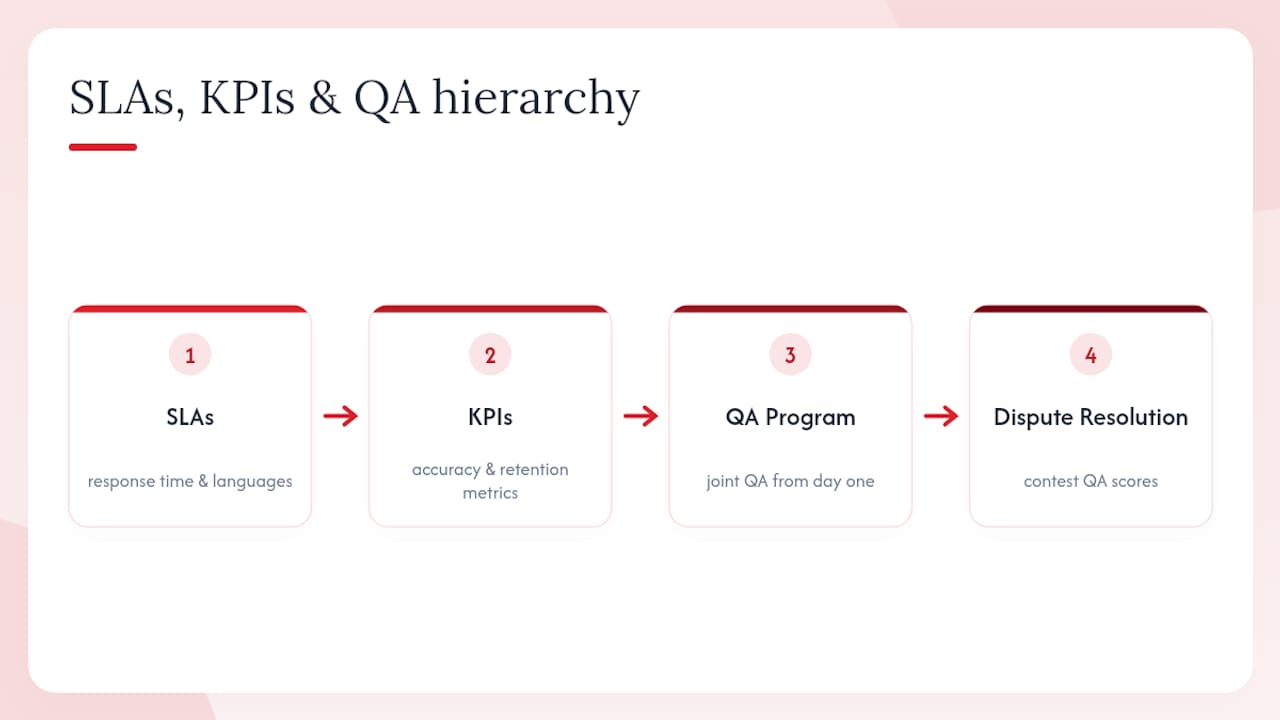
Include a dispute resolution process for QA disagreements — agents and team leads need a clear path to contest a score. Workanova’s QA and quality monitoring service provides a structured framework operators can use as a reference when drafting their own QA requirements.
Industry coverage on casino customer support consistently identifies response time and language availability as the two factors most directly tied to player trust and retention — both are measurable and should be in your SLA table from day one.
What pricing models and onboarding timelines should you expect?
Pricing for dedicated iGaming support teams typically follows one of three shapes: FTE-based retainers, blended hourly rates, or per-ticket models. For a true dedicated team, FTE retainers are the most common structure — you pay for a defined headcount, and that team works exclusively for you. Blended hourly works for mixed workloads where volume is unpredictable. Per-ticket pricing suits overflow or seasonal coverage but rarely makes sense as the primary model for a 24/7 dedicated operation.
Cost drivers to factor into your budget:
- Language mix: native speakers in high-demand languages (German, Turkish, Portuguese) carry a premium over English-only coverage
- Coverage hours: 24/7 costs more than business-hours coverage; weekend and holiday staffing adds to the base rate
- Functional scope: VIP desk, KYC/payment handling, and 2nd-line escalation each add to the per-FTE cost
- SLA stringency and reporting: tighter SLAs and more frequent reporting require more management overhead
Specialist BPOs serving regulated verticals commonly present pricing as FTE retainers for dedicated teams; procurement should ask for ramped pricing and pilot terms to reduce risk in the early months.
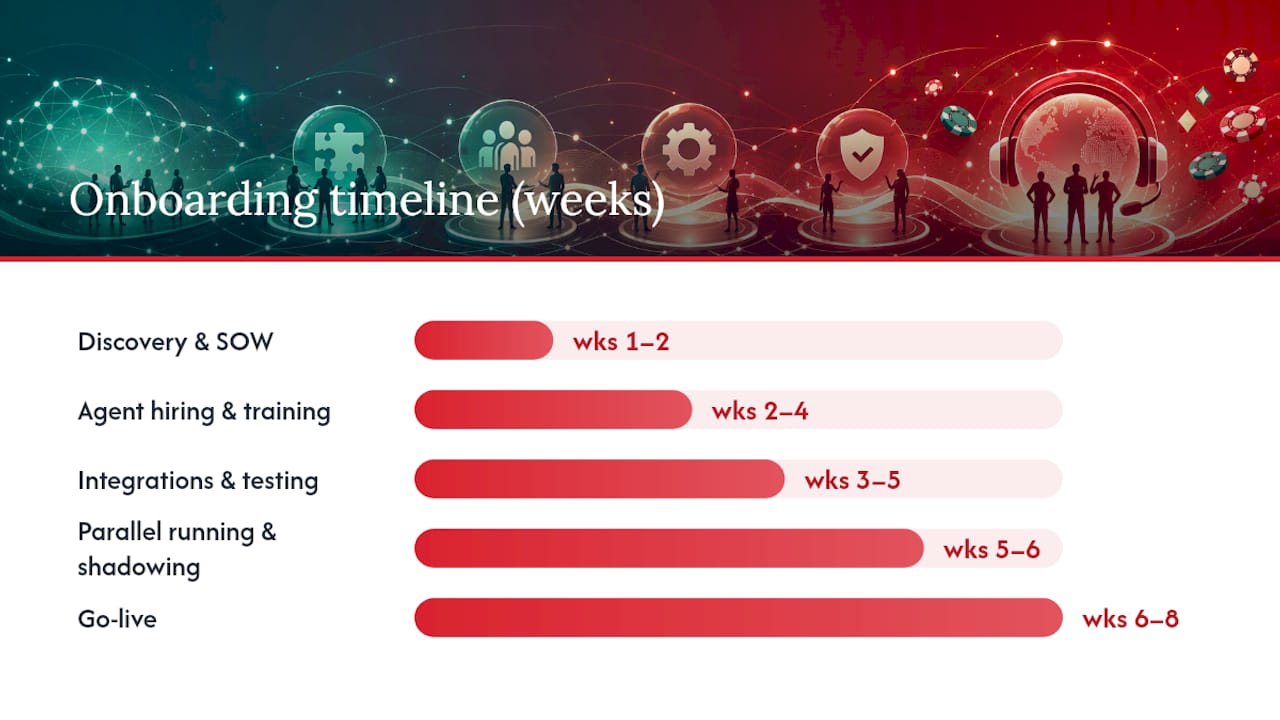
A realistic onboarding sequence for a dedicated team:
- Discovery and SOW (weeks 1–2): define scope, languages, escalation rules, permitted agent actions, and integration requirements
- Agent hiring and training (weeks 2–4): recruit or assign agents, complete product and compliance training, and run the KYC playbook exercise
- Integrations and sandbox testing (weeks 3–5): connect helpdesk, CRM, and payment systems; run agents through test scenarios
- Parallel running and shadowing (weeks 5–6): agents handle live traffic alongside your existing team, with QA review of every interaction
- Go-live (week 6–8): full handover, with daily check-ins and weekly QA reviews for the first month
Negotiate ramp-price steps for the first 60–90 days, a defined trial period with exit rights if SLAs are missed, and performance-based credits tied to specific KPI breaches. Operators who skip the pilot phase often discover staffing or integration gaps at full volume. Scaling player support without large headcount additions is achievable with the right vendor structure, but only when the onboarding sequence is followed in full.
Why Workanova is a recommended choice for licensed iGaming operators
Workanova delivers managed, outsourced player support for licensed online casinos and sportsbooks: 24/7 multilingual coverage in 14+ languages, live chat, email, VIP and retention support, KYC/payments handling, and QA — all backed by strict SLAs. Operating since 2014, the team brings operator-focused experience that generic BPOs cannot replicate.
Key proof points:
- Dedicated teams go live in weeks, not quarters — operators receive a trained team ready to scale for jackpot drops and traffic peaks without building an in-house department
- 14+ languages with native-speaker coverage, including markets with mandatory localization requirements
- KYC and payment handling built into the service scope, not offered as an add-on
- SLA-backed QA governance with defined sampling rates, scoring rubrics, and coaching cadence
- Compliance-ready onboarding, including operator-led KYC playbook exercises before agents touch live accounts
For operators evaluating multilingual support coverage, Workanova’s language-specific QA process ensures that fluency and policy adherence are measured in every language, not just English. The Turkish 24/7 support capability is a concrete example: where mandatory localization requirements apply, Workanova has the staffing and QA infrastructure to meet them.
How do you evaluate and select the right vendor?
Use a weighted checklist and require evidence during the RFP phase. Vendors who cannot produce documentation during due diligence will not produce it after contract signature.
Questions to ask in vendor demos:
- Can you run a live language fluency test for each required language, today?
- Show us your sandbox environment and walk us through a KYC escalation scenario.
- What is your documented process for a data incident, and what is your notification timeline?
- How do you staff for peak events — what is your surge capacity and how quickly can you add agents?
- What SLA remedies are in your standard contract, and have you ever paid a credit?
- Who is the named account manager, and what is their escalation path to your leadership?
Red flags to watch for:
- No sandbox environment or unwillingness to do a pre-live test period
- Vague SLA language (“best efforts,” “target response times”) with no defined penalties
- Inability to demonstrate KYC or payment-handling competence with a real scenario
- Opaque data handling — no clear answer on where player data is stored or who has access
- No native speakers for your key markets, or fluency claims that cannot be tested
- Staffing model that relies on shared agents rather than a dedicated team
Buyer checklist for scoring vendors:
- Language coverage confirmed with live test
- 24/7 staffing model documented with redundancy plan
- KYC/payment handling demonstrated in a scenario
- Integration capability confirmed for your helpdesk and CRM
- SLA terms reviewed with defined penalties
- Data handling and security documentation received
- References from licensed operators provided and contacted
- Pilot or shadow phase agreed in the contract
Require a short pilot or shadow phase before full go-live. A vendor confident in their delivery will agree to it. One who resists is telling you something.
The operational reality most operators underestimate
What operators consistently underestimate is the cost of a slow ramp. A vendor who takes four months to go live does not just delay your support coverage — they delay your ability to scale for the next peak event, and they extend the period where your in-house team is carrying the full load.
The operators who get the most from an outsourced dedicated team are the ones who treat onboarding as a joint project, not a vendor handoff. That means assigning an internal point of contact, completing the KYC playbook exercise before agents go live, and running a genuine parallel period rather than a nominal one. The vendor owns the agents and the QA process. You own the product rules, the regulatory filings, and the data. That division has to be explicit in the contract and understood by both teams on day one.
Workanova’s model is built around that clarity. Dedicated teams, named SLAs, and AI-assisted automation for routine inquiries that frees trained agents for compliance-sensitive and high-value interactions — the combination is what makes the model work at scale.
Workanova gives you a dedicated team live in weeks
Workanova’s iGaming managed support delivers a dedicated, trained team covering 24/7 multilingual live chat, email, VIP handling, KYC/payments, and SLA-backed QA — typically live within six to eight weeks of contract signature.
The next step is straightforward. Request a capabilities deck and a language fluency test for your key markets. Ask for an integration sandbox and proposed pilot dates. Then request a tailored commercial proposal with ramp-price steps and pilot terms included. Operators ready to move can scale iGaming support without large headcount additions — contact Workanova to get a scoped proposal for your operation.
Sources
- Clutch

