

How to Evaluate Outsourcing Partner Quality: 2026 Guide
August 8, 2026Outsourced, SLA-backed player support is the right call for any US-licensed online casino or sportsbook that needs 24/7 multilingual live chat and email, KYC and payments handling, VIP retention, and measurable compliance outputs without building a full internal department. This is what the industry calls compliance-focused player support, or compliance podrške u igamingu in procurement shorthand. It is not regulatory consulting, licensing advisory, or AML legal counsel. It is managed, frontline operations: trained agents, documented SLAs, audit logs, and QA governance delivered by a vendor who becomes an operational extension of your team.
Before you sign anything, confirm the vendor delivers all four of these:
- SLA metrics in writing: first response time (FRT), KYC completion SLA, withdrawal handling SLA, and regulatory incident response time
- Audit logs and access controls: SOC2 or equivalent certification, role-based access control (RBAC), multi-factor authentication (MFA), and masked PII views
- Documented onboarding timeline: a week-by-week ramp plan from contract sign to full go-live
- Compliance reporting cadence: daily breach alerts, weekly KPI rollups, and monthly compliance packs
Key Takeaways
Outsourced compliance-focused player support delivers measurable KYC, payments, and retention outcomes for US-licensed operators when procured with documented SLAs, SOC2 evidence, and a structured pilot.
| Point | Details |
|---|---|
| Demand SLA reports upfront | Require FRT, KYC completion, and regulatory incident response SLAs in writing before signing. |
| Require SOC2 evidence | Accept only a current SOC2 Type II or ISO 27001 report, not a self-attestation. |
| Run a 6–12 week attribution pilot | Link player UID data across CRM, payments, and support to measure LTV and retention impact. |
| Confirm SSO, RBAC, and audit logs | These three controls are non-negotiable for US regulatory compliance and vendor oversight. |
| Negotiate phased SLA penalties | Activate full contractual penalties only after week eight to allow a structured ramp. |
| Workanova as a turnkey option | Workanova delivers 24/7 multilingual support in 14+ languages with SLA governance live in weeks. |
Table of Contents
- What does a compliance-focused player support service actually cover?
- Which KPIs and compliance metrics should your SLA require?
- How do you integrate an outsourced team into your tech stack securely?
- What SLA terms and pricing structures should you negotiate?
- How do you prove the support team’s impact on player LTV?
- What questions should you ask vendors during procurement?
- What does a compliant go-live timeline look like?
- The case for compliance-first outsourcing in US iGaming
- Workanova delivers turnkey compliance player support for US operators
- Sources
What does a compliance-focused player support service actually cover?
A managed player support contract typically bundles six operational modules. Understanding each one lets you map SLAs and internal responsibilities before the contract is drafted.
Frontline live chat and email handles the majority of ticket volume: account queries, bonus questions, deposit confirmations, and general navigation. KYC intake and verification covers document collection, identity checks, and escalation of edge cases to your internal compliance team. Payments and withdrawals handling manages dispute triage, provider coordination, and status updates, though final fraud decisions stay in-house. VIP and retention is a dedicated sub-team running proactive outreach, loyalty touchpoints, and churn-risk interventions. Second-line escalation routes complex cases, responsible gambling (RG) triggers, and regulatory incidents to your internal compliance or legal function. QA and coaching closes the loop with call monitoring, ticket audits, and agent calibration sessions.
What stays in-house: sensitive fraud investigations requiring legal hold, product engineering fixes, and final RG determinations. The vendor surfaces the signal; your team makes the call.
Pro Tip: The three handover items that cut ramp time most are your VIP ruleset (tier thresholds, contact frequency, bonus limits), payment provider API credentials, and a one-page player persona document describing your top three player segments. Vendors who receive these on day one reach full productivity weeks faster.
Which KPIs and compliance metrics should your SLA require?
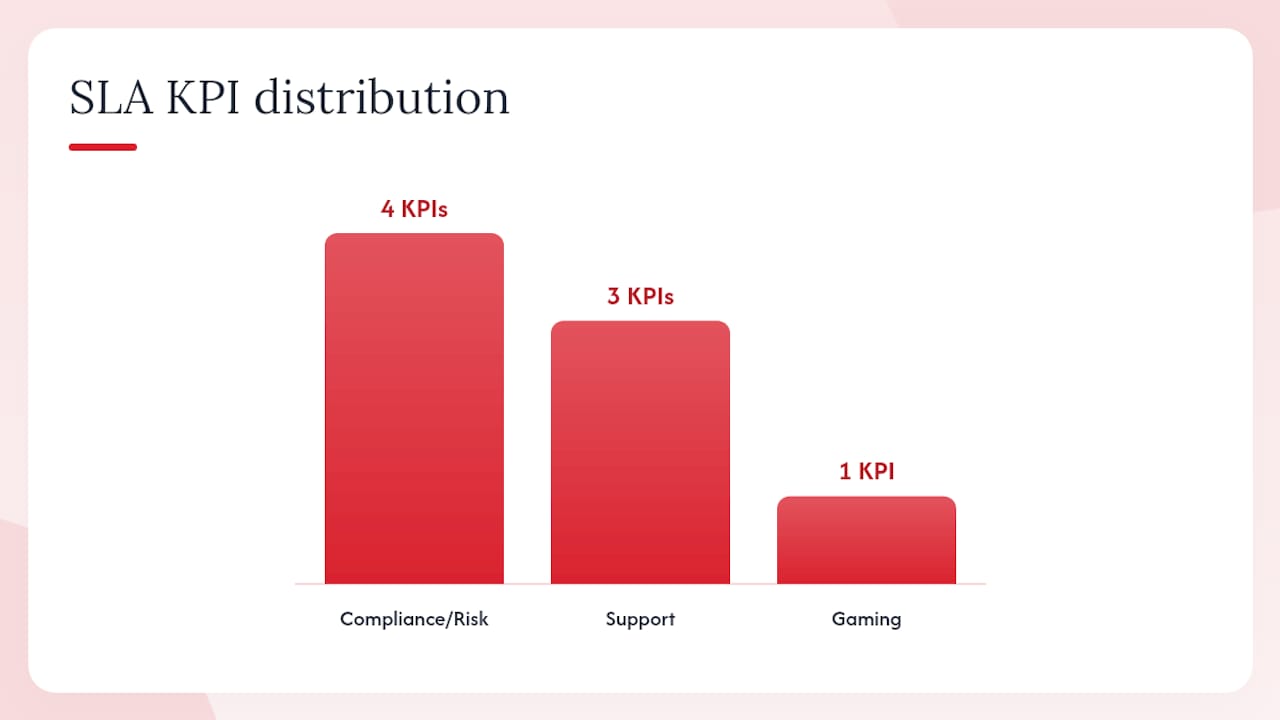
Comm100’s iGaming metric framework groups the metrics you need into three axes: Gaming, Support, and Compliance/Risk. Require all three in your SLA dashboard.
| Metric | Category | Target Range |
|---|---|---|
| KYC Completion Rate | Compliance | A high percentage within SLA window |
| Regulatory SLA Compliance Rate | Compliance | A very high level of compliance |
| Time-to-Self-Exclusion-Honour | Compliance | Under 24 hours |
| AML Alert Rate | Compliance/Risk | Tracked; spikes trigger escalation |
| Chargeback Rate | Gaming/Risk | A low percentage of transactions |
| First Response Time (FRT) | Support | A fast response time for live chat |
| First Contact Resolution (FCR) | Support | A high rate across ticket types |
| CSAT | Support | A high satisfaction score |
One benchmark worth noting: AI handles a high share of incoming chats across industries, but iGaming’s full-resolution rate without human intervention is significantly lower than sectors like banking, because player queries are context-heavy. Plan for hybrid AI and human workflows rather than full automation.
Reporting cadence to require: daily automated alerts for any SLA breach, weekly KPI rollups by ticket type, and monthly compliance packs that include audit logs and agent QA scores. Linking FCR and average resolution time to deposit and retention outcomes in your dashboard is what separates a compliance-grade reporting setup from a basic helpdesk export.
How do you integrate an outsourced team into your tech stack securely?
Integration is where compliance risk concentrates. A vendor with strong SLAs but weak access controls creates more exposure than no vendor at all.
Technical integration checklist:
- SSO and RBAC configured before day one, with agent access scoped to the minimum required
- Ticket routing rules in your help desk (Zendesk, Freshdesk, or equivalent) that segment KYC, payments, and RG tickets from general support
- API access for payment providers and KYC tools granted via service accounts, not personal credentials
- Masked PII views for agents who handle verification but do not need full data access
- Encrypted storage and TLS-in-transit for all data exchanged with the vendor
Security controls to require from the vendor:
- SOC2 Type II report (or ISO 27001 equivalent), current within 12 months
- PCI DSS scope minimization for any agent touching payment card data
- MFA enforced on all vendor systems accessing your environment
- Quarterly vendor access reviews and a documented offboarding process for departing agents
On data privacy: US operators in states with active iGaming markets must align vendor data handling with CCPA/CPRA obligations. Require the vendor to sign a Data Processing Agreement (DPA) that covers data subject access requests, breach notification timelines (72 hours is the standard most operators adopt from GDPR-aligned workflows), and restrictions on cross-border data transfers. If your player base includes EU residents, GDPR obligations for customer support data handling apply alongside CCPA, and the vendor must be able to demonstrate compliance with both.
Escalation paths for fraud, RG, and security incidents must be documented in the contract: the vendor identifies and tags, your internal team receives a structured alert within a defined window, and the vendor takes no unilateral action on sensitive cases.
What SLA terms and pricing structures should you negotiate?
Require penalty clauses that activate only after a defined cure period, not on the first breach. A vendor who faces financial penalties on day one of a ramp has no incentive to flag problems early. Structure penalties to escalate with breach frequency, and pair them with incentive credits for sustained outperformance.
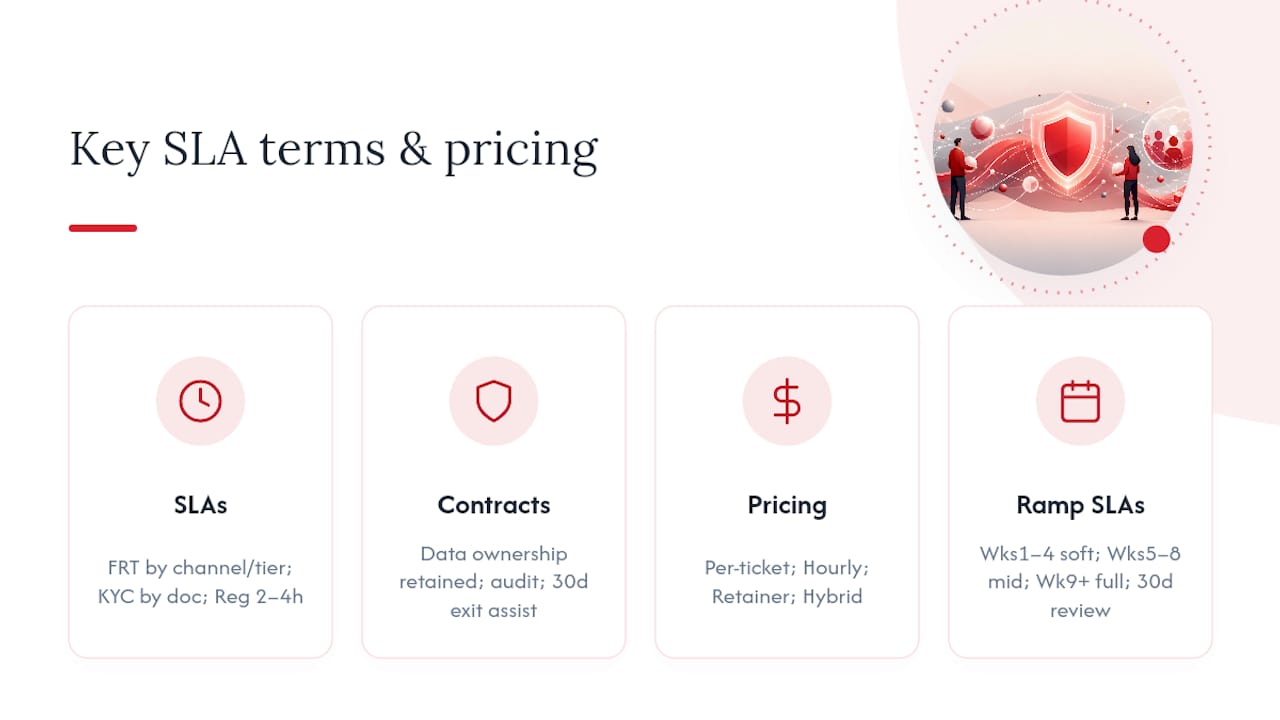
SLA metrics to lock in: FRT by channel and tier (VIP gets a tighter window than standard), KYC completion SLA by document type, withdrawal handling SLA by payment method, and regulatory incident response time (typically two to four hours for a first acknowledgment).
Contract clauses to require: data ownership stays with the operator at all times, audit rights allow you to inspect vendor systems and logs on reasonable notice, subprocessor lists are disclosed and updated when changed, and termination assistance (data export, knowledge transfer) is included for a minimum of 30 days post-contract.
Pricing models: per-ticket pricing suits lower-volume operations with predictable ticket types. Hourly billing fits burst capacity needs. A dedicated team retainer is the right structure for VIP-centric or high-volume operations where consistent agent familiarity with your player base matters. Hybrid models, a retainer base plus per-ticket overflow, work well for operators with seasonal peaks.
Pro Tip: Negotiate phased ramp SLAs: a softer target for weeks one through four, a mid-range target for weeks five through eight, and full contractual SLAs from week nine onward. Add a 30-day performance review gate before long-term penalty clauses activate.
How do you prove the support team’s impact on player LTV?
A Comm100 survey of iGaming operators found that the majority want proof of support’s impact on player LTV before increasing investment, but most lack the attribution systems to measure it. The measurement plan below closes that gap.
- Link your data sources: connect your CRM, payments platform, session analytics, and support CRM using a shared player UID. Every support interaction must be tagged with that UID before analysis is possible.
- Define your events: set explicit definitions for “contacted support,” “KYC completed,” “withdrawal resolved,” and “self-exclusion triggered” so cohort analysis is consistent.
- Run a phased experiment: hold back a segment of players from a new support routing or VIP touch cadence for six to eight weeks, then compare deposit frequency, time-to-next-deposit post-contact, and 90-day retention between cohorts.
- Use near-term proxies while attribution matures: change in deposit frequency within 14 days of a support contact, CSAT cohort retention rates, and NPS delta by support channel are measurable within weeks, not quarters.
- Commit to a 6–12 week pilot before drawing conclusions. Decision-quality results require enough volume to separate signal from noise, especially for VIP segments where ticket counts are lower.
What questions should you ask vendors during procurement?
Ask every finalist vendor: “Can you show us a real SLA report from a current client, with the breach log included?” A vendor who hesitates or offers only a clean summary has not been tested under real operating conditions.
Vendor selection scorecard:
- SLA coverage: 24/7 availability confirmed, with documented escalation for holidays and peak events
- Security evidence: SOC2 Type II or ISO 27001 current report, not a self-attestation
- KYC integrations: confirmed API connections with the verification providers your operation uses
- Multilingual coverage: languages confirmed with native-speaker QA, not machine translation
- US operator references: at least one reference from a state-licensed casino or sportsbook; rapid scaling to hundreds of agents across multiple US states is achievable but must be validated in procurement
- QA governance: sample QA scorecard, calibration cadence, and agent attrition rate
Red flags: no audit logs available for inspection, subprocessor list withheld as “confidential,” incident response plan never tested, agent attrition above 30% annually.
Pro Tip: Score vendors on a weighted matrix across the categories above before demos. Weight compliance evidence and US operator references at 30% each. Vendors who perform well in demos but score poorly on documented evidence rarely perform well under regulatory scrutiny.
What does a compliant go-live timeline look like?
A realistic deployment runs eight to ten weeks from contract signature to full SLA acceptance.
- Weeks 1–2 (Contract and onboarding): legal approvals, DPA execution, NDA, and knowledge transfer kickoff. Operator delivers VIP ruleset, RG thresholds, tone of voice guide, and payment provider contacts.
- Weeks 2–3 (Systems integration): SSO and RBAC configured, ticket routing rules built, API credentials provisioned for KYC and payments tools, and masked PII views tested.
- Weeks 3–5 (Agent training and QA): agents trained on your product, player segments, escalation paths, and RG protocols. First QA calibration session completed before any live volume.
- Weeks 5–6 (Soft launch): limited live volume, daily QA reviews, and SLA monitoring under phased targets. Operator compliance team reviews first audit log exports.
- Weeks 7–8 (Full go-live): full volume transferred, standard SLAs active, weekly KPI reporting begins, and 30-day performance review gate set.
Operator tasks that cause the most delays: late delivery of production API keys, incomplete VIP rulesets, and legal review bottlenecks on the DPA. Assign an internal owner to each of these before week one.
The case for compliance-first outsourcing in US iGaming
Workanova has delivered SLA-backed, managed player support for licensed iGaming operators since 2014. The operational reality of US-market support is that compliance pressure and player expectations move faster than most in-house teams can absorb. State-by-state licensing requirements, CCPA obligations, and RG mandates create a compliance surface that a generalist BPO cannot cover without iGaming-specific training and documented QA governance.
What operators consistently underestimate is the cost of the ramp period when it is unstructured. Workanova’s onboarding model delivers 24/7 multilingual coverage across 14+ languages, with agents live and QA-calibrated in weeks, not quarters. SLA governance and compliance reporting are built into the engagement from day one, not retrofitted after the first audit.
Workanova delivers turnkey compliance player support for US operators
US-licensed operators evaluating outsourced player support need a partner who is already operating inside the compliance requirements of state-regulated markets, not one learning them alongside you.
Workanova provides dedicated, trained support teams covering 24/7 live chat and email, KYC and payments handling, VIP retention, and QA governance, all under documented SLAs. Teams go live in weeks. Scale your player support without building a large internal team and request SLA examples, SOC2 documentation, and a pilot proposal directly from the Workanova iGaming player support page.
Sources
- 41 Essential iGaming Metrics & KPIs Every Operator Should Track

