

iGaming Ticketing: Choosing Managed Support Over In-House
August 17, 2026The fastest way to fix slow payouts isn’t a new payment provider. It’s connecting your payout orchestration directly to your support CRM, embedding KYC and AML checkpoints into the flow itself, and giving agents real-time visibility into where every transaction sits. Do that, and most payouts clear without a ticket ever being opened.
Three moves matter more than the rest:
- Route payouts through an API layer with smart, method-aware logic instead of a single static rail.
- Pre-verify payout methods at the deposit stage so withdrawals don’t stall on identity checks later.
- Push live payment status into the agent’s screen so players get answers without escalation.
Hand your teams this checklist today: engineering exposes payout webhooks to the support CRM, payments sets tiered auto-approve thresholds, support pre-loads scripts tied to payment states, and compliance defines the manual-review triggers. Operators using advanced payment routing report payout success rates as high as 99.7% and deposit conversion near 98.8%. That gap between average operators and top performers is almost entirely an integration problem, not a payments problem.
Key Takeaways
Payout speed and support ticket volume are both direct results of how tightly payment orchestration is integrated with the support CRM.
| Point | Details |
|---|---|
| Integrate orchestration with CRM | Feed payment webhooks directly into the support system so agents see status without a second dashboard. |
| Pre-verify at deposit | Confirm payout methods when a deposit clears, not when a withdrawal request arrives. |
| Automate the closed-loop rule | Auto-flag method mismatches instead of leaving agents to explain AML holds manually. |
| Track P95 payout time | Median payout speed hides the outliers actually driving support tickets. |
| Use a managed partner for scale | Workanova provides 24/7 multilingual payout and KYC support built to absorb volume spikes without new hiring. |
Table of Contents
- How Does Obrada Isplata Podrškom iGaming Actually Work?
- What Integration Points Connect Payments and Support?
- How Do You Embed KYC and AML Checks Without Slowing Payouts?
- Which KPIs Actually Signal a Healthy Payout System?
- What Should Support Scripts Cover for Payout Issues?
- Where Should Ops Leads Start in the Next 90 Days?
- Give Your Payout Support the Same Speed as Your Payments
- Frequently Asked Questions
- Sources
How Does Obrada Isplata Podrškom iGaming Actually Work?
Obrada isplata podrškom igaming, or payout processing supported by player service teams, follows a predictable pipeline: request, verification, routing, settlement, and reconciliation. A player submits a withdrawal, the system checks it against KYC and AML rules, an orchestration layer picks the fastest valid rail, funds settle, and finance reconciles the transaction against the ledger.
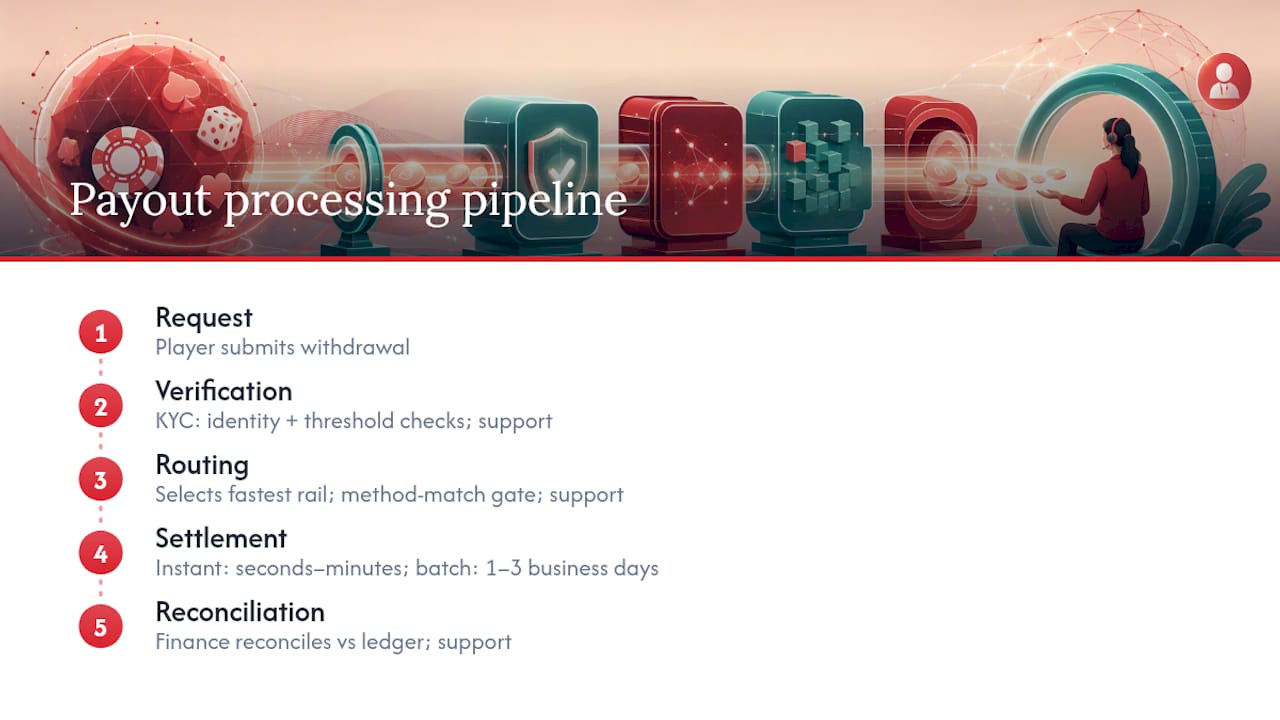
Instant methods (SEPA Instant, Faster Payments, PIX, push-to-card, e-wallets) clear in seconds to minutes. Batch methods, mainly bank wires, take one to three business days and generate the bulk of support tickets simply because players have no visibility during the wait. Inpay documents instant, multi-currency cross-border payouts running 24/7 across more than 90 countries, which is the benchmark worth aiming for if your current stack still leans on wires as a default.
Mandatory AML gates sit at three points: identity verification before first payout, method-matching against the deposit source, and threshold checks above set limits. Support agents need visibility at each gate, not just the finance team.
Pro Tip: Map your payout flow on one page and mark every point where a human, not a system, currently makes the call. Those are your bottlenecks.
What Integration Points Connect Payments and Support?
The gap between a payout system that runs quietly and one that floods your queue comes down to specific technical hooks. Miss one, and agents end up manually checking a payment dashboard for every player who asks “where’s my money.”
Build these connections first:
- Payment orchestration API feeding transaction state directly into the support CRM, not a separate finance tool.
- Webhook events for every payout status change (initiated, processing, paid, failed, returned).
- Pre-verification flags attached at deposit time so a payout method is already trusted before a withdrawal request exists.
- Name and IBAN matching run automatically against the account holder, not manually by an agent.
- Dispute and chargeback lifecycle events synced so support sees a chargeback the moment finance does.
- Reconciliation endpoints exposing settlement status so agents can confirm a payout actually left the account, not just that it was approved.
Automation rules do the heavy lifting once those hooks exist. Auto-close the ticket when a webhook fires “paid.” Auto-route to the KYC queue when the system flags a method mismatch. Pre-authorize a payout method the moment a deposit clears, so the withdrawal request itself becomes a formality rather than a review.
Each team owns a distinct piece:
- Engineering builds and maintains webhook reliability, including retry logic and event deduplication.
- Payments sets SLA targets per rail (instant methods under 5 minutes, wires under 24 hours) and manages backup providers.
- Support configures CRM fields to surface payment state without a second login.
HiPay’s iGaming guidance recommends maintaining core and backup payment partners specifically so a single provider outage doesn’t stall every withdrawal in a market.
Pro Tip: Build idempotency keys into every webhook call. Duplicate “paid” events without them will trigger duplicate agent notifications and confuse players who get the same confirmation twice.
Pro Tip: Set a retry window of at least 15 minutes with exponential backoff before you treat a webhook as failed and fall back to manual reconciliation.
How Do You Embed KYC and AML Checks Without Slowing Payouts?
Compliance controls that live outside the payout flow create the delays players complain about most. The fix is building verification into the pipeline itself, not bolting it on as a separate review step after a withdrawal request lands.
Run these checks automatically:
- Enforce the closed-loop rule: payouts must return to the original deposit method up to the deposit amount, a standard AML control across regulated markets.
- Match payer name and IBAN against the account holder on file.
- Screen against sanctions and politically exposed person (PEP) lists on every withdrawal above a set threshold.
- Trigger manual review or a source-of-funds request when a payout exceeds tiered limits.
Support needs the compliance status visible directly on the player’s account record, not buried in a separate system. When an agent sees “method mismatch” as a flag rather than a mystery, they can explain the hold instead of escalating blind. A tiered review framework works well here: broad auto-approve under a set amount for fully verified players, manual review for mismatches or large sums, and flagged investigation for suspicious patterns.
Agents handling a method mismatch can say plainly: “Your withdrawal needs to return to the card or account you deposited from, that’s a standard security rule, not something specific to your account.” That single sentence, delivered consistently, prevents most repeat tickets on this topic. Workanova’s KYC verification guidance covers the documentation side operators need to keep this process defensible.

Pro Tip: Use Open Banking data services to pre-verify payer identity at deposit. It cuts false-positive holds on legitimate players significantly more than tightening manual review criteria after the fact.
Which KPIs Actually Signal a Healthy Payout System?
Payout health shows up in a handful of numbers, and most operators only check them after a spike in complaints. Track them continuously instead.
Watch these metrics:
- Payout success rate — the percentage that complete without failure or manual intervention.
- Instant-coverage percentage — the share of payouts settling through an instant rail versus batch.
- Mean time to payout, tracked at both median and P95, since the P95 figure exposes the outliers driving tickets.
- Ticket volume per 1,000 payouts — a direct measure of how much friction the system creates.
- Auto-approve rate — how much of your compliance review is actually automated.
- Chargeback rate and reconciliation mismatch rate — early warning signs of fraud or integration errors.
Trustly reports more than 95% instant payout coverage across 30 European markets, a useful external benchmark when negotiating provider SLAs.
What Should Support Scripts Cover for Payout Issues?
Four ticket types account for most payout complaints: verification holds, method mismatches, failed transfers, and FX or fee disputes. Each needs a consistent, pre-approved response so agents aren’t improvising explanations of compliance policy under pressure.
Use these as starting templates:
- Verification hold: “Your withdrawal is pending a standard identity check. This typically clears within [SLA window] and doesn’t affect your balance.”
- Method mismatch: explain the closed-loop rule plainly, without implying suspicion of the player.
- Failed transfer: confirm the funds returned to the player’s balance and give a clear retry timeline.
- FX or fee complaint: point to the fee schedule shown before the withdrawal was confirmed, since hidden fees are a leading driver of repeat contact on this topic.
Escalation should be mechanical, not improvised: collect the transaction ID, payment provider logs, and webhook history before contacting finance, and set a clear expectation (typically 24 to 48 hours for finance-level investigation). When payment-status webhooks feed the CRM directly, agents can auto-update players without manually checking a separate dashboard, which is the single biggest time-saver in a payout queue. Workanova’s guide to help desk software for iGaming covers what to look for in a platform that supports this kind of webhook-driven automation.
Pro Tip: Display the exact FX rate and fee amount before the player confirms a withdrawal, not after. It cuts fee-related tickets more than any script change.
Where a Managed Support Partner Fits Into Payout Operations
Scaling payout support in-house means hiring and training specialists in KYC review, multilingual communication, and payment escalation, all before a single jackpot weekend tests the system. A managed partner shortens that runway. Workanova’s iGaming player support model runs onboarding through knowledge transfer, CRM and webhook configuration, a supervised pilot, then full handover, typically live within weeks rather than months.
What operators gain during high-volume payout events:
- 24/7 multilingual coverage across 14+ languages, so payout inquiries don’t queue overnight.
- Trained KYC and payments handling built into the support workflow, not treated as a separate escalation.
- VIP and retention specialists who understand high-value withdrawal sensitivity without needing a script for every scenario.
Where Should Ops Leads Start in the Next 90 Days?
Assign three tracks now: engineering builds webhook integration and payout status routing, payments negotiates SLA terms with backup providers, and support pre-loads the scripts above and trains on the compliance flags. Treat webhook integration and pre-verification as quick wins; treat multi-provider redundancy as the higher-effort item worth phasing in over 60 to 90 days. Measure payout success rate and ticket volume before and after each change, and adjust based on what actually moves.
Give Your Payout Support the Same Speed as Your Payments
If your payments stack already runs instant rails but your support team still can’t tell a player whether their withdrawal cleared, the gap isn’t technology. It’s staffing a team trained to work inside that payment data every hour of the day. Workanova builds that team for you: a dedicated, multilingual support group live within weeks, trained on KYC and payments handling from day one, with webhook and CRM integration built into onboarding rather than left as a phase-two project.
During a jackpot drop or a major sporting event, payout ticket volume can spike overnight, and hiring temporary agents rarely works fast enough to matter. Workanova’s player support outsourcing for iGaming operators is built specifically to absorb that surge without a hiring cycle. If you’re preparing for a traffic peak, the World Cup 2026 readiness guide walks through the staffing math. Book a technical discovery call to see how fast your CRM and webhook setup could go live.
Frequently Asked Questions
What does “obrada isplata podrškom igaming” mean in practice?
It refers to processing player payouts with player support directly integrated into the workflow, so agents can see payment status, resolve compliance flags, and answer withdrawal questions without escalating to a separate finance team.
How fast should an instant payout method clear?
Instant rails like SEPA Instant, Faster Payments, and e-wallets typically settle within seconds to a few minutes. Anything routed through a wire will take one to three business days regardless of how well the support integration is built.
Why do payouts have to return to the original deposit method?
This is the closed-loop rule, a standard AML control requiring payouts to return to the same method used for deposit, up to the deposit amount, before any excess can go elsewhere.
What’s the biggest lever for reducing payout support tickets?
Pre-verifying payout methods and completing KYC at registration, rather than at withdrawal, removes the single largest source of delay and repeat contact.
Should support agents have direct visibility into payment status?
Yes. Agents working without real-time payment visibility end up guessing or escalating unnecessarily, which increases both ticket volume and resolution time.
Sources
- Which systems support real-time payment routing and intelligent orchestration — Nuvei
- Trustly for iGaming Payments
- Closed-loop payouts explained — Brite Payments
- iGaming Payments — Inpay

