

Jackpot Drop Player Support: Your Operator Playbook
August 15, 2026The fastest, lowest-risk path to compliant 24/7 player support is a managed, AI-orchestrated ticketing model, meaning a support partner whose console reads and writes directly into your PAM, payments, KYC, and CRM systems, rather than a standalone helpdesk that requires agents to tab between six tools to close one ticket.
This is the core of effective upravljanje tiketima igaming (iGaming ticket management): combining real-time system orchestration, AI triage that filters out routine noise, and trained human agents who step in for VIPs, disputes, and anything regulators will ask about later. Real-world deployments show AI agents handling 65 to 80% of incoming tickets autonomously when the automation layer has genuine read/write access to the operator stack, not just a canned-response library bolted onto a chat widget.
Why does orchestration matter more than the ticketing software’s interface? Because a support agent who can’t see KYC status, bonus eligibility, or withdrawal history inside the ticket has to open three other tabs to find that information, and every one of those context switches adds minutes to resolution time during exactly the moments (jackpot drops, World Cup weekends, promo launches) when minutes matter most.
Who to shortlist and why:
- Workanova — a managed, outsourced player support provider offering 24/7 multilingual coverage, VIP/retention pods, KYC and payments handling, and SLA-governed escalation, live within weeks rather than months.
- Optimove — a CRM and marketing personalization platform for iGaming; strong for player engagement campaigns, but it is not a ticket orchestration or support-desk system.
- Zendesk — a general-purpose helpdesk platform with iGaming-specific messaging, including claims of automating 80%+ of inquiries that operators should validate against their own pilot data before signing anything.
Quick Stat: Operators running orchestrated AI ticketing report 65 to 80% of routine tickets resolved without human intervention, with additional proactive ticket avoidance when root-cause issues get fixed upstream.
Key Takeaways
Managed, AI-orchestrated ticket support with real-time integration into PAM, payments, KYC, and CRM systems delivers faster resolution and audit-ready compliance than isolated helpdesk software.
| Point | Details |
|---|---|
| Pick a pilot domain first | Start orchestration with your highest-volume category, usually withdrawals or KYC resubmissions, over a 2 week test. |
| Demand read/write access | Require orchestration into PAM, payments, and KYC in your RFP, not just read-only dashboards. |
| Require traceable policy logs | Every regulated decision, like a bonus dispute or withdrawal ruling, needs an audit trail tied to the specific policy applied. |
| Set VIP-specific SLA targets | VIP tickets need tighter response and resolution windows than standard queues to protect retention. |
| Consider a managed partner | Workanova delivers 24/7 multilingual support with orchestration, VIP pods, and SLA governance live within weeks. |
Table of Contents
- How Do You Choose the Right iGaming Ticketing Solution?
- Why a Managed, Orchestrated Support Model Works Best
- What Successful iGaming Ticket Orchestration Looks Like in Practice
- What Support Operators Get Wrong About Ticket Orchestration
- Get Your iGaming Ticketing Live in Weeks, Not Months
- Frequently Asked Questions
- Sources
How Do You Choose the Right iGaming Ticketing Solution?
Picking between in-house software, an outsourced managed team, or a hybrid model comes down to five questions you can answer in a single vendor call, if you ask the right ones.
Start with the feature checklist. A ticketing system built for iGaming needs to do more than log conversations. It needs real-time orchestration that reads from your PAM, hits your KYC provider, checks the bonus engine, and writes the resolution back, all without an agent leaving the ticket screen. It needs multichannel coverage across live chat, email, voice, and messaging apps, feeding into one unified player view. And it needs audit logging that ties every resolution to the specific policy rule applied, since a bonus dispute or a withdrawal delay is a regulated decision, not just a customer service moment.
- Real-time read/write access to PAM, payments, KYC, and CRM
- Unified player context panel showing balance, session history, bonus state, and KYC status in one screen
- Multichannel intake (chat, email, voice, social/messaging) routed into a single queue
- Policy-linked audit logs for every ticket resolution, not just a timestamp
A unified context panel that surfaces balance, recent sessions, bonus state, and KYC status in one sidebar cuts the back-and-forth that otherwise stretches a five-minute ticket into a fifteen-minute one.
Then test the AI claims against a pilot, not a slide deck. Vendors love to quote automation percentages. What you actually need to see is AI workflow logic that sorts tickets by game type, player tier, and urgency, then routes the ones it can’t resolve to the right human queue instead of a general inbox. Ask for a live pilot with your own ticket volume before you trust any vendor’s automation number, including the ones cited in this article.
Set your SLA and KPI bands before you shop, not after. Here’s a starting framework most mid-size operators can adapt:
- Confirm integration depth. Ask for API and webhook documentation, not a marketing page. If the vendor can’t show you a working connection to a PAM similar to yours, treat that as a delay risk.
- Verify data residency and certifications. GDPR compliance statements and recognized security certifications should be available on request, not buried in a sales deck.
- Run a phased pilot. Two to six weeks on your highest-volume ticket category (usually withdrawals or KYC Level 1/2) tells you more than any reference call.
- Budget for change management. Staff training and knowledge-base alignment take longer than the software rollout itself.
- Price it by model. Per-ticket pricing suits low-volume operators; per-seat or managed-fee pricing suits operators scaling past a few thousand tickets a month.
Pro Tip: Ask every ticketing vendor to show you a resolved ticket’s audit trail, not just its resolution time. If they can’t produce the specific policy rule that was applied to a bonus or withdrawal decision, that’s a governance gap regulators like the MGA or UKGC will eventually flag.
Watch for three red flags during due diligence: vendors who avoid traceable policy logs, vendors who promise automation rates with no pilot data to back them, and vendors running black-box AI with no visibility into how a decision was reached. Any one of these turns a routine audit into a multi-week scramble.
Why a Managed, Orchestrated Support Model Works Best
Building an in-house ticketing operation that hits enterprise SLAs typically takes six to twelve months: hiring, training, integrating your PAM, and building the governance layer regulators expect. A managed provider with existing orchestration infrastructure compresses that into weeks.
Workanova runs this model specifically for licensed iGaming operators. The setup includes dedicated multilingual teams across 14+ languages, 24/7 live chat and email coverage, VIP and retention pods staffed separately from general support, KYC and payments handling built into the ticket workflow, and second-line escalation with SLA governance baked in from day one, all detailed on the iGaming player support page.
This approach fits best in a few specific scenarios:
- Rapid scale-ups that need support capacity to grow without a proportional hiring spree.
- Peak traffic events like jackpot drops or major sporting finals, where ticket volume can spike 5 to 10 times overnight and internal teams often collapse under the load.
- Regulated markets requiring audit-ready decision logs that trace every bonus or withdrawal ruling back to the exact policy applied.
- Operators where in-house hiring is impractical, whether due to cost, geography, or the multilingual coverage a single-region team can’t provide.
A managed team with orchestration access resolves KYC and payments tickets faster than a stretched internal team simply because the agent never leaves the ticket to check a status in another system. That single design choice, giving the support console read/write access instead of read-only visibility, is what separates a ticketing setup that survives a traffic spike from one that buckles under it.
VIP retention is where this gap shows up fastest. A VIP player with a delayed withdrawal doesn’t wait patiently while an overworked internal agent hunts through three admin panels. A dedicated VIP pod with structured SLA tiers and direct system access resolves that same ticket in minutes, and that speed is often the difference between a retained high-value player and a churned one.
What Successful iGaming Ticket Orchestration Looks Like in Practice
The pattern across successful deployments is consistent: operators who start narrow and expand see faster returns than operators who try to overhaul every ticket category at once.
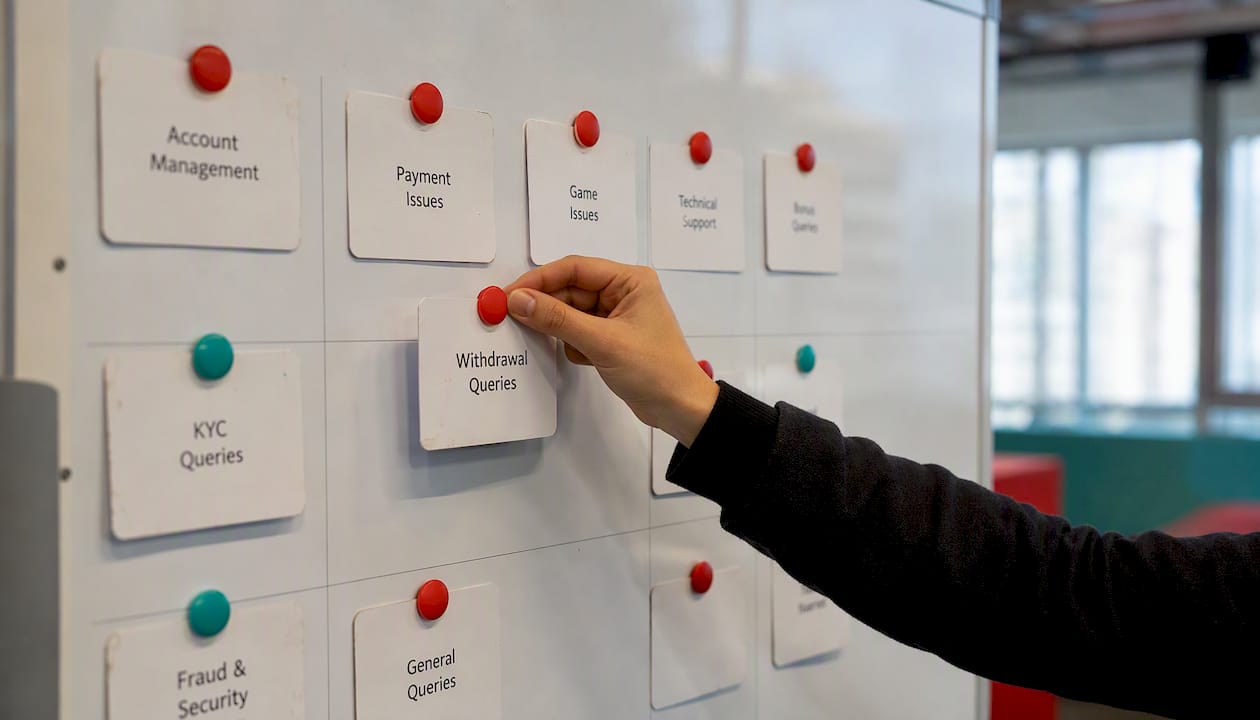
A typical rollout targets the single highest-volume ticket domain first, usually withdrawal status inquiries or KYC document resubmissions, and builds orchestration around that one workflow before touching anything else. The support team gets read/write access to the payments system and KYC provider for that specific category, AI triage handles the routine “where’s my withdrawal” volume, and human agents focus on exceptions and disputes. Once that domain hits its SLA targets consistently, the same orchestration pattern extends to bonus disputes, then account verification, then general account questions.
Integrated resort operators offer a useful parallel outside pure online sportsbooks. Ticketing platforms in physical resort and entertainment venues treat complimentary tickets and internal cross-charging as fully reportable financial events, with audit trails down to the cent. That same discipline, treating every resolution as a traceable, accountable event rather than a closed chat window, is exactly what regulated iGaming operators need from their ticket queues. A bonus credited or a withdrawal approved is a financial decision whether it happens in a casino cage or a live chat window, and it needs the same audit rigor either way.
The operators who see the strongest results are the ones who resist the urge to automate everything simultaneously. Phased orchestration, one high-volume category at a time, gives your compliance team a chance to validate the audit trail before volume scales, and gives your support agents time to trust the AI’s triage decisions instead of second-guessing every routed ticket.
What Support Operators Get Wrong About Ticket Orchestration
Most implementation failures don’t come from bad software. They come from sequencing mistakes and skipped change management.
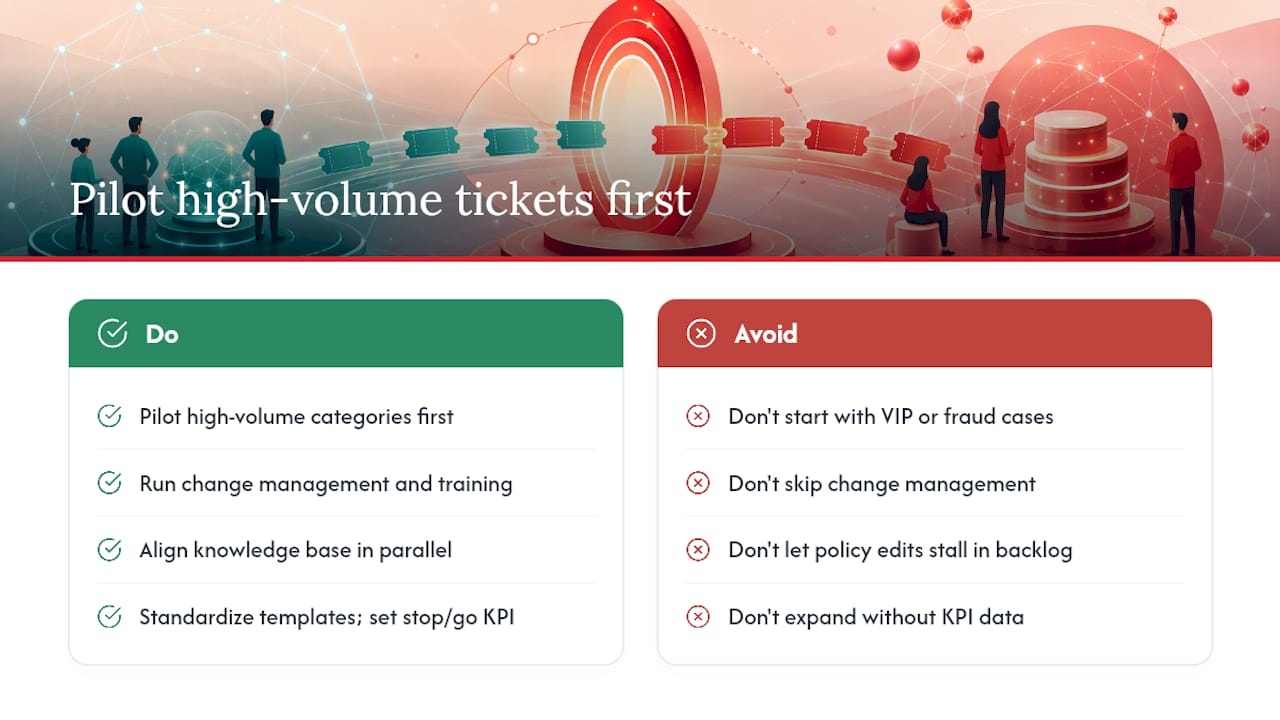
Start with the highest-volume ticket category, not the most complex one. Operators who try to orchestrate VIP escalations or fraud disputes first, because those feel like the highest-stakes tickets, usually stall out. Those categories require the most judgment and the least standardization. Withdrawals, KYC resubmissions, or basic promotions questions are higher volume, more repetitive, and far easier to validate against clean SLA data in a two-to-six-week pilot. Prove the model works there, then widen scope.
Change management matters more than most rollout plans admit. Staff need training that goes beyond “here’s the new tool.” They need to understand why the AI routed a ticket the way it did, so they trust the system instead of manually overriding every automated decision out of habit. Knowledge-base alignment has to happen in parallel, since an AI triage layer is only as good as the policy documentation it’s pulling from. And you need a governance loop for policy edits, meaning when a bonus rule changes, that update needs to reach the ticketing logic within days, not through an engineering ticket that sits in a backlog for a month.
A few quick wins compound fast once the pilot is live. Standardize ticket templates so agents aren’t reinventing responses for the same five recurring issues. Tune triage rules specifically for VIP tiers, since a generic urgency score misses the commercial weight of a high-value player’s complaint. And instrument a clear stop/go KPI for each domain before you expand, so you’re expanding based on data, not optimism.
Get Your iGaming Ticketing Live in Weeks, Not Months
Workanova lets you scale player support through jackpot drops, sports finals, and regulatory audits without hiring and training ten new agents every time volume spikes. That’s the practical difference between a managed model and building in-house: you get a trained, multilingual team live within weeks, backed by published SLAs and orchestration into your PAM, payments, and KYC systems from day one.
If you’re evaluating pilot scope, start with your highest-volume ticket category, whether that’s withdrawal status or KYC resubmissions, and run it as a contained two-to-six-week test. Workanova’s iGaming support outsourcing page outlines service options for operators at different stages, and the scaling playbook walks through how operators replace a hiring spree with a managed engagement instead. Reach out for a readiness call to scope your pilot domain and get a straight answer on timeline and coverage.
Frequently Asked Questions
What is the best approach to upravljanje tiketima igaming for a mid-size operator?
A managed, AI-orchestrated model that integrates with your PAM, payments, and KYC systems typically outperforms standalone in-house software for operators without a dedicated engineering team to build and maintain that integration layer themselves.
How much of iGaming ticket volume can realistically be automated?
Operator deployments with genuine system orchestration report 65 to 80% of routine tickets resolved autonomously, though this figure depends heavily on how deeply the AI layer connects to your actual backend systems.
Should VIP tickets go through the same automated triage as standard tickets?
No. VIP tickets need dedicated routing to trained human agents with tighter SLA windows, since automated triage tends to underweight the commercial value of a high-tier player’s issue.
What’s the typical timeline to launch a managed ticketing pilot?
Most operators can scope and launch a focused pilot, targeting one high-volume ticket category, within two to six weeks when working with an established managed support provider.
Do complimentary tickets and bonus credits need the same audit trail as paid transactions?
Yes. Integrated resort ticketing platforms already treat comps as reportable financial events, and the same standard applies to bonus credits and promotional adjustments in regulated iGaming environments.
Sources
Operators building a business case for orchestrated ticket management can validate the claims in this article against a few additional resources:

