

Choosing an iGaming BPO Partner Without Adding Risk
August 21, 2026For licensed casino and sportsbook operators, migrating player support to a licence-grade managed provider is the fastest way to gain 24/7 multilingual scale and regulator-ready KYC handling, provided you lock in data ownership and acceptance gates before you sign anything. A help desk migration igaming project succeeds or fails on that sequencing.
The recommendation is direct: choose a managed provider with proven iGaming licence experience over a generic BPO or a DIY software swap when your priority is 24/7 multilingual coverage, KYC throughput, and audit trails a regulator will accept. Your immediate next step should be a scoping call, 30 to 60 minutes, to map non-negotiable integrations and acceptance criteria before any contract talk starts.
- Verdict: licence-grade managed support beats in-house scaling for coverage-heavy, compliance-sensitive work.
- Next step: book a scoping call this week to define integrations and acceptance criteria.
- Evidence to demand: a provider with a real operating history (Workanova has run multilingual player support since 2014), documented seat-to-live timelines measured in weeks, not quarters.
Key Takeaways
A successful iGaming help desk migration depends on proving data ownership and player-journey acceptance criteria before cutover, not on selecting a vendor with the fastest go-live promise.
| Point | Details |
|---|---|
| Define scope before vendor talks | Map authoritative owners for identity, wallet, bonus, and payment data before signing any contract. |
| Test journeys, not features | Run acceptance tests on registration, KYC, deposits, withdrawals, bonus settlement, and disputes. |
| Build rollback triggers upfront | Set measurable thresholds for unmatched transactions and dispute delays with named owners. |
| Assign durable post-launch owners | Put one person in charge of data quality, reconciliation, incidents, and change requests. |
| Choose a licence-grade partner | Workanova has run 24/7 multilingual player support since 2014, with teams live in weeks under strict SLAs. |
Table of Contents
- What Does an iGaming Help Desk Migration Checklist Look Like?
- What Is the Migration Roadmap From Discovery to Stabilization?
- Which Roles and Governance Rules Keep a Migration Licence-Grade?
- Which Player Journeys Need Acceptance Testing Before Go-Live?
- How Do You Build a Rollback Plan for a Player Support Migration?
- Who Owns Data Quality and Continuous Improvement After Go-Live?
- What Operators Get Wrong About Help Desk Migration
- How Workanova Executes a Licence-Grade Migration
- Frequently Asked Questions
- Sources
What Does an iGaming Help Desk Migration Checklist Look Like?
Before any vendor sees your requirements document, you need internal clarity on scope, data, and access. Skipping this step is the single most common reason migrations stall at week six instead of finishing on schedule.
- Define scope and exclusions. Decide what stays in-house, usually product decisions, compliance sign-off, and final regulatory reporting, versus what transfers to the vendor.
- Map authoritative data domains. Identity, wallet balances, bonus state, payment references, and support history each need one named system of record. Ambiguity here is where reconciliation failures start.
- List required access. API keys, production data exports, KYC provider credentials, and payment ledger extracts all need to be inventoried and permissioned before pilot testing begins.
- Assemble cross-functional owners. Pull in product, compliance, payments, risk, and CRM leads, not just support management, since cross-functional ownership is what exposes friction points before they become tickets.
- Estimate volumes and peak scenarios. Model your language mix and jackpot-event traffic spikes, since a managed provider’s staffing plan depends entirely on these numbers.
Pro Tip: Request your KYC provider’s throughput logs from your last three verification spikes before the scoping call. Vendors size teams off peak demand, not averages, and vague volume estimates lead to under-resourced pilots.
What Is the Migration Roadmap From Discovery to Stabilization?
A phased rollout, not a weekend cutover, protects both player experience and licence standing. Four phases, each with a defined exit gate, keep the project honest.
- Discovery and mapping. Produce a migration map naming the authoritative owner and downstream consumer for every data field. A PAM migration is an operating-model transition, and success hinges on which journeys get proven before cutover, not on how polished the vendor demo looked.
- Pilot and parallel run. Validate a bounded cohort, a single language or a single product line, while shadowing live tickets and reconciling outcomes against your legacy system.
- Cutover decision. Set explicit criteria for phased versus single-flip migration. Build a rollback decision tree with measurable triggers and named approvers before go-live, not during an incident.
- Stabilization and reconciliation. Define your reconciliation window, your manual intervention rules, and exactly how long legacy read-only access stays available. Balance reconciliation and open-case handoff deserve their own runbook, because a short maintenance window alone does not prove a cutover is safe.
Typical timelines run:
- Discovery and mapping: 2 to 3 weeks
- Pilot and parallel run: 3 to 4 weeks
- Ramp and cutover: 1 to 2 weeks
- Stabilization: 2 to 4 weeks post-launch
Licence-grade desks that follow a regulator-standard assessment and gated pilot can reach live handling in roughly eight weeks. Faster is possible, but only when your discovery phase is genuinely complete.
Which Roles and Governance Rules Keep a Migration Licence-Grade?
Your operating model, not your ticketing software, is what a regulator actually cares about. The roles below need named owners on both sides of the contract.
- Operations lead: owns the day-to-day relationship and escalation authority.
- Support lead and agents: handle Tier 1 and Tier 2 volume, live chat, email, and phone across your language footprint.
- VIP owner: manages high-value player relationships with a dedicated escalation path, separate from general queue handling.
- Payments and risk owner: signs off on KYC exceptions and payment holds.
- CRM and platform admin: maintain integration health between the vendor’s tools and your core systems.
Shift handover needs a written protocol, not a verbal pass. QA cadence should run daily spot checks and weekly deep reviews. Because iGaming support carries distinct pressure around bonuses, payment disputes, and verification, your vendor contract needs named SLA owners and a regulator-ready audit trail, not a generic service-level summary.
Pro Tip: Keep final compliance sign-off in-house even when you outsource frontline support. A vendor can execute KYC workflows expertly, but the licence sits with you.
Which Player Journeys Need Acceptance Testing Before Go-Live?
Acceptance testing is where migrations actually get proven or exposed. Test the journeys that create real financial or regulatory exposure, not just the easy ones.
| Player Journey | Acceptance Criteria | Reconciliation Method |
|---|---|---|
| Registration and KYC | Verification completes within provider SLA; document status matches source system | Cross-check KYC provider logs against CRM status |
| Deposits and withdrawals | Transaction status matches ledger within agreed window | Match payment references against processor records |
| Bonus settlement | Bonus terms apply correctly to eligible accounts | Compare bonus engine output to wallet balance |
| Account restrictions | Restriction applied and reflected across all channels immediately | Audit restriction logs against support tickets |
| Password recovery | Recovery completes without support escalation in standard cases | Track ticket volume tied to recovery flow |
| Dispute handling | Dispute resolved within defined SLA with documented outcome | Review case logs against resolution timestamps |
Your first 90 days should track failed or delayed journeys, manual interventions per week, unmatched transactions, and time-to-resolve compared against historical baselines. Assign one owner per KPI and report weekly during stabilization, then move to monthly once trends flatten.
A gated pilot that proves these journeys under regulator-standard assessment before live handling materially lowers your licence risk. Skipping journey-level testing in favor of a general go-live checklist is how operators end up debugging KYC failures in production.
How Do You Build a Rollback Plan for a Player Support Migration?
Rollback planning is not pessimism. It is what separates a controlled migration from a licence incident.
Watch for four failure modes: balance reconciliation mismatches, KYC throughput drops, payment reference errors, and VIP experience degradation. Each needs a measurable rollback trigger, for example a defined percentage of unmatched transactions or a median dispute resolution delay beyond your SLA threshold, with a named owner authorized to pull it.
- Keep read-only legacy system access available through stabilization.
- Staff a temporary manual reconciliation team for the first two weeks post-cutover.
- Have payment holds and a VIP hotline ready as fallback controls.
- Confirm your contract includes SLA remedies and exit support, not just uptime guarantees.
Pro Tip: Write your rollback thresholds into the contract before signature, not into a shared document after go-live. Vendors negotiate differently when the trigger numbers are already binding.
Who Owns Data Quality and Continuous Improvement After Go-Live?
Migration success is measured in month three, not week one. Assign durable owners: one for data quality, one for payment reconciliation, one for incident response, and one for change requests, so ownership doesn’t quietly drift back to whoever answers fastest.
- Daily: ticket volume, unmatched transactions, and open incidents.
- Weekly: KPI trends, QA scores, and language coverage gaps.
- Monthly: change request backlog, training needs, and contract performance against SLA.
Route change requests through a triage owner before they become ad hoc fixes, which is how operational debt accumulates. Pair ticket QA with language QA and continuous agent training to keep quality from drifting once the initial excitement of go-live fades.
What Operators Get Wrong About Help Desk Migration
Most migration advice treats this as a technology decision: pick a platform, migrate the tickets, retrain the agents. That framing misses the actual risk. The hard part isn’t moving data between systems. It’s proving that a new team, operating under a new set of incentives, handles a withdrawal dispute or a KYC exception the same way your best in-house agent did.
Conventional wisdom also overweights speed. Operators fixate on “how fast can we go live” when the better question is “what did we prove before we went live.” A vendor who can staff 50 agents in two weeks isn’t impressive if none of them have handled a bonus abuse case under your specific terms and conditions. The eight-week timelines that licence-grade providers cite include the gated testing that makes speed safe, not just fast.
If there’s one priority to fix before anything else, it’s ownership clarity. Decide who owns identity data, who owns wallet state, who owns the escalation call on a VIP complaint, before you evaluate a single vendor. Operators who skip that step end up negotiating operational boundaries mid-migration, under pressure, with a partner who already has their staff live.
How Workanova Executes a Licence-Grade Migration
Workanova has run managed, outsourced player support since 2014, with 24/7 multilingual teams covering 14 or more languages, including the Turkish-language coverage many regulated markets now require. That means you’re working with a partner that has already built the governance structures this playbook describes, not one learning them on your account.
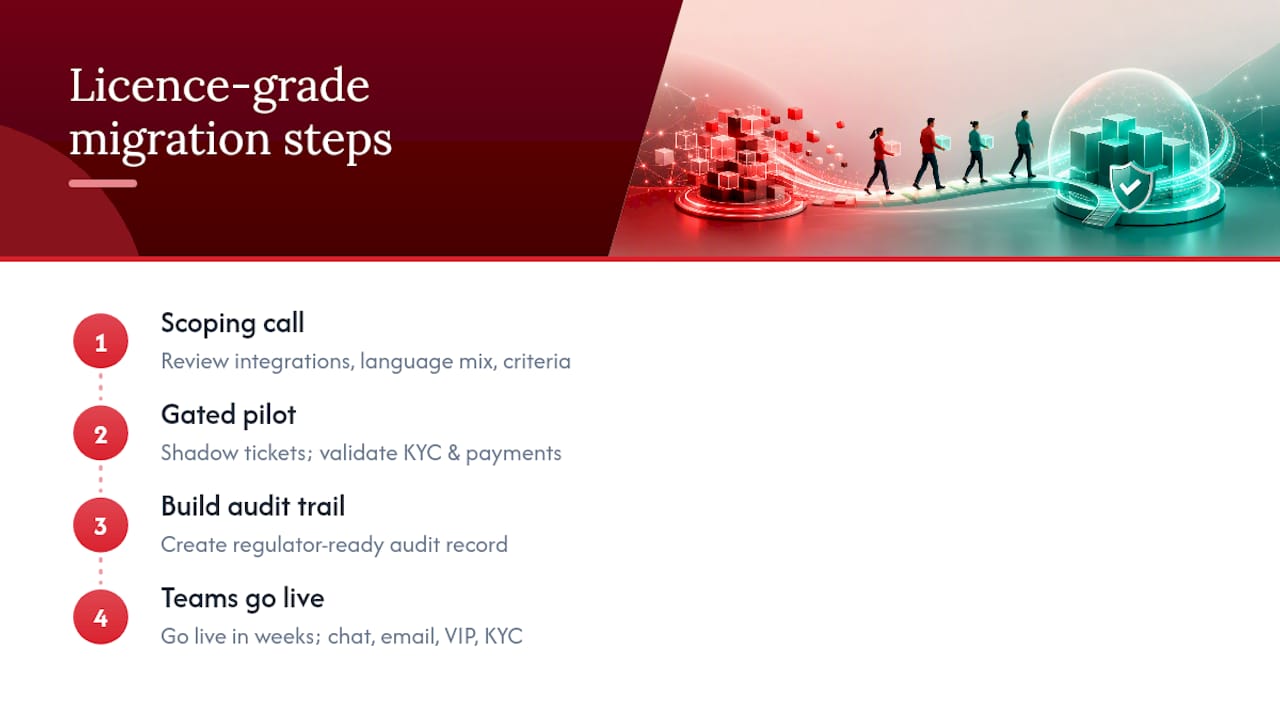
Instead of a generic BPO ramping up unfamiliar agents, Workanova runs gated pilots that shadow your live tickets, validate KYC and payment journeys, and build the regulator-ready audit trail your compliance team will need at renewal. Teams go live in weeks, covering live chat, email, VIP retention, and KYC handling under strict SLAs, so you scale through a jackpot-driven traffic spike without hiring ten times your current headcount.
If you’re mapping your own migration timeline, start with a scoping call to walk through your integrations, language mix, and acceptance criteria. Review Workanova’s iGaming player support page for scope details, or look at how scaling support without adding 50 agents works in practice before your next peak traffic event.
Frequently Asked Questions
How long does a typical iGaming help desk migration take?
Most licence-grade migrations typically run several weeks total across discovery, pilot, cutover, and stabilization. Providers with established regulator-standard assessment processes can reach live handling around the eight-week mark once discovery is complete.
What data should stay under the operator’s control during migration?
Identity verification decisions, final compliance sign-off, and core wallet logic typically remain operator-owned, even when a managed provider handles frontline KYC document review and payment reference checks.
What triggers a rollback during a help desk migration?
Common triggers include a defined percentage of unmatched transactions, dispute resolution delays beyond SLA thresholds, or a measurable drop in KYC throughput. Each trigger needs a named owner authorized to act on it.
Can a phased migration reduce risk compared to a single cutover?
Yes. A phased approach lets you validate one language or product line first, catching integration or reconciliation issues in a bounded environment before the full player base moves.
What should be in the vendor contract beyond service-level agreements?
Look for testable acceptance criteria, documented data access rights, change control procedures, and defined exit support, not just uptime percentages or headline SLA numbers.
Sources
- Player Account Management in iGaming: How to De-Risk a PAM Migration – iGaming Express
- iGaming & Online Betting Support Outsourcing 2026 | Player Care, KYC & Responsible Gaming — PITON-Global

