

Processing iGaming Payouts With Integrated Support: A Playbook
August 19, 2026If you’re outsourcing player support for a licensed operation, shortlist partners that can prove compliance certifications, name specific jurisdictions they’ve supported (UKGC, MGA, or equivalent), and run true 24/7 follow-the-sun coverage. Everything else, including price, comes second. Workanova fits this profile and is worth including on any shortlist built around this standard.
Use this on your next discovery call:
- Ask for documented RG training completion records tied to the specific jurisdiction you’re licensed in.
- Request the KYC/AML escalation protocol, with a real audit trail example, not a policy summary.
- Confirm actual overnight staffing ratios, not just a claim of “24/7.”
Regulators like the UKGC and MGA hold you responsible for outsourced work, and evidence of ISO 27001, SOC 2, or PCI DSS controls is the baseline, not a differentiator.
Key Takeaways
Choosing a BPO partner for regulated iGaming player support requires verifying compliance certifications and RG training records before evaluating price or service breadth.
| Point | Details |
|---|---|
| Compliance comes first | Verify ISO 27001, SOC 2, and PCI DSS evidence before discussing pricing or scope. |
| RG training must be documented | Ask for dated completion records and escalation protocols, not policy summaries. |
| Pilot before you commit | Run a 2 to 5 week pilot with real KYC and RG test cases tied to go/no-go criteria. |
| Onboarding typically takes several weeks | Treat faster promises as a signal that compliance groundwork is being skipped. |
| Workanova fits the checklist | Runs 24/7 multilingual support with documented RG training, KYC handling, and compliance-focused QA since 2014. |
Table of Contents
- What Does Outsourcing iGaming Player Support Actually Cover?
- What Compliance and Security Controls Are Non-Negotiable?
- What Questions Should You Ask a BPO Partner Before Signing?
- How Long Does Onboarding Actually Take?
- Why Should QA Measure Compliance, Not Just Satisfaction?
- How Workanova Maps to the Partner Checklist
- Frequently Asked Questions
- Sources
What Does Outsourcing iGaming Player Support Actually Cover?
Before you write an RFP, you need to know which functions a licence-grade BPO should own outright, and which ones you keep close. Most operators bundle too much or too little into the outsourcing scope, and both mistakes are expensive.
A properly scoped partner typically runs:
- 24/7 live chat and email/ticketing coverage across your peak and off-peak windows.
- Voice support for high-value disputes or regulatory-sensitive conversations.
- KYC and identity verification handling, integrated with providers like Sumsub or Jumio.
- Payments and payout support, including chargeback and delay queries.
- VIP and retention support for high-value player segments.
- Fraud and bonus-abuse review at first-line triage.
- Second-line escalation and trust-and-safety handling.
Integration matters as much as the service list. A capable BPO plugs directly into your helpdesk or CRM, reads transaction logs for payment disputes, and works inside your existing KYC provider’s dashboard rather than asking you to build a parallel system. Specialist providers commonly advertise this exact bundle, pairing 24/7 multilingual support with KYC, AML monitoring, and payments handling under one contract.
Some decisions never leave your building. Final responsible gambling interventions, licence filings, and sanctions reporting stay with the operator, even when your BPO flags the underlying case. A good partner is explicit about this line in the contract; a vague one blurs it, and that ambiguity becomes your regulatory exposure later.
What Compliance and Security Controls Are Non-Negotiable?
Treat every BPO conversation as a compliance conversation first and a customer-experience conversation second. The vendor is functioning as an extension of your compliance perimeter, and you carry the liability if something goes wrong on their side of the phone line.
Certifications and data controls. Ask for current, dated audit reports, not marketing pages claiming compliance. ISO 27001 covers information security management. SOC 2 addresses control effectiveness over time. PCI DSS applies wherever agents touch card or payout data. Data residency terms matter separately from certifications; confirm where player data physically sits and whether that satisfies your GDPR obligations if you serve EU players.
Responsible gambling training. This is where most vendor claims fall apart under scrutiny. Regulators including the MGA expect documented completion records for jurisdiction-specific RG training, along with escalation protocols proving agents can spot and act on welfare concerns outside standard business hours. A vendor who can’t produce a training completion log with dates, agent names, and refresher cycles hasn’t actually built the program. Ask how often refreshers happen and what triggers an off-cycle retrain.
KYC and AML operations. Verification queries need clear escalation thresholds. Low-risk document checks might resolve at first line, but anything touching source-of-funds or high-risk jurisdictions should route through a maker-checker process, where a second reviewer signs off before a decision is finalized. Ask the vendor to walk you through an actual escalation, not a flowchart.
Security and continuity. Segregation of duties matters more in iGaming support than most industries, because the same agent handling a KYC document could theoretically also process a withdrawal. Ask how access controls prevent that overlap. Also ask about business continuity planning specific to iGaming peaks: what happens to your live chat queue if a major site event floods the floor at 2 a.m. local time?

Pro Tip: Don’t accept a certification logo on a slide deck as proof. Ask for the actual audit report or certificate number, and verify it independently before you sign anything.
Due diligence here isn’t optional paperwork. As outlined in guidance on choosing an iGaming BPO partner without increasing risk, the operator remains the party regulators hold accountable, which means RG training proof, KYC/AML protocols, documented payment handling, and real 24/7 staffing evidence all need to be verified, not assumed.
What Questions Should You Ask a BPO Partner Before Signing?
Once a vendor clears the compliance basics, the real evaluation starts. This is where you separate operators who can talk about iGaming from ones who’ve actually run it under licence conditions.
Structure your questionnaire around three categories:
- People. What direct experience does the team have with your specific licence type? Can they show a sample RG training module rather than describe one? What does their background-check process look like for agents handling KYC or payment data? What languages do they support natively, and how do they validate accent and fluency quality, not just a language checkbox?
- Process. What does their escalation matrix look like for a suspicious KYC document versus a player expressing distress? Can they produce two or three operator references you can actually call, and are those references from licensed operators in markets similar to yours?
- Technology. How do they integrate with your existing helpdesk, CRM, and payment provider without custom development on your side? What does their reporting dashboard show you in real time versus what you have to request manually?
Your contract should lock in specific SLA and KPI language, not vague commitments to “high quality service.” Insist on:
- Average handle time (AHT) targets by channel and complexity tier.
- First response time (FRT) for live chat, email, and escalated cases separately.
- Resolution SLA windows, with tighter thresholds for RG and KYC escalations than routine queries.
- A defined escalation SLA specifically for responsible gambling and KYC flags, since these carry regulatory weight routine tickets don’t.
- QA scoring targets that explicitly include RG-language accuracy, not just customer satisfaction scores.
- Reporting cadence, ideally weekly operational reports plus real-time dashboard access.
On pricing, expect one of a few common structures. Per-FTE pricing charges a flat rate per agent regardless of ticket volume, which is predictable but can waste money during quiet periods. By-role pricing tiers rates based on seniority or specialization, useful if you need dedicated VIP agents alongside generalist first-line support. Per-ticket models scale with volume but can get expensive during surges unless capped. Retainer structures blend a base fee with volume-based adjustments and are common for operators with predictable but seasonal traffic. Whichever model you choose, negotiate a trial pilot rate, a ramp-based fee schedule that lowers your cost while the team is still learning your product, and a performance holdback tied to QA and SLA compliance in the first 90 days.
Red flags that should end the conversation immediately:
- No jurisdiction-specific RG training records, only generic customer service training.
- Vague or undocumented escalation protocols for welfare concerns.
- Overnight staffing that’s thin enough to leave players waiting during off-hours incidents.
- Missing or expired SOC 2 or ISO 27001 evidence.
- No audit trail for past KYC decisions, meaning you can’t verify how a prior verification call was actually handled.
Before signing a multi-year contract, run a structured pilot. A two-to-six-week pilot scope should include real test cases: a payment dispute scenario, a suspected fraud pattern, and a simulated RG intervention. Validate that the audit trail captures every decision point, and set go/no-go criteria tied to specific QA and compliance pass rates rather than a subjective “felt fine” assessment.
How Long Does Onboarding Actually Take?
Most licence-grade onboarding runs eight to twelve weeks from discovery to full production, and any vendor promising a two-week go-live for regulated support should raise questions about how much compliance groundwork they’re actually skipping.
| Phase | Typical Timing | What Happens |
|---|---|---|
| Discovery and process audit | Weeks 1 to 2 | Vendor reviews your current workflows, escalation paths, and compliance requirements |
| Curriculum and tooling build | Weeks 3 to 5 | RG and product training built, helpdesk/CRM and KYC provider integrations configured |
| Pilot phase | Weeks 7 to 8 | Capped ticket volume live, dual-running with in-house team on high-risk flows |
| Production ramp | Weeks 10 to 11 | Volume scales, QA gating confirms consistency before full handoff |
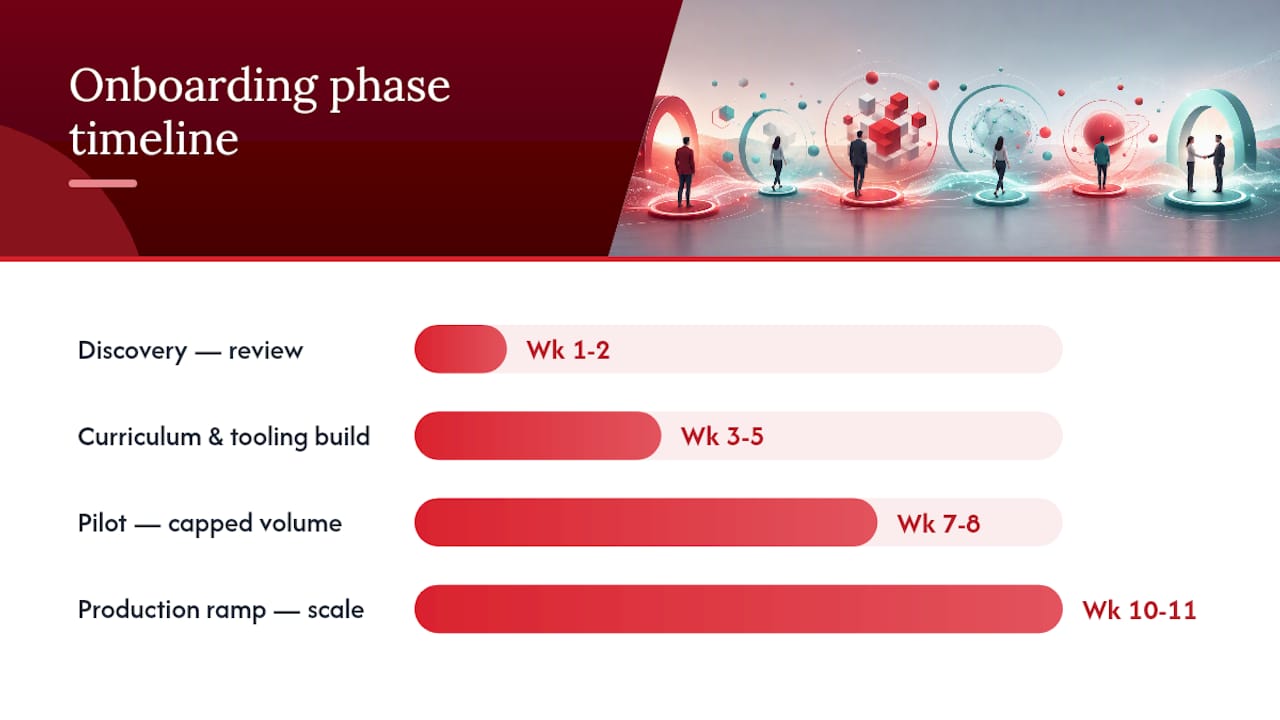
During the pilot, cap volume deliberately rather than flooding the new team immediately. Keep your in-house staff running parallel on high-risk categories like KYC escalations and RG interventions until QA scores hold steady across several weeks. Build a surge playbook before you need it. Offshore teams that handle event-driven volume spikes rely on predictive forecasting and pre-planned staffing, not last-minute scrambling, when a major tournament or sportsbook event hits.
Why Should QA Measure Compliance, Not Just Satisfaction?
A support team can post excellent CSAT scores while quietly mishandling every RG conversation that comes through chat. That gap is exactly what compliance-focused QA is built to catch.
Regulators require documented RG training and escalation protocols, but training records only prove the curriculum existed. QA has to verify agents actually apply it in live conversations. Build your vendor scorecard around specific pass/fail criteria:
- Did the agent select the correct escalation category for the situation?
- Was the correct KYC document checklist applied to that verification type?
- Did the agent follow the correct script steps for payment-handling disputes?
- Is the audit trail complete enough to reconstruct the decision later?
Fold these into every vendor review cycle alongside standard QA metrics, and treat compliance-language QA as a pass/fail gate rather than a percentage blended into an overall satisfaction score.
A publisher’s perspective on partner selection
Compliance-led selection isn’t a slower path, it’s the only one that holds up under audit. Insist on a pilot with real KYC and RG test cases as your go/no-go gate.
How Workanova Maps to the Partner Checklist
You’ve seen the checklist: compliance certifications, documented RG training, real 24/7 coverage, and QA that tests for compliance language, not just politeness. Workanova has built its player support operations around exactly that standard since 2014, running 24/7 multilingual coverage across 14+ languages, with KYC and payments handling built into the same team rather than bolted on separately.
Every agent works from documented RG training records with jurisdiction-specific escalation protocols, and QA scoring includes compliance-language checks, not just satisfaction ratings. If your current setup means hiring and training ten extra agents just to survive a traffic spike or a jackpot drop, that’s a staffing problem Workanova is built to absorb without the twelve-month hiring cycle. Onboarding follows the same phased, audit-friendly timeline outlined above, with a live team typically ready inside weeks rather than quarters.
If you’re ready to test this against your own compliance requirements, request a pilot through Workanova’s iGaming support page and build your go/no-go criteria around real KYC and RG test cases before you commit to anything longer term.
Frequently Asked Questions
What is the biggest mistake operators make when selecting a BPO partner?
Prioritizing price or ticket volume capacity over documented compliance evidence. A vendor without verifiable RG training records or a clear KYC escalation trail can expose you to regulatory risk that far outweighs any cost savings.
Should I outsource KYC verification entirely, or keep it in-house?
Most operators outsource first-line KYC document review while keeping high-risk, source-of-funds decisions under a maker-checker process that includes in-house oversight. This hybrid approach is common precisely because strategic compliance ownership tends to stay in-house even when delivery scales externally.
How long should a BPO pilot run before signing a full contract?
Two to six weeks is typical, long enough to test real KYC disputes, payment escalations, and simulated RG interventions, with go/no-go criteria tied to QA and compliance pass rates rather than a general impression.
Do I need country-specific responsible gambling training for every market I operate in?
Yes. Regulators expect training curricula matched to the specific jurisdiction’s rules, not a generic RG module. Ask any vendor to show a sample module for your exact licensing market before assuming coverage.
What’s a reasonable overnight staffing expectation for 24/7 support?
It depends on your traffic patterns, but a vendor should be able to show actual overnight staffing ratios and historical response times during low-traffic hours, not just a claim that coverage exists around the clock.
Sources
- iGaming outsourcing vs in-house: Team Strategy | Jadex

