

Scaling Player Support Without Hiring 50 Agents
April 30, 2026
Multilingual Customer Support for iGaming Operators
July 21, 2026Should you hire internally or outsource for World Cup 2026 surge capacity? The question sounds operational. It's actually financial. Here's a model built on real iGaming staffing data that shows what each path costs and where the break-even sits for operators of different sizes.
Most operators make this decision based on instinct or historical preference. The ones who get it right run the numbers first. Here's how to build the model for your specific operation.
Cost Input 1:
The true cost of a temporary in-house hire
A temporary iGaming support agent for a 6-week tournament period costs more than their hourly rate. Add: recruitment fees (15-20% of first-year salary even for temps), onboarding and training time (1-2 weeks at full productivity loss), equipment and licensing, HR administration, and the productivity curve (a new agent is at 60-70% effectiveness for the first 3 weeks). True 6-week cost is typically 40-60% higher than the base contract rate.
Cost Input 2:
The revenue cost of under-staffing
If you don't build enough capacity and SLA breaks, the cost isn't just operational — it's revenue. Quantify it: what is your average player LTV? What percentage of players who experience a support failure during a tournament churn within 30 days? Industry data suggests 15-25% churn within 30 days for players with an unresolved complaint. For an operator with 10,000 active players at €150 LTV, every 1% churn costs €15,000 in future revenue.
Cost Input 3:
Outsourcing: what you actually pay
Workanova pricing for World Cup surge capacity (2026): dedicated trained agents, €18-28/hour all-in, no recruitment cost, no equipment cost, 2-week ramp with existing iGaming training, flexible scaling up or down within 48 hours, and a dedicated account manager. For a 6-week tournament requiring 5 surge agents at 160 hours each, total cost: approximately €14,400-22,400. Compare this to your internal cost model before deciding.
The Model:
Break-even analysis by operator size
Small operators (under 5,000 active players): outsourcing almost always wins. Fixed costs of in-house temp hiring are disproportionate to volume. Mid-size operators (5,000-50,000 players): hybrid model typically optimal — existing team handles baseline, outsourced surge handles the peak multiplier. Large operators (50,000+ players): dedicated BPO relationship with surge provisions contractually built in is the standard approach.
The single biggest advantage of outsourcing for a defined tournament period isn't cost — it's speed. Internal hiring takes 6-8 weeks minimum. Outsourcing with a specialist partner takes 2 weeks. The World Cup starts June 11. If you're reading this in May, the internal hiring path is already closed. The outsourcing path is still open — but only for operators who move before the end of May.




Every iGaming World Cup support cost forecast must account for more than agent hours — it must include chargebacks, Trustpilot damage, and post-tournament churn. iGaming support volume during FIFA World Cup 2026 will spike 3–5x baseline for the 39-day tournament window. See why support teams collapse during the World Cup.
Here’s the cost model every iGaming operator needs before signing a support staffing plan. Compare against the cost of scaling player support without hiring. For iGaming market data, see Statista’s online gambling industry overview.
Cost Input 1: iGaming World Cup support cost forecast — your baseline per-ticket cost
Start with your current cost per resolved ticket — typically €3.50–€8.00 for iGaming operators. During the World Cup, this increases because average handle time goes up when agents are under pressure.
Cost Input 2: The cost of a delayed withdrawal ticket
A withdrawal ticket that takes more than 4 hours has a 23% probability of generating a chargeback. Average chargeback cost for iGaming: €35–85 in fees, plus the disputed amount, plus 3–6 months of payment processor relationship damage.
Cost Input 3: Trustpilot score impact on paid acquisition
A 0.5-point drop in Trustpilot score reduces paid acquisition landing page conversion by 8–12% for iGaming operators. At €200,000/month in paid acquisition, a drop from 4.2 to 3.7 costs €16,000–24,000 per month in lost conversions. Learn to protect your Trustpilot score during the World Cup.
Cost Input 4: The cost of outsourced surge capacity
A specialist iGaming outsourcing partner quotes €18–32 per agent hour for surge capacity. For a 45-day window at 20 agents at 8 hours per day, that’s €130,000–230,000. Compare that to the cost of chargebacks, Trustpilot damage, and churn from not having the capacity.
Cost Input 5: The cost of doing nothing
Operators who go in with no surge plan typically see: 15–25% churn increase during the tournament, 200–500 new negative reviews, 3–6 months of depressed paid acquisition, and key staff leaving due to burnout. Also read: how iGaming operators can prepare for the World Cup 2026 traffic surge.
Related resources
Featured analysis: Best iGaming Player Support Companies in 2026 — our full comparison of the leading iGaming player support outsourcing providers, also published on LinkedIn.
Meeting us in person? Workanova is exhibiting at SBC Summit Lisbon 2026 — Stand B606, Hall 2, 29 September to 1 October. Book a slot and we will walk you through how a dedicated player support team is staffed, trained and live in 4–8 weeks.
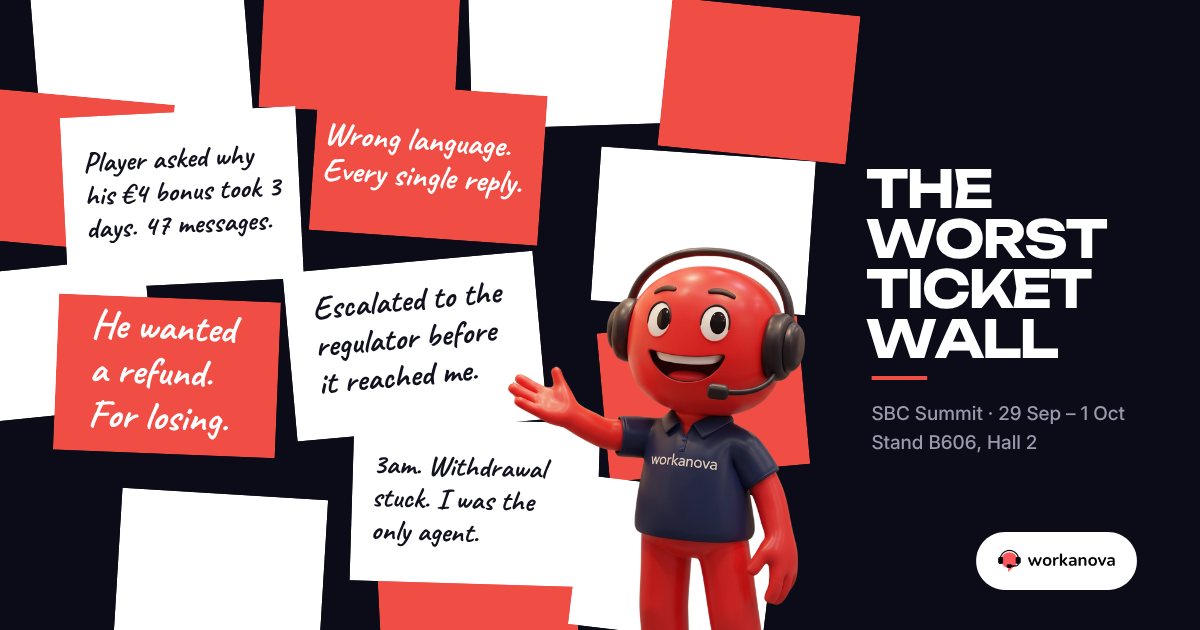
SBC SUMMIT We are exhibiting in Lisbon 29 Sep – 1 Oct · Stand B606, Hall 2.Write your worst support ticket on our wall — best one wins a free month. Book a meeting



1 Comment
I will definitely bookmark this site. Awesome content.