

Operators: Cut VIP Casino Setup Costs by Roughly Half
August 30, 2026Compliant overnight KYC coverage in iGaming comes from dedicated night-shift specialists governed by the same compliance function as your day team, not a scaled-down version of it. Your controls need to cover identity, age, address, sanctions and PEP screening, source of funds, and geolocation, with clear escalation paths into enhanced due diligence (EDD), QA, and structured handovers. If you outsource, the partner must prove trained analysts, written SLAs, and audit trails your regulator can inspect on demand, and you still need a jurisdiction map for every license you hold.
TL;DR:
- Night-shift KYC in iGaming requires the same depth of checks as daytime operations, including identity, age, address, sanctions, PEPs, SOF, and geolocation.
- Risk tiering allows low-risk accounts to be processed automatically, while high-risk cases must always be escalated to senior analysts for review.
- Operators need a jurisdiction matrix based on official regulatory sources to make quick, compliant decisions during late-night hours.
- Fatigue and minimal oversight in early morning hours increase error risk, making dedicated leadership and QA essential for compliance during night shifts.
- Outsourcing providers must demonstrate trained analysts, clear SLAs, and regulator-ready audit exports to ensure reliable 24/7 KYC coverage.
Table of Contents
- What KYC Must Cover for Night-Shift Operations in iGaming
- How Do Jurisdiction Rules Change Overnight KYC Decisions?
- Why Night Shifts Carry More Compliance Risk
- How to Staff and Retain a Night-Shift KYC Team
- Building a Tech Stack for Reliable 24/7 KYC
- What SLAs and QA Should Look Like Overnight
- What a Working Night-Shift KYC Setup Actually Looks Like
- Why Night-Shift KYC Deserves a Seat in Your Compliance Program
- Get Compliant Night-Shift KYC Coverage Without Building It Yourself
- Sources
What KYC Must Cover for Night-Shift Operations in iGaming
Night-shift KYC in iGaming isn’t a lighter version of daytime review. The same regulatory obligations apply at 3 a.m. as they do at 3 p.m., which means your overnight team needs the same depth of checks, just executed under different conditions.
The core checklist looks the same across casino, sportsbook, and daily fantasy sports (DFS) verticals, but the proof standard for each check varies by license:
- Identity verification: government-issued ID matched against a liveness check or selfie capture, cross-referenced with the account holder’s stated details.
- Age verification: documentary proof confirming the player meets the jurisdiction’s minimum gambling age, which is not uniform across states or countries.
- Address verification: a utility bill, bank statement, or government correspondence dated within the last three months in most licensing frameworks.
- Sanctions and PEP screening: automated list checks against global sanctions databases and politically exposed person registers, run at onboarding and re-run periodically.
- Source of funds (SOF): payslips, bank statements, or tax documents once a player crosses a deposit or withdrawal threshold tied to your risk model.
- Geolocation verification: GPS or IP-based confirmation that the player is physically located in a licensed jurisdiction at the time of play.
Risk tiering is what lets a night reviewer move fast without cutting corners. Low-risk accounts with clean automated screening and modest deposit history can clear through straight-through processing. Anything that trips a threshold, unusual deposit velocity, a mismatched document, a PEP hit, a VPN flag on geolocation, should route automatically into EDD. A junior overnight reviewer should never be the final word on an EDD case; that decision belongs to a senior analyst, even if it means the case waits until a senior reviewer is reachable by escalation protocol rather than being pushed through by whoever is on shift.
How Do Jurisdiction Rules Change Overnight KYC Decisions?
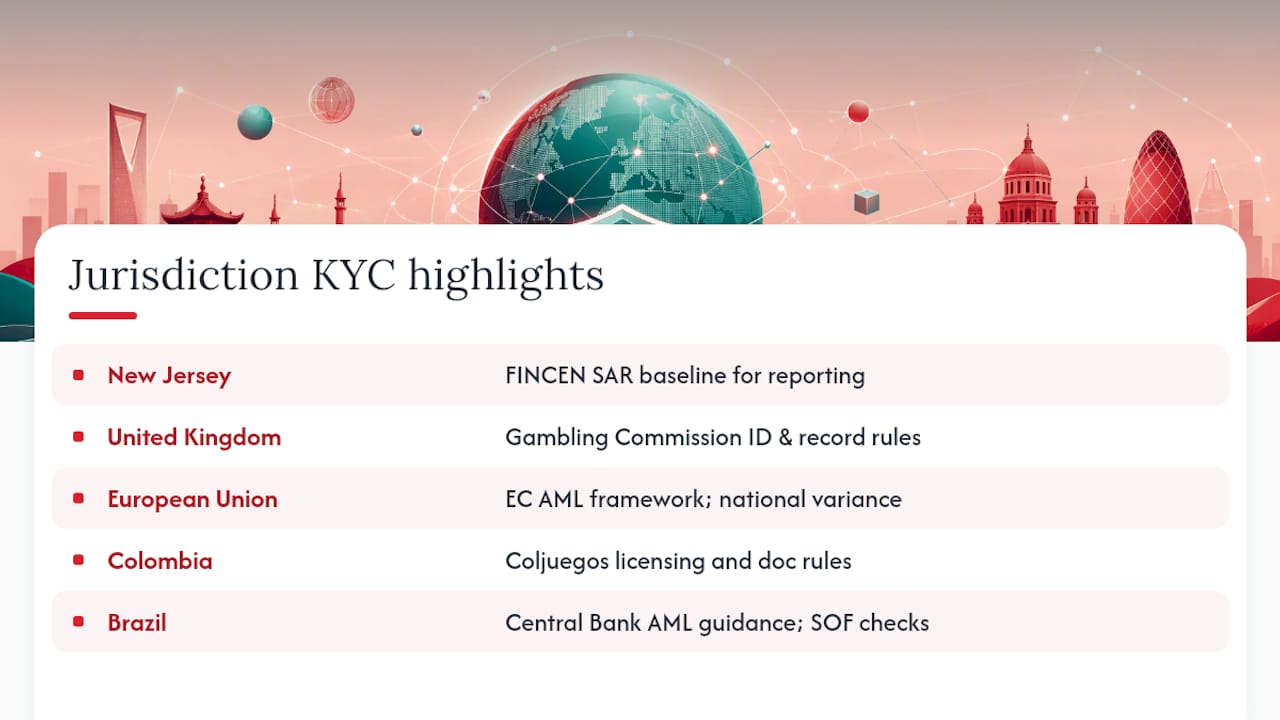
A player flagged in New Jersey at 2 a.m. doesn’t face the same documentation bar as one in Ontario or Colombia, and your night team needs a reference they can act on without waiting for a compliance officer to wake up. Building a simple jurisdiction matrix, one row per license, columns for document requirements, age threshold, payment rules, and reporting triggers, turns an ambiguous 3 a.m. decision into a two-minute lookup.
Start that matrix with the authoritative sources, not aggregator blog posts. In the US, the FINCEN casino SAR final rule sets the baseline for suspicious activity reporting and directly shapes what your overnight team must flag and document. In the UK, the Gambling Commission’s identity verification requirements under the LCCP spell out exactly what proof of identity and recordkeeping look like for a mature, tightly supervised market. Operators running across the EU should treat the European Commission’s AML guidance as the framework each member state builds its national rules from, since local variance is common even within the bloc.
Fragmentation gets sharper outside North America and Europe. A LATAM-facing operator needs to consult national regulators directly, Coljuegos in Colombia publishes its own licensing and documentation rules, and Brazil’s central bank AML guidance shapes how you handle source-of-funds checks tied to local payment rails. A US multi-state sportsbook operator faces the steepest version of this problem: a player moving between states mid-session can trigger different age rules, different SOF thresholds, and different reporting windows, all inside a single overnight shift.
Why Night Shifts Carry More Compliance Risk
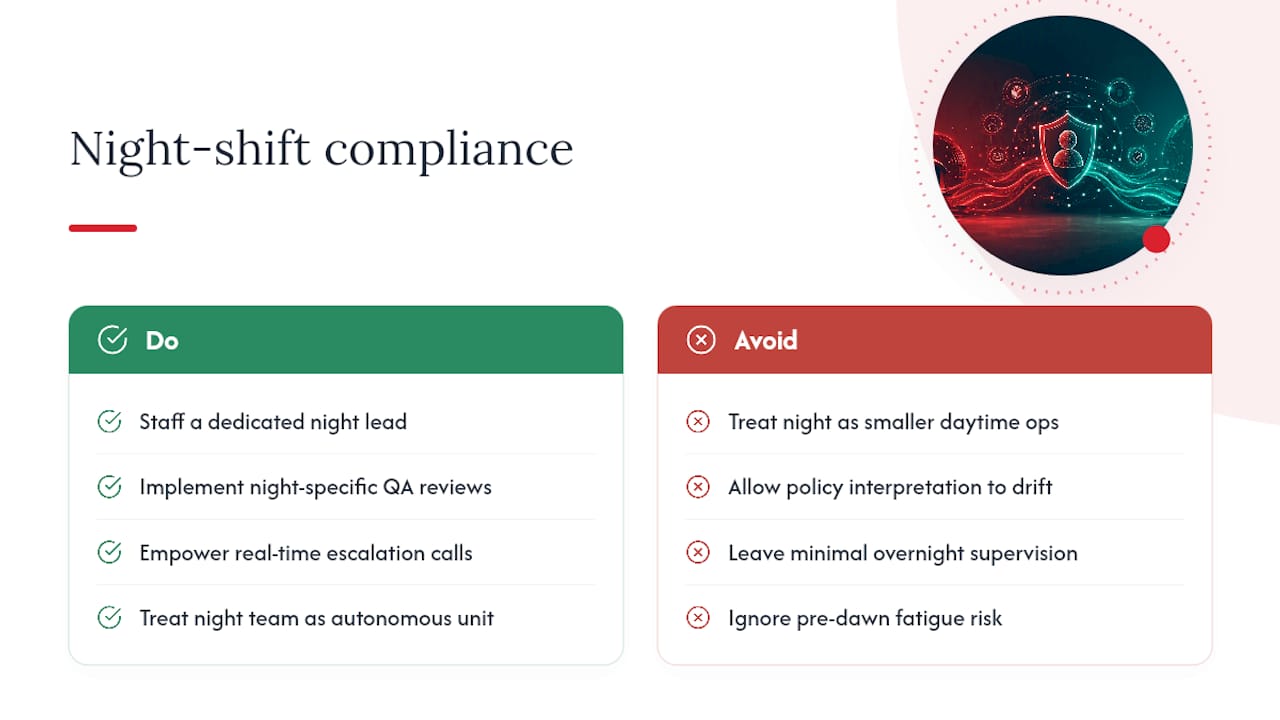
Treating the night shift as a smaller, quieter version of daytime operations is where most compliance programs quietly fail. The risk isn’t theoretical. It’s biological, procedural, and structural, and each layer compounds the other two.
Human alertness follows a circadian rhythm, and the window between roughly 2 a.m. and 6 a.m. is when cognitive performance and decision accuracy dip most sharply for most people, regardless of how experienced they are. A reviewer who catches document mismatches easily at 9 p.m. can miss the same pattern at 4 a.m., not from lack of skill but from the same fatigue curve every shift worker experiences. That’s not a staffing inconvenience. It’s the exact window when a sanctions hit, a forged document, or a structuring pattern in deposits is most likely to slip through.
Fatigue-driven review errors cluster in the pre-dawn hours, the same window where staffing is thinnest and senior oversight is least available. That combination, tired reviewers plus minimal supervision, is precisely the gap regulators look for during enforcement reviews.
Governance failures compound the fatigue problem. Operators without a dedicated night lead often let policy interpretation drift: one reviewer treats a borderline address document as sufficient, another on a different night rejects the same document type. Without a QA function specifically reviewing night output, and without a lead empowered to make real-time escalation calls, that drift becomes the pattern regulators flag in an audit. Enforcement actions in this industry are not rare. UK regulators have fined operators millions of pounds for compliance shortfalls, and gaps traced back to inconsistent overnight review are a common thread in those cases. Night teams that handle high-risk EDD cases during global peak betting windows function, in practice, as an autonomous compliance unit. Staff and govern them that way, with dedicated QA and a clear leadership line, and the fatigue risk stops being a liability you’re hoping doesn’t surface during an inspection.
How to Staff and Retain a Night-Shift KYC Team
Getting night-shift KYC right starts with shift design, not headcount. A fixed-night model, the same specialists working the same hours every week, consistently outperforms rotating shifts for accuracy, because reviewers build pattern recognition specific to that time window and don’t carry circadian disruption from constantly shifting sleep schedules. Build your team around this structure:
- Design a fixed-night roster with a 30 to 60 minute overlap at shift start and end so outgoing and incoming reviewers can walk through open cases together rather than relying on a written note alone.
- Define four distinct roles: junior reviewer for standard clearances, senior EDD analyst for escalated cases, a night lead with authority to make real-time policy calls, and a QA reviewer who audits samples independently of the shift’s own output.
- Set a training cadence before go-live, not after: AML fundamentals, jurisdiction-specific document standards, and familiarity with frameworks like ACAMS certification for senior analysts handling EDD.
- Build retention into the compensation structure, not as an afterthought. Job postings from regulated financial platforms show that mature night-shift KYC roles commonly carry a fixed shift structure paired with a night-shift premium, and many employers layer on transport support, meal allowances, and periodic health checks to offset the toll of overnight work.
- Give the night lead a seat in compliance planning, not just an operational reporting line, so policy changes reach the overnight team the same day they reach daytime staff.
Pro Tip: Rotate your QA reviewer’s sample selection between shifts weekly so night staff can’t predict which cases will be audited. Predictable sampling is how policy drift goes undetected for months.
If you’re building this function in-house and need senior EDD talent, a specialized compliance recruiter focused on BSA/AML hiring will move faster than a generalist staffing agency unfamiliar with gaming-specific screening requirements.
Building a Tech Stack for Reliable 24/7 KYC
The technology layer either makes your night team faster or makes them the bottleneck, and the difference usually comes down to how much triage happens before a human ever opens a case. A well-designed flow follows a clear sequence:
- Pre-check automation runs document authenticity checks, sanctions screening, and basic data matching the instant a player submits documents, clearing the obvious pass cases without human involvement.
- Risk scoring assigns a numeric or tiered score based on deposit velocity, document quality, geolocation consistency, and screening hits, determining whether a case goes to straight-through clearance or manual triage.
- Manual triage puts a human reviewer in front of anything the score flags, with the case file pre-populated with the specific reason it was flagged, not just a raw document dump.
- EDD escalation routes anything involving a sanctions or PEP hit, SOF thresholds, or repeated flags into the senior analyst queue automatically, removing the judgment call of whether to escalate from the junior reviewer entirely.
Geolocation deserves its own attention because it sits at the friction point between compliance and player experience. Overly aggressive geofencing frustrates legitimate players near state or national borders; overly loose geolocation invites regulatory exposure. The workable middle ground uses layered signals, GPS plus IP plus Wi-Fi triangulation, rather than relying on a single data point that a VPN can defeat.
On the SOF side, deposit thresholds should trigger a documentation request automatically rather than waiting for a reviewer to notice a pattern manually. Whatever platform you build on, it needs case-management logging detailed enough to reconstruct any decision months later, with retention periods matched to your longest licensing requirement, because a regulator’s request for records rarely arrives on a convenient timeline.
What SLAs and QA Should Look Like Overnight
Governance is what keeps a night shift from becoming a compliance blind spot, and it needs to be specific enough that a regulator reading your documentation understands exactly how decisions get made and checked.
- Set SLA targets around three KPIs: time-to-decision on standard cases, backlog size at shift handover, and false-positive rate on automated flags, tracked separately for night shifts so you catch degradation before it becomes a pattern.
- Run night QA as its own function, sampling a fixed percentage of overnight decisions independently, with findings reported directly into compliance rather than filtered through operations management.
- Hold a weekly cross-shift calibration session where day and night QA reviewers compare borderline calls to catch policy drift before it compounds.
- Document every handover in the case-management system itself, open cases, risk flags, and evidence links, not in a shared spreadsheet or a Slack message that disappears from institutional memory.
Pro Tip: Ask any outsourcing partner to produce a sample audit export before you sign, not after. If they can’t generate a regulator-ready report in the sales process, they won’t be able to produce one during an actual inspection either.
What a Working Night-Shift KYC Setup Actually Looks Like
Workanova has run 24/7 multilingual player support and KYC handling for licensed operators since 2014, including US-focused KYC workflows where document standards and reporting expectations shift by state. Dedicated teams typically go live within weeks, not quarters, which matters when a new license or a traffic spike doesn’t wait for a hiring cycle.
Before signing with any outsourcing partner, run through a short procurement checklist: ask for evidence of AML training completion rates, confirm language and timezone coverage matches your actual player base, and require a sample regulator-ready audit export before contract signature. The most common pitfall operators run into is discovering, after go-live, that a vendor’s “24/7 coverage” means a skeleton crew with no senior EDD escalation path after midnight.
Why Night-Shift KYC Deserves a Seat in Your Compliance Program
The industry still treats night-shift KYC as a staffing problem to solve cheaply rather than a compliance function to build deliberately. That framing gets operators into trouble. A reviewer working the 2 a.m. to 6 a.m. window is making the same regulatory judgment calls as your best daytime senior analyst, often with less backup and under worse biological conditions, which means the function deserves better leadership attention, not less.
The operators who avoid enforcement headlines are the ones who give their night team a real QA line into compliance, invest in leadership at the shift-lead level, and treat staff wellbeing, rest, transport, health checks, as a compliance investment rather than an HR nicety. Maintaining regulator-ready audit trails isn’t paperwork for its own sake; it’s what lets you walk a regulator through any decision, day or night, without a gap in the story.
— Miroslav
Get Compliant Night-Shift KYC Coverage Without Building It Yourself
Building a fully staffed, regulator-ready night-shift KYC team from scratch means recruiting specialists, standing up training, and building QA governance before you process a single overnight case. Workanova skips that build phase entirely: operators get a trained, dedicated KYC team live in weeks, with SLA-backed time-to-decision targets and audit exports ready for inspection from day one.
Workanova has delivered 24/7 multilingual player support and KYC outsourcing for iGaming operators since 2014, covering identity, age, SOF, and geolocation checks across licensed markets without operators needing to hire ten agents to cover a single time zone. Before you sign with any partner, ask the questions that actually matter: How are night shifts staffed, and by whom? What does AML training completion look like? Can they produce a jurisdiction coverage map and a sample audit log before contract signature? What’s the escalation path when a case needs senior EDD review at 3 a.m.?
If you’re evaluating whether to build in-house or bring in a specialist team, Workanova’s outsourced player support for iGaming operators is built to answer those questions directly, with dedicated teams and documented SLAs from the first week of the contract.
Sources
- FINCEN casino SAR final rule
- Gambling Commission: customer identity verification (LCCP)
- European Commission: anti-money laundering at EU level
- Bloomberg: operator fined by UK regulator (example enforcement)
- Coljuegos (Colombia gambling regulator)
Recommended