

Protect Against £629.3m APP Losses: Payments Fraud Prevention for Finance and Ops
September 3, 2026Why we are putting the industry’s worst support tickets on a wall
September 8, 2026An incident escalation process for iGaming player support is the documented path a case travels from a front-line chat or email agent to second-line teams, compliance, and outside dispute resolution. The Gambling Commission expects licensees to acknowledge complaints within 24 hours, resolve most cases within a few weeks, and offer ADR once internal steps are exhausted or after a maximum of eight weeks. Your next move: audit your intake channels today and confirm every one of them attaches to a single player ID before you build anything else.
TL;DR:
- Operators must ensure all intake channels connect to a single player ID and gather standardized data to maintain case integrity and meet regulator timescales.
- Clear ownership and decision authority at each escalation level prevent delays, with documented evidence trails crucial for successful ADR resolution.
- Speedy acknowledgment within 24 hours and regular updates during lengthy cases significantly improve player trust and reduce escalation to regulatory complaints.
- Using integrated helpdesk systems and automation helps manage high volumes, preserve case context, and streamline triage and escalation processes.
- Outsourcing support teams can deliver rapid, scalable incident escalation structures, especially ahead of major events or volume spikes, without lengthy internal hiring delays.
Table of Contents
- What the Escalation Process Actually Needs to Deliver
- How Do You Capture the Right Data at Intake?
- Who Owns Each Escalation Level, and When Do They Act?
- What Belongs in an ADR Evidence Pack?
- How Should You Communicate During an Escalation?
- Which Systems and Automation Actually Support This?
- How Do Outsourced Teams Run This Process at Scale?
- What the Data Actually Tells You to Fix First
- Get an Escalation Process Audit Before Your Next Peak Event
- Sources
- FAQ
What the Escalation Process Actually Needs to Deliver
Get the outcomes right before you touch the workflow diagram. A working incident escalation process protects player funds, preserves evidence for later review, reduces churn, and keeps you inside regulator timescales. Miss any one of those and the process is decoration, not infrastructure.
Most operators can run on a five-stage model:
- Intake — every channel funnels into one ticket tied to one player ID.
- Triage — priority assigned based on financial exposure, VIP status, and regulatory risk.
- Investigation — logs, transaction records, and provider responses get pulled and timestamped.
- Decision and remedy — a written outcome with a specific fix, refund, or explanation.
- Closure or ADR — case closed with player sign-off, or handed to an independent dispute resolution provider.
Withdrawal delays, KYC rejections, account blocks, and VIP disputes all move through the same five stages. Only the triage weighting and the owner change.
How Do You Capture the Right Data at Intake?
Speed at intake decides how the rest of the case goes. If a player messages you on live chat, then emails a screenshot an hour later, and those become two separate tickets, you’ve already lost the thread and possibly the complaint clock. A structured intake process should open one channel per dispute and collect a fixed set of fields every time, regardless of where the contact originated.
Standard fields worth mandating on every escalation ticket:
- Account ID and verified player identity
- Transaction ID(s) tied to the complaint
- Timestamps for the disputed event and the contact itself
- The specific remedy the player is requesting
- Screenshots or attachments as submitted
Triage then sorts tickets into priority bands. A useful priority grid treats service disruptions and payment or account-access issues as urgent, recurring technical glitches as medium, and general questions as low priority. Assign an SLA clock to each band the moment the ticket opens, not when an agent finally reads it.
Pro Tip: Ask agents to request and preserve third-party evidence (payment provider confirmations, KYC vendor logs) at first contact — waiting until escalation almost always means the evidence has expired or the provider’s retention window has closed.
Who Owns Each Escalation Level, and When Do They Act?
Ambiguity kills escalation processes faster than volume does. If two people think they own a decision, or nobody does, the case sits. Build a matrix that names an owner and a decision boundary for every level.
- Level 0 — Front line. Standard queries, no financial exposure beyond routine limits. Agent resolves and closes.
- Level 1 — Team lead. Payment delays, KYC friction, moderate monetary disputes. Lead has authority to approve standard remedies.
- Level 2 — Second-line or compliance. Self-exclusion breaches, suspected fraud, VIP account disputes, regulatory-risk flags. Requires a named second-line owner with authority to approve exceptions or refunds above standard thresholds.
- Level 3 — Head of Support or COO. Systemic failures, press or regulator exposure, cases nearing the ADR trigger window.
Each level needs its own documentation trail: who escalated, why, what evidence moved with the case, and what decision authority was exercised. Keep that trail clean from day one. A messy handover at Level 2 becomes an unusable evidence pack at ADR.
What Belongs in an ADR Evidence Pack?
When a case is heading to independent dispute resolution, ambiguity in the handover reflects on you, not just the case. Best practice calls for a written outcome that pairs the decision with the full evidence trail and clear ADR instructions, so the reviewer isn’t reconstructing the story from fragments.
Your evidence pack should contain:
- The final response letter sent to the player
- All player submissions, including screenshots and prior correspondence
- Full session logs and merged transcripts across channels
- Transaction records and provider confirmation responses
- Internal investigation notes and remedy calculations
- The specific regulatory or contractual basis for the decision
Store everything in write-once storage with timestamps, and assign one internal contact per case for ADR correspondence. Multiple people fielding follow-up questions on the same case is how details start contradicting each other. When you do offer ADR, the Gambling Commission’s own guidance frames it as a release valve, not a failure. Tell the player plainly: internal steps are done, here is the provider’s name, here is how to submit.
How Should You Communicate During an Escalation?
Silence is what turns an annoyed player into a repeat complainant, or worse, a regulator complaint. Acknowledge every escalated case within 24 hours with a case ID and an honest timeline estimate. For anything that runs longer than a few days, update the player roughly every five to seven days even if the update is “still investigating, here’s what’s next.”
- Acknowledgment message: case ID, what was received, expected timeframe.
- Progress update: what’s been checked, what’s outstanding, revised timeline if it changed.
- Final outcome: evidence summary, decision, remedy details, and ADR information if the player disagrees.
Pro Tip: Draft your final outcome template so the evidence summary comes before the decision, not after. Players who see the reasoning first are far less likely to escalate to ADR purely out of frustration at feeling unheard.
Clear cadence does double duty: it cuts repeat contacts, and it’s often the difference between keeping a VIP account and losing one to a competitor over a case that was actually resolved fairly.
Which Systems and Automation Actually Support This?
Pick one helpdesk as your system of record and integrate your PAM, payments, and KYC data into it before adding new contact channels. An omnichannel record that merges chat, email, and messaging transcripts is what prevents a complaint clock from quietly resetting when a player switches from live chat to email mid-case.
- Merge transcripts into a single case view so no agent works from a partial history.
- Use AI-assisted triage to auto-resolve routine queries and flag high-risk cases for human review.
- Position automation “below the line”: it should absorb volume, never make the escalation decision on a self-exclusion or fraud flag.
- Keep human-in-loop checkpoints and full audit logs on anything touching money, KYC, or regulatory risk.
Tools like 42Voice’s agent workflow platform support this kind of AI-to-human handoff without losing case context, which matters most during the exact peak events when your ticket volume triples overnight.
How Do Outsourced Teams Run This Process at Scale?
Building this five-stage process in-house takes months of hiring, tooling, and training most operators don’t have spare capacity for, especially heading into a major sporting event or a promo spike. A managed provider that specializes in iGaming can stand up the entire structure, not just staff a chat queue.
Workanova builds and runs dedicated, outsourced player support teams for licensed operators, covering live chat, email and ticketing, VIP and retention support, KYC and payments handling, second-line escalation, and QA, all under written SLAs. Operating as a Belgrade-based BPO with 37 employees, Workanova delivers 24/7 coverage in 14 or more languages, and a client’s own named support team can be fully staffed and live within 4 to 8 weeks.
Before signing with any provider, check for:
- Direct integration with your existing helpdesk, PAM, and payments stack
- A documented evidence handover process ready for ADR
- Named escalation owners with real decision authority, not a shared inbox
- Proven capacity to scale for jackpot drops, major tournaments, and promo spikes without SLA slippage
What the Data Actually Tells You to Fix First
The conventional advice on escalation is to build a pretty flowchart and call it done. That misses the point entirely. The regulator doesn’t care about your diagram. It cares whether you acknowledged a complaint inside 24 hours and whether ADR triggered on time. Everything else is internal process theater until those two numbers hold up.
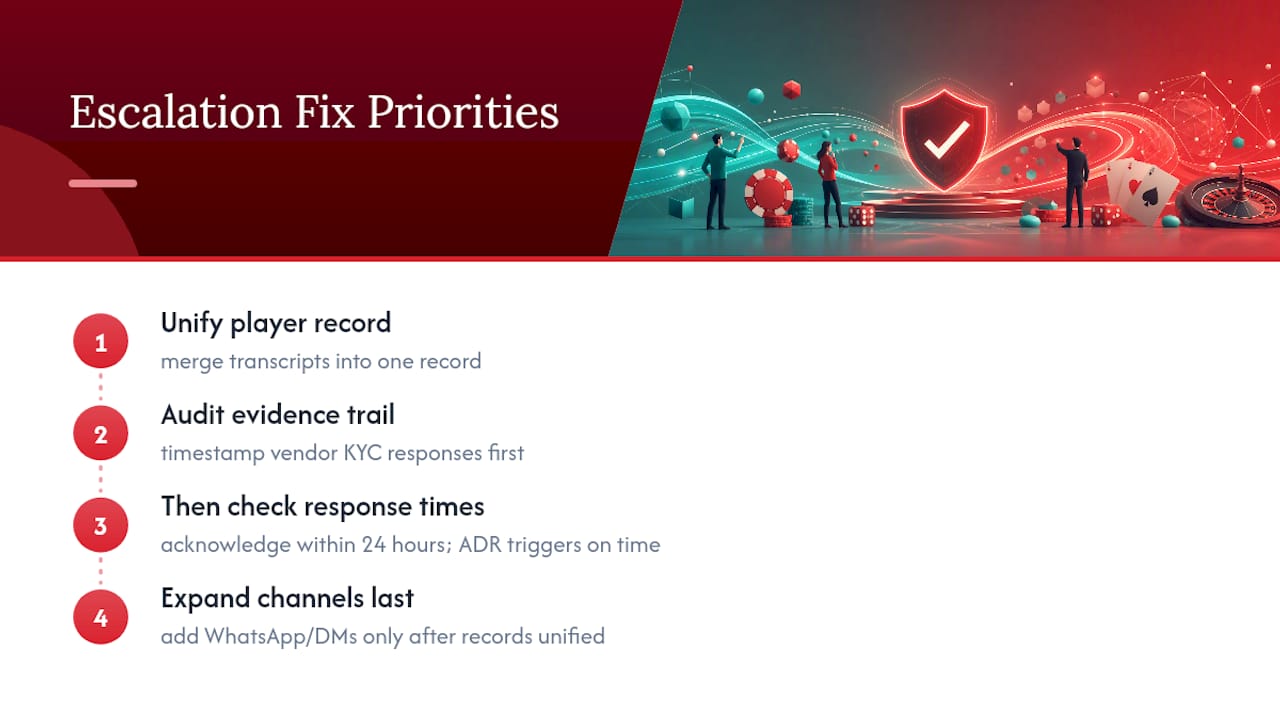
Where most operators get this wrong is sequencing. They add channels (WhatsApp, social DMs, a new chat widget) before they’ve merged transcripts into one player record. That’s backwards. An unmerged channel doesn’t add reach, it adds a way to lose a complaint clock. Unify the record first, then expand where players actually are.
If you take one thing from this: audit your evidence trail before you audit your response times. Fast acknowledgments mean nothing if the case falls apart at ADR because nobody timestamped the KYC vendor’s response. Fix the paper trail, and the SLA numbers tend to follow because the same discipline that preserves evidence also forces faster triage.
— Miroslav Maslovarić
Get an Escalation Process Audit Before Your Next Peak Event
Workanova is the alternative to building a second-line escalation function from scratch. Instead of spending months hiring, training, and stress-testing a team before your next World Cup weekend or jackpot promo, you get a fully staffed, client-named support team live in 4 to 8 weeks, running live chat, email, KYC, payments, and second-line escalation under written SLAs from day one.
If your current process breaks under volume, or you’re not confident your evidence trail would survive an ADR handover, request a support audit and see exactly where the gaps sit. Check how Workanova helps operators scale player support without hiring 50 new agents and get a straight answer on timeline and coverage for your markets.
Sources
- Timescales for the complaints process — Gambling Commission
- Player Dispute Handling and ADR – A Step-by-Step Template – Mopoga
- How to run omnichannel player support without losing context – iGaming CX
- Player Dispute Resolution: Best Practices for iGaming | InTarget
FAQ
What Is the First Step in an Incident Escalation Process?
The first step is intake: attaching every inbound contact, regardless of channel, to a single player ID and ticket before any triage or escalation decision happens.
How Fast Must You Acknowledge a Player Complaint?
You should acknowledge within 24 hours, in line with Gambling Commission expectations, even if full resolution takes longer.
When Should a Case Move to ADR?
A case should move to alternative dispute resolution once your internal complaints process is exhausted or after a maximum of eight weeks, whichever comes first.
Who Should Own Level 2 Escalations?
Level 2 escalations, covering fraud flags, self-exclusion breaches, and VIP disputes, need a named second-line or compliance owner with clear authority to approve exceptions.
Can Outsourced Teams Handle Second-Line Escalation?
Yes. Providers like Workanova run second-line escalation, KYC, and payments handling under written SLAs, with teams typically live within 4 to 8 weeks.
Recommended
- Dedicated iGaming Support Teams: Scale 24/7 in Weeks
- iGaming World Cup 2026 Traffic Surge Prep
- iGaming Player Support SLA: Operator’s Checklist
- Multilingual Customer Support for iGaming Operators
Write your worst support ticket on our wall — best one wins a free month. Book a meeting