
65–80% Ticket Autonomy for iGaming Operators Through Deep Integration
September 3, 2026
Protect Against £629.3m APP Losses: Payments Fraud Prevention for Finance and Ops
September 3, 2026Follow the sun support means routing customer issues between regional teams so each shift owns tickets during its own local business hours, then hands off open cases as the next region wakes up. Done right, it delivers continuous coverage without a single team working nights: lower overnight queues, faster resolution, and fewer burned-out agents. It fits companies with customers spread across time zones and tickets that can’t wait eight hours for a reply. It’s the wrong fix for low-volume products or generous SLAs.
TL;DR:
- Follow-the-sun support requires a unified ticketing system, standardized handoff templates, and timezone-aware routing to ensure smooth transitions between regions.
- A two-region setup provides around 16 hours of coverage daily, while adding a third region can nearly achieve full 24-hour support for most customer needs.
- Proper governance includes overlapping shifts, regional leads, escalation paths, automated triage, and cross-trained backups to prevent handoff failures and coverage gaps.
- Common pitfalls include vague notes, boundary timing errors, and language gaps, which can be mitigated with structured processes, automation, and careful planning.
- Vendors like Workanova offer ready-to-deploy teams that establish effective follow-the-sun support within weeks, avoiding lengthy in-house buildouts.
Table of Contents
- What Is Follow the Sun Support and How Does It Work?
- What Systems and Governance Does Follow-the-Sun Support Need?
- What Are the Benefits of Follow-the-Sun Support?
- What Are the Common Pitfalls in Follow-the-Sun Support?
- How Do You Implement Follow-the-Sun Support Step by Step?
- What Metrics and SLAs Should You Track?
- What Tools and Automation Support Follow-the-Sun Coverage?
- How Workanova Runs Follow-the-Sun Support for iGaming Operators
- Is Follow-the-Sun Support the Right Investment?
- Get Follow-the-Sun Support Running Without Building It Yourself
- Sources
- FAQ
What Is Follow the Sun Support and How Does It Work?
Follow the sun support splits the 24 hour clock into regional shifts, each covering its own business hours, and each handing unresolved tickets to the next team as the day rolls west. A three-region setup covering, say, the Philippines, Europe, and the US West Coast can deliver close to round the clock support without anyone working a graveyard shift.
The mechanics matter more than the geography. At the end of each shift, the outgoing team doesn’t just log off. They document ticket status, escalate anything unresolved, and pass ownership through a structured handoff. Most mature setups build a paid 30 to 60 minute overlap window at every boundary, so the incoming team can ask questions live instead of guessing from notes.
This is fundamentally different from a single team doing 24/7 on-call, where one group absorbs every shift including 3 a.m. pages. Follow the sun spreads the load across people already awake and alert during their own daytime.
Two patterns dominate:
- Two-region model: typically Europe/EMEA paired with a region eight to twelve hours offset, covering roughly 16 hours of live coverage.
- Three-region model: adds Asia-Pacific or the Americas to close the remaining gap, pushing toward full 24-hour coverage.
What Systems and Governance Does Follow-the-Sun Support Need?
Before you scale regions, get the foundation right. A follow-the-sun model without the right scaffolding doesn’t fail loudly. It fails quietly, one dropped ticket at a time.
- Unified ticketing and CRM. Every region needs to work from the same system with mandatory structured notes on every ticket, not a patchwork of regional tools that don’t talk to each other.
- Timezone-aware routing. An orchestration layer that automatically routes tickets to the region currently on shift, rather than relying on manual reassignment.
- Standardized handoff template. A fixed structure, backed by a searchable knowledge base, so incoming agents aren’t reconstructing context from scratch.
- Overlap scheduling and rolling on-call. Built-in windows where two regions are live simultaneously, plus a rotating on-call layer for anything that spikes outside business hours.
- Regional leads and escalation paths. Named owners in each region who can authorize escalations and answer the incoming shift’s questions during overlap.
- QA governance. Consistent scoring criteria applied across all regions, not a different bar in each office.
- Automation and AI triage. Tools that pre-tag ticket priority and draft handoff summaries, cutting the manual work at every boundary.
- Training and language coverage. Cross-trained backups for every language pair, so a single person’s day off doesn’t create a coverage gap.
Pro Tip: Treat the handoff template as a product, not a formality. Make required fields machine-validated in your helpdesk so an agent physically cannot close a shift without status, actions taken, and next steps filled in.
What Are the Benefits of Follow-the-Sun Support?
The clearest payoff is speed. Regional coverage during local business hours means tickets get worked immediately instead of sitting in a queue until the home office opens. That shows up directly in mean time to resolution and in SLA compliance rates, since fewer tickets are waiting for someone to simply show up.
The second payoff is people. Spreading shifts across time zones means nobody is stuck on a permanent night rotation, and Salesforce points to reduced burnout and better retention as a direct result of aligning work to local daytime hours.
Where this pays back fastest:
- Incident response, where every hour a P1 sits unassigned costs money or reputation.
- VIP and retention support, where high-value customers expect a response regardless of when they reach out.
- Regulated operations, such as licensed gambling platforms, where compliance windows and payment issues can’t wait for business hours in one country.
- Event-driven spikes, like a major sporting tournament or a jackpot event that triggers a surge no single-region team can absorb.
The coverage math: two well-placed regions can stretch live support to roughly 16 hours a day; add a third and you’re within reach of full 24-hour coverage, according to the operational pattern behind follow-the-sun.
What Are the Common Pitfalls in Follow-the-Sun Support?
Most follow-the-sun programs don’t fail because the concept is flawed. They fail because a handful of predictable operational gaps go unaddressed.
- Handoff failures. Tickets get dropped when notes are vague or missing. The fix is a mandatory structured handoff document combined with a paid overlap window where the outgoing and incoming teams overlap live.
- Boundary timing errors. Tickets that arrive minutes before a shift ends get orphaned. Build routing rules that auto-assign anything arriving in the final 30 minutes of a shift to the next region instead of the outgoing one.
- Sticky tickets. Complex cases bounce between regions repeatedly, losing context each time. Assign rolling regional on-call ownership and let agents flag a ticket “do not reassign” when continuity matters more than speed.
- Language and holiday gaps. A single agent’s holiday shouldn’t take a language out of coverage. Cross-train backups in advance and plan holiday calendars across all regions, not just your home market.
- Low-volume mismatch. If your ticket volume is modest and your SLA tolerance is generous, follow-the-sun adds coordination overhead you don’t need. A single team with an on-call rotation often solves the problem more simply.
How Do You Implement Follow-the-Sun Support Step by Step?
Rolling out follow-the-sun works best as a phased build, not a flip of a switch.
- Audit your customer geography and ticket volume. Pull data on where tickets originate and when, and use that to decide which regions actually need live coverage first.
- Design your overlap windows, handoff template, and SLA behavior. Fix your handoff document fields and decide how SLAs should behave when a ticket crosses a regional boundary.
- Configure routing rules and mandatory fields in your helpdesk. Build schedule-based routing, region-specific views, and macros so tickets land in the right queue automatically, and structured notes are enforced, not optional.
- Pilot with one product line or your VIP segment. Measure regional MTTR and CSAT for four to six weeks, and run a weekly debrief specifically on handoff quality, not just resolution speed.
- Scale by adding regions or automation. Once the pilot’s handoff failure rate is low and stable, expand coverage or layer in AI triage to cut manual work further.
Pro Tip: Don’t launch a third region until your two-region handoff failure rate is under control. Adding coverage on top of a broken handoff process just multiplies the breakage.
A structured rollout like this can move from audit to live pilot in a matter of weeks rather than quarters, provided the handoff mechanics are locked down before you add headcount.
What Metrics and SLAs Should You Track?
Track mean time to resolution and time to first response by region separately, not blended, because a global average hides which shift is actually struggling. Add a handoff-failure rate: the percentage of tickets that bounce back with missing or incomplete context. That single number tells you more about program health than almost anything else.
- MTTR and TTR measured per region, so you catch a specific shift underperforming before it drags the whole average down.
- Regional CSAT tracked separately, since customer satisfaction in one region can mask a problem brewing in another.
- Handoff-failure rate, the clearest early warning signal that your process is breaking down.
- Pause SLAs across handoffs, so the clock stops when a ticket is genuinely waiting on the customer rather than sitting idle in transit.
- Tiered SLAs by ticket type, with 24/7 targets for outages and P1s, and business-hours targets for general questions.
SLA strategies that pause timing across handoffs hold up far better than naive time-based SLAs that don’t account for a ticket crossing three regions in a day. Pair that with a weekly cross-region dashboard review, and boundary problems surface in days instead of months.
What Tools and Automation Support Follow-the-Sun Coverage?
The right stack removes the manual guesswork at every boundary. Schedule-based, timezone-aware routing should be the backbone, automatically shifting ownership as one region’s hours end and the next begin, configured directly in the helpdesk.
- AI triage that tags priority and drafts a first-pass handoff summary before a human ever touches the ticket.
- Mandatory structured fields and macros that enforce consistency instead of relying on agent memory.
- Pager and alerting rules tuned specifically for P1 tickets and the fragile minutes around shift boundaries.
- A searchable knowledge base, backed by community moderation where relevant, to deflect repeat questions before they ever become tickets.
An automation-first architecture that classifies incidents and routes them to local owners during their working hours cuts the number of live handoffs your teams actually need to manage by hand.
How Workanova Runs Follow-the-Sun Support for iGaming Operators
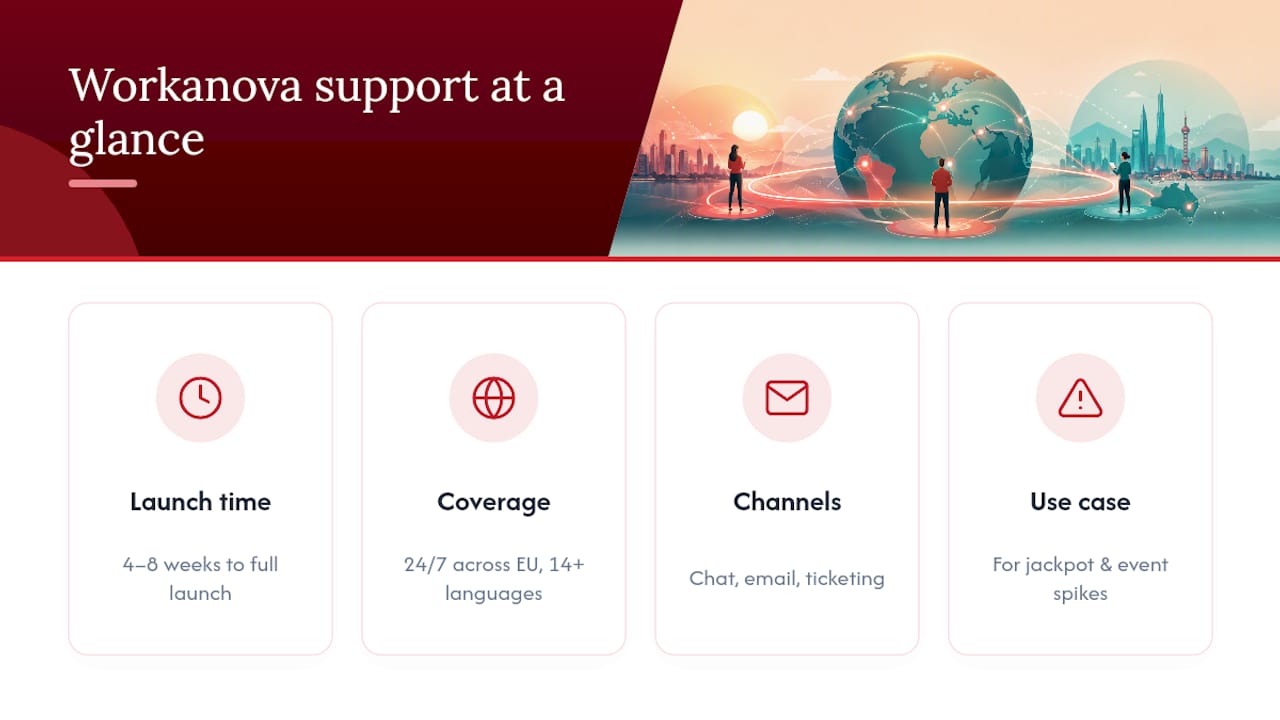
Workanova builds and runs dedicated, named support teams for licensed casino and sportsbook operators across EU time zones, with 24/7 coverage in 14+ languages. That includes live chat, email and ticketing, VIP and retention support, KYC and payments handling, second-line escalation, and QA, all governed by written SLAs.
Most engagements go from kickoff to a fully staffed, trained, launched team in four to eight weeks.
The operators that come to us are usually mid-crisis: a jackpot drop or a World Cup weekend just multiplied their ticket volume overnight, and their in-house team can’t staff up fast enough to match it.
That’s the exact scenario follow-the-sun coverage exists to solve, at a scale most in-house teams can’t build alone.
Is Follow-the-Sun Support the Right Investment?
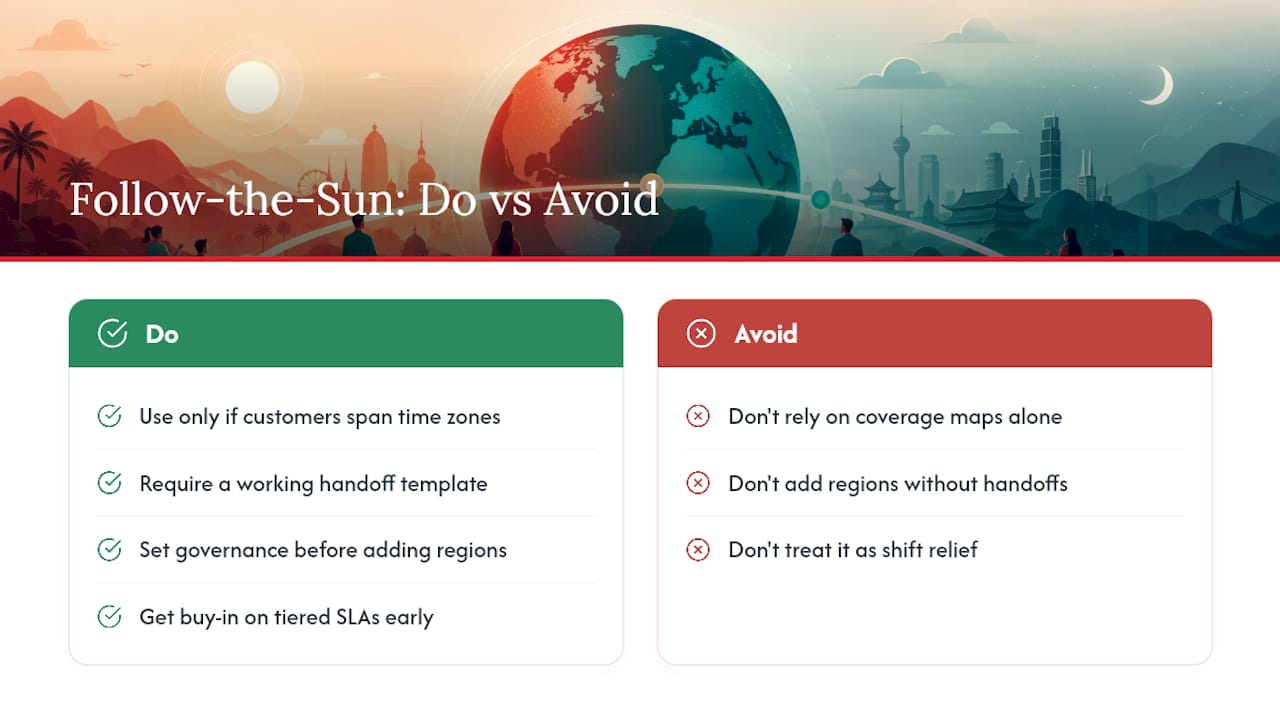
Follow-the-sun is strategic when your customer base genuinely spans time zones and ticket delay has a real cost. It’s a tactical patch when someone’s just tired of night shifts. Those are different problems with different solutions.
Judge any vendor or internal plan on one question: can they show you a working handoff template, not just a coverage map? Coverage without disciplined handoffs is just three teams dropping the same tickets in sequence. Get the governance right before you add regions, and get stakeholder buy-in on tiered SLAs early, since that’s where budget conversations usually stall.
— Miroslav Maslovarić
Get Follow-the-Sun Support Running Without Building It Yourself
Building follow-the-sun coverage in-house means recruiting across regions, standing up training programs, and writing your own handoff governance from scratch, usually over several quarters. Workanova replaces that build with a fully staffed, named support team, live in four to eight weeks, covering live chat, email, ticketing, VIP and retention, KYC and payments, second-line escalation, and QA, all under written SLAs from day one.
For licensed operators facing jackpot spikes, major sporting events, or promo surges that overwhelm an internal team’s capacity, that speed matters more than a slow internal hiring process ever will. If you’re evaluating how to scale player support without hiring 50 agents, the practical next step is a discovery call to map your regions, volume, and SLA targets against a working coverage plan.
Sources
This guide draws on operational guidance from Salesforce, Zendesk, Timezoners, and Wikipedia.
- What Is the Follow the Sun Model? Key Benefits and More | Salesforce
- Follow-the-Sun Customer Support That Doesn’t Drop Tickets at the Handoff | Timezoners
- Follow-the-sun – Wikipedia
FAQ
What Does “Follow the Sun” Support Mean?
It means dividing customer support into regional shifts aligned to local business hours, with each region handing off open tickets to the next as the workday moves west, so coverage continues without anyone working through the night.
What Does “Follow the Sun” Mean in a Business Context?
Outside support specifically, “follow the sun” describes any globally distributed operation, engineering included, that passes active work between time zones to keep progress continuous around the clock.
How Many Regions Do You Need for Full 24/7 Coverage?
Two well-placed regions typically cover about 16 hours a day; adding a third region closes the remaining gap and gets you close to full 24-hour coverage.
What Is Follow-the-Sun Coverage in Customer Support?
It’s a staffing model where regional teams each own tickets during their own business hours and hand off unresolved cases at shift end, backed by unified ticketing, structured handoff notes, and paid overlap windows so context doesn’t get lost. Providers like Workanova build these teams as a managed service for operators that need the coverage without building it in-house.
Do You Need Your Own Offices in Every Region to Run Follow-the-Sun Support?
No. Companies can adopt the model incrementally by focusing on the regions with the highest ticket volume first, or by partnering with a managed support provider that already staffs across the needed time zones.
Recommended
SBC SUMMIT We are exhibiting in Lisbon 29 Sep – 1 Oct · Stand B606, Hall 2.Write your worst support ticket on our wall — best one wins a free month. Book a meeting