

Audit Ready Night KYC in Weeks for iGaming Operators
September 1, 2026
Launch Follow the Sun Support in 4–8 Weeks for Ops Leaders
September 3, 2026The fastest path to scalable, compliant iGaming support is a single help-desk system of record wired directly into player account, payments, and verification systems. Get that architecture right and you can expect production AI agents to resolve 65 to 80 percent of tickets autonomously, fewer repeat contacts, and audit trails regulators actually trust. Workanova builds this integration layer for operators before adding a single new support channel.
TL;DR:
- Integrating support systems with PAM, payments, and KYC delivers immediate benefits, including shorter handle times and higher first-contact resolution.
- Prioritize connecting identity, payments, and KYC first, before adding bonus engines and full CRM sync, to avoid delays and complexity.
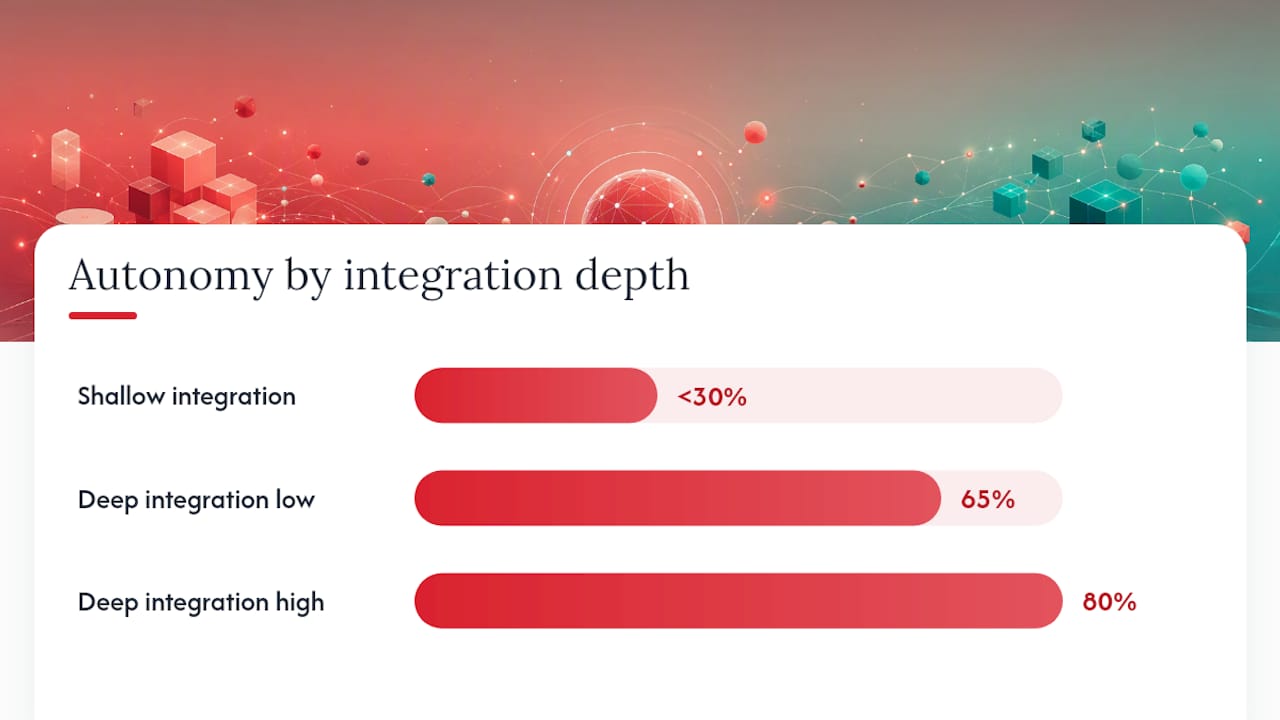
- Deep AI automation relies on extensive system integration; shallow setups only resolve about 30 percent of tickets autonomously.
- Phased implementation, with rigorous testing and 30-day measurement windows, ensures smooth rollout and validation of improvements.
- Security measures must include encryption, role-based access, audit trails, and real-time data sync to maintain compliance during integration.
Table of Contents
- What Is Help Desk Integration for iGaming and Why Does It Matter?
- What Systems Should a Help Desk Integrate First?
- How Does Integration Depth Limit AI Automation in Support?
- How Do You Roll Out Help Desk Integration Without Disrupting Support?
- Should You Hire, Automate, or Outsource to Scale Support?
- Which Metrics Prove Your Integration Is Working?
- What Are the Most Common Integration Pitfalls?
- How Do You Secure Data Across Integrated Help Desk Systems?
- How Do You Keep Help Desk and iGaming Platform Data in Sync?
- What Compliance Requirements Apply During Help Desk Integration?
- How Should You Plan for Backup and Disaster Recovery?
- What Should You Look for When Selecting Help Desk Software?
- An Operator-First Take on Integration Depth
- Get Your Help Desk Integration Live Without Building an In-House Team
- Sources
What Is Help Desk Integration for iGaming and Why Does It Matter?
Most iGaming support stacks grow the wrong way. An operator launches live chat, bolts on email, adds WhatsApp for a regional market, then wonders why agents keep asking players to repeat themselves. Each channel holds a different slice of the player’s history, and none of them talk to the player account management (PAM) system, the payments processor, or the KYC vendor. That’s the shadow workflow problem: agents toggle between five tabs to answer one ticket, and every toggle adds seconds to handle time and risk to compliance.
Real help desk integration for iGaming means the support platform pulls live data from PAM, payments, and KYC systems into one player record, so any agent (or bot) sees the full picture the moment a ticket opens.
The payoff shows up fast. Unifying channels into a single player record reduces repeated contacts and generally improves first-contact resolution because agents keep transcript continuity and PAM context instead of starting cold on every interaction.
Quick wins operators see after unification typically include:
- Shorter average handle time, since agents stop hunting across systems for account status
- Higher first-contact resolution (FCR) because the full player history is visible immediately
- Fewer repeat contacts from players re-explaining the same issue across channels
- Continuity for VIP and high-value players whose retention managers need the same live data agents see
Pro Tip: Track handle time and FCR for two weeks before integration and two weeks after. The delta is the clearest internal case you’ll ever build for further investment in the connected stack.
What Systems Should a Help Desk Integrate First?
Not every integration delivers equal value on day one. Sequencing matters more than completeness, and operators should connect identity first, then payments and KYC, before layering in bonus engines and CRM data.
Here’s the order that produces the fastest measurable gains:
- Identity and player ID linking. Every ticket needs to resolve to one player account instantly, across every channel.
- Payments status. Deposit and withdrawal state are the single most common driver of support contacts in iGaming.
- KYC and verification state. Agents need to know instantly whether a player is verified, pending, or flagged, without opening a separate portal.
- Bonus engine data. Promo eligibility and wagering status resolve a large share of low-complexity tickets on their own.
- PAM/CRM sync. VIP tier, lifetime value, and retention flags let agents (and retention teams) treat high-value players appropriately.
The agent pane, at minimum, should surface:
- Recent ticket history across all channels
- Current KYC status and any pending document requests
- Real-time balance and last transaction status
- VIP tier and any active retention flags
- Active promo or bonus flags tied to the account
For an MVP, connect identity, payments, and KYC first, and treat bonus engine and full CRM sync as phase two. Trying to sync everything on day one is how integration projects stall for months. Our guide to choosing help desk software built for iGaming breaks down which platforms handle this sequencing natively versus which need heavy custom middleware.
How Does Integration Depth Limit AI Automation in Support?
Every AI agent has an “integration surface,” the set of systems and actions it can actually reach. That surface, not the underlying language model, is what caps autonomous resolution. An AI agent that can read a KYC status but not update it will bounce every verification question straight to a human, no matter how good its language understanding is.
Production deployments that are deeply integrated with PAM, payments, and KYC resolve 65 to 80 percent of tickets autonomously, while shallow integrations that only read ticket text rarely clear 30 percent. The gap is entirely about what the agent is allowed to do, not what it can say.
Retrieval-augmented generation (RAG) paired with a knowledge graph closes part of that gap. Knowledge graphs improve triage accuracy in regulated domains by giving the AI structured, current rules instead of stale documentation, which matters enormously when bonus terms or AML thresholds change mid-quarter.
Realistic autonomy still needs hard escalation gates:
- Verification decisions above a risk threshold always route to a human
- Any dispute involving funds above a set amount escalates automatically
- Responsible-gaming flags never resolve without human review
Pro Tip: Measure “action coverage,” the percentage of critical actions your AI agent can actually execute versus just describe. It predicts autonomy far better than ticket volume ever will. Gartner recommends evaluating generative AI options against clear KPIs before scaling deployment, and action coverage is exactly the kind of KPI that belongs on that scorecard. Our breakdown of AI in iGaming customer support walks through where automation genuinely helps versus where it just moves the bottleneck.
How Do You Roll Out Help Desk Integration Without Disrupting Support?
Integration projects fail when operators try to connect everything at once. A phased, test-driven rollout gets you measurable wins in weeks instead of a single high-risk launch months out.
- Discovery and mapping. Inventory every support channel currently in use, then map which fields (balance, KYC status, VIP tier) each ticket type actually needs. Define SLAs for each field’s freshness before you write a line of integration code.
- Build the MVP connector list. Start with identity, payments, and KYC ingestion, plus basic ticket routing. Resist the urge to add bonus engine or full CRM sync in this phase.
- Run staging tests with synthetic tickets. Simulate real player scenarios, including VIP escalation flows and verification edge cases, before any live traffic touches the new connectors.
- Measure for 30 days before expanding. Case studies on phased rollouts show operators using a 30-day measurement window after each phase to confirm the integration is delivering before adding the next channel or system.
- Add channels only after the core record is stable. Once identity, payments, and KYC sync reliably, layer in additional channels like social messaging or SMS.
Pro Tip: Run your 30-day measurement window against the same KPIs you’ll use long-term (FCR, AHT, repeat contact rate). Switching metrics mid-rollout makes it impossible to tell if the integration actually worked.
Ticket routing design deserves its own attention here. Our guide on managed ticket management for iGaming covers how to structure escalation paths so the phased rollout doesn’t create new bottlenecks at handoff points.
Should You Hire, Automate, or Outsource to Scale Support?
Traffic peaks in iGaming aren’t gentle. A major sporting event, a jackpot drop, or a new market launch can triple ticket volume in days, and each option for handling that surge carries a different trade-off.
Hiring builds long-term capacity but takes months to reach full productivity, and headcount doesn’t shrink easily once the peak passes. Automation scales instantly and cheaply, but only as far as your integration surface allows, which is exactly why the earlier sections matter before you lean on bots for volume. Managed outsourcing sits between the two: a dedicated multilingual team can go live in weeks, absorb peak volume without permanent headcount, and plug into the same integrated help desk your in-house team already uses.
The right mix depends on what’s actually driving the volume spike:
- Predictable seasonal peaks (major tournaments, holiday promotions) favor outsourced surge capacity over new hires
- Permanent volume growth in a core market justifies in-house headcount investment
- Language expansion into new regulated markets almost always favors outsourcing, since building 24/7 native-language coverage internally takes years, not weeks
- Compliance-heavy workflows (KYC escalations, AML flags) need agents trained specifically on those systems, whether outsourced or internal
SLAs and QA governance matter regardless of who staffs the desk. A managed team without strict SLA accountability creates the same fragmentation risk as an under-resourced in-house team. That’s the entire value proposition behind scaling player support without adding 50 new hires: capacity that flexes with demand without the ramp-up delay.
Which Metrics Prove Your Integration Is Working?
Integration success is measurable within weeks, not quarters, if you’re tracking the right numbers. Core KPIs to monitor:
- First-contact resolution (FCR), the clearest single signal that agents have the data they need at ticket open
- Automation rate, the share of tickets resolved without human intervention
- Repeat contact rate, which should drop sharply once channels share one player record
- CSAT, tracked separately for verified versus pending-KYC players
- Average handle time (AHT) and escalation rate to second-line support
Governance can’t stop at dashboards. Every KYC, AML, and responsible-gaming event needs an immutable audit trail recording which system produced each status change, attached directly to the ticket for regulator review. Sync cadence matters here too: payment and verification status should refresh in near real time, while lower-risk fields like promo eligibility can tolerate a slightly longer lag without breaking agent workflows.
What Are the Most Common Integration Pitfalls?
Most integration failures trace back to the same handful of mistakes, and they’re avoidable if you catch them before go-live.
- Adding channels before unifying the player record. Fragmented histories are the direct result of prioritizing new front-end channels over fixing the integration layer, and they make every ticket harder to resolve and harder to audit.
- Missing transcript handoffs between channels or agents. If a player moves from chat to email, the new agent needs the full prior context, not a summary.
- Stale KYC data driving agent decisions. A verification status that’s even a few hours old can cause an agent to approve or block the wrong action.
- Skipping audit log verification before launch. Confirm every status change is logged with its source system before you go live, not after an auditor asks.
Pro Tip: Attach player ID to every ticket at creation, not after triage. Retrofitting ID linkage after tickets pile up unlinked is one of the most expensive cleanup jobs in a support operation.
How Do You Secure Data Across Integrated Help Desk Systems?
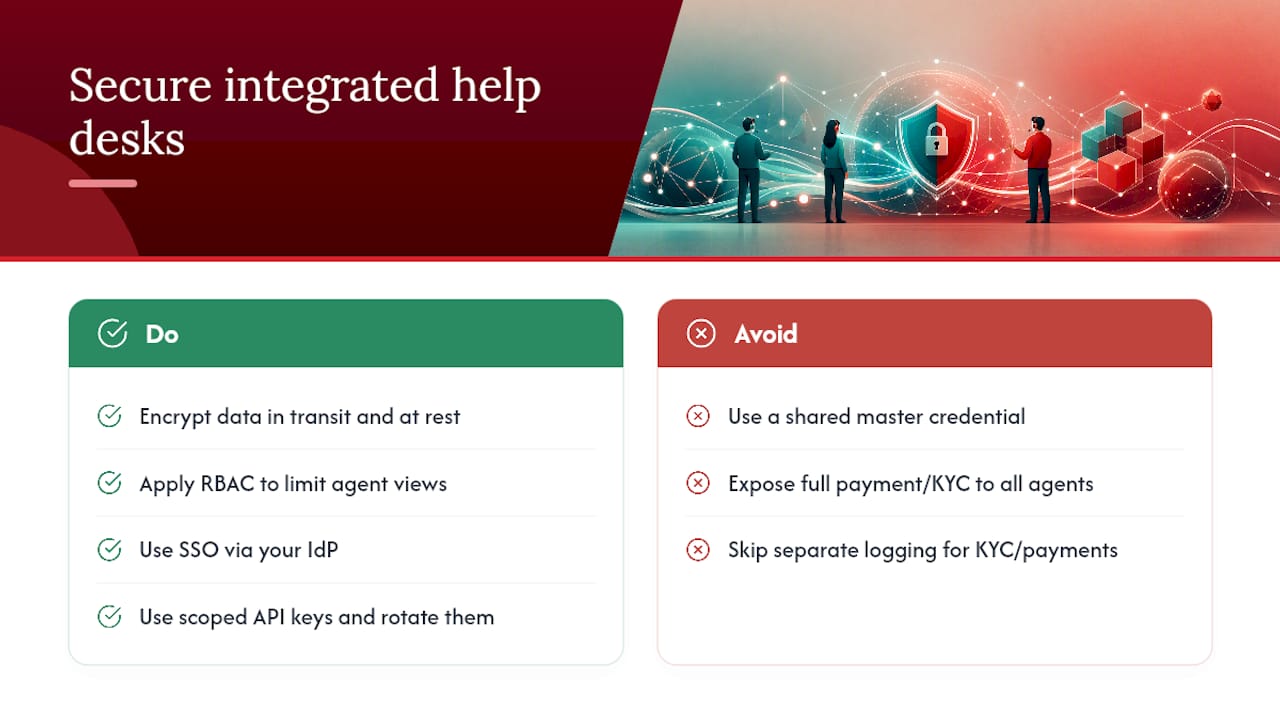
Player financial data, KYC documents, and betting history moving between systems create real exposure if security is an afterthought. Every connector between your help desk and PAM, payments, or KYC vendor needs encryption in transit and at rest, using current TLS standards for data moving between systems and AES-grade encryption for stored records.
Access controls matter as much as encryption. Not every support agent needs to see full payment card details or complete KYC documents. Role-based access control (RBAC) should limit what each agent tier can view: front-line agents see status flags, second-line escalation teams see verification documents, and only compliance-cleared staff see full financial history. Field-level masking, showing the last four digits of a payment method rather than the full number, reduces exposure without slowing agents down.
Single sign-on (SSO) tied to your identity provider closes another common gap: agents logging into five separate systems with five separate passwords, several of which never get revoked when someone leaves. Consolidate authentication through the help desk itself wherever possible.
API connections between systems need their own scrutiny. Each connector should use scoped API keys with the minimum permissions needed for its function, not a master credential shared across every integration. Rotate those keys on a schedule, and log every API call touching KYC or payments data separately from general ticket activity, since that log becomes critical evidence during a regulatory inquiry. Payment-specific integrations carry particular weight here; partners like CARDZ3N’s sports betting and iGaming merchant services illustrate how payment flows themselves need to be verifiable at the point support agents touch them, not just at the processor level.
How Do You Keep Help Desk and iGaming Platform Data in Sync?
Real-time synchronization sounds simple until you’re reconciling a balance update that hit the PAM system three seconds before an agent pulled up the ticket. That three-second gap is enough for a player to see a different number than the agent does, and enough to generate a complaint about “wrong information.”
The core challenge is that PAM, payments, and KYC systems update on their own schedules, not on the help desk’s schedule. Payments processors often batch settlement updates, while balance changes need to reflect instantly. Building one universal sync cadence for every field is a mistake; instead, tier your sync requirements by risk. Balance and verification status need near-instant webhook-based updates. Promo eligibility and account preferences can tolerate a short polling interval, often a few minutes, without causing agent confusion.
Webhooks solve most real-time needs better than scheduled polling, since the source system pushes updates the moment they happen instead of the help desk asking repeatedly. But webhooks fail silently if you don’t monitor them; a dropped webhook connection can leave your help desk showing stale data for hours before anyone notices. Build a simple heartbeat check that flags when a critical data feed hasn’t updated within its expected window.
Conflict resolution needs a clear rule too: when two systems report different values for the same field (a common issue during payment processing delays), the help desk should default to the system of record for that data type, PAM for balance, the KYC vendor for verification status, rather than whichever update arrived last.
What Compliance Requirements Apply During Help Desk Integration?
Audit trails cover the “what changed and when” question, but GDPR and AML compliance raise separate requirements that integration teams often treat as an afterthought rather than a design constraint.
Under GDPR, any player data flowing between your help desk and PAM, payments, or KYC systems needs a documented legal basis and a defined retention period. That means your integration can’t just mirror every field forever; build automatic purge or anonymization rules into the sync itself for data that no longer serves an active support or compliance purpose. Player right-to-erasure requests also become more complex once data lives in multiple connected systems. If a player exercises that right, your architecture needs a way to propagate deletion across the help desk, the ticketing history, and any synced copies, not just the source system.
AML compliance adds its own layer during KYC-related tickets. Suspicious activity flags need to move from the KYC or transaction-monitoring system into the help desk fast enough that an agent doesn’t inadvertently process a withdrawal request for a flagged account. That’s a real-time sync requirement with regulatory teeth behind it, not just an operational nicety.
Data residency requirements complicate multi-market operators further. A player’s data may need to stay within a specific jurisdiction depending on the licensing authority, which means your integration architecture needs to account for where each connected system physically stores data, not just how fast it syncs. This is one area where a generic help desk platform without iGaming-specific configuration experience tends to fall short, and it’s worth confirming a vendor’s track record with regulated gaming data specifically before committing.
How Should You Plan for Backup and Disaster Recovery?
An integrated help desk creates a single point of failure risk alongside its efficiency gains: if the system of record goes down, every connected channel loses its shared context simultaneously. Disaster recovery planning needs to account for that concentration risk directly.
Start with backup frequency tied to data criticality. Ticket and player-record data should back up continuously or near-continuously, not on a nightly batch schedule, since losing even a few hours of KYC status changes or payment disputes during an incident creates real compliance exposure. Store backups across geographically separate locations so a regional outage doesn’t take out both the live system and its recovery copy.
Define a recovery time objective (RTO) and recovery point objective (RPO) for the help desk specifically, not just for your broader infrastructure. An iGaming operator running live sportsbook traffic during a major event can’t tolerate the same downtime window a back-office system might. Many operators target an RTO measured in minutes for the help desk layer, given how quickly ticket backlogs grow during an outage.
Test failover procedures on a schedule, not just when something breaks. A disaster recovery plan that hasn’t been tested in a live-fire drill within the past few months is a plan you can’t actually trust. Include the integration connectors themselves in that testing, since a failover that restores the help desk but loses its connection to PAM or KYC systems just recreates the fragmentation problem you built the integration to solve in the first place.
What Should You Look for When Selecting Help Desk Software?
Choosing a help desk platform for an iGaming operation is fundamentally different from choosing one for general ecommerce, and evaluating on ticket volume or seat pricing alone misses what actually matters.
Integration capability should top the list. Confirm the platform has native connectors, or a well-documented API, for PAM systems, payment processors, and common KYC vendors, rather than requiring custom middleware for every connection. Ask vendors directly how many iGaming-specific integrations they’ve shipped, not just how flexible their API is in theory.
Support services from the vendor itself matter more than most operators expect during evaluation. A platform with weak documentation or slow vendor support turns every integration hiccup into a multi-week ticket with the software provider, which defeats the purpose of choosing that platform in the first place.
Other criteria worth weighing:
- Compliance-ready audit logging built into the platform, not bolted on through a third-party add-on
- Multilingual interface support if you’re serving markets beyond a single language
- Role-based access control granular enough to separate front-line agents from compliance staff
- Proven uptime history specifically under high-traffic conditions, since generic uptime numbers don’t reflect event-day spikes
Our comparison of help desk platforms built for iGaming operators walks through how Zendesk, Intercom, and Freshdesk each handle these requirements differently, which matters before you commit to a multi-year contract.
An Operator-First Take on Integration Depth
Most integration advice treats automation as a software problem. It isn’t. It’s an integration problem wearing a software costume. Every operator we’ve worked alongside who struggled with bot performance had the same root issue: the AI could read data but couldn’t act on it, so every meaningful case bounced to a human anyway, and the promised efficiency gains never materialized.
Workanova has delivered 24/7 multilingual player support since 2014, across 14+ languages, and the pattern holds every time. Operators who unify identity, payments, and KYC before layering on channels or automation get a trained, integrated support team live within weeks. Operators who chase channel coverage first spend months untangling fragmented player records afterward.
The uncomfortable truth for a lot of leadership teams: your automation roadmap is capped by decisions your integration team made a year ago, not by which AI vendor you pick next quarter. Fix the plumbing first. Everything downstream, including bot autonomy, gets easier.
— Miroslav
Get Your Help Desk Integration Live Without Building an In-House Team
Workanova gets a trained, integrated player support team live in weeks, not the months a full in-house build usually takes, and every agent works inside a help desk already wired into your PAM, payments, and KYC systems from day one.
That means no lengthy internal hiring cycle before you can handle a traffic surge, no separate vendor relationship for multilingual coverage, and no gap between “the integration is done” and “agents can actually use it.” Workanova delivers 24/7 support across 14+ languages, with live chat, email, VIP and retention handling, KYC and payments management, and SLA-backed QA built into every engagement.
Reach out when you’re facing a fast scale-up, need KYC and payments handled inside the same ticket flow, or have a multilingual peak event on the calendar. Start with Workanova’s outsourced player support page for the full service breakdown, or go straight to the playbook for scaling support without hiring 50 new agents to see exactly how the ramp-up works.
Sources
- InteractiveAI | AI player support for iGaming
- How to run omnichannel player support without losing context – iGaming CX
- Gartner — customer service leaders should assess generative AI options
Recommended
- iGaming Ticketing: Choosing Managed Support Over In-House
- Processing iGaming Payouts With Integrated Support: A Playbook
Write your worst support ticket on our wall — best one wins a free month. Book a meeting